Reading guide
Content guideOverview
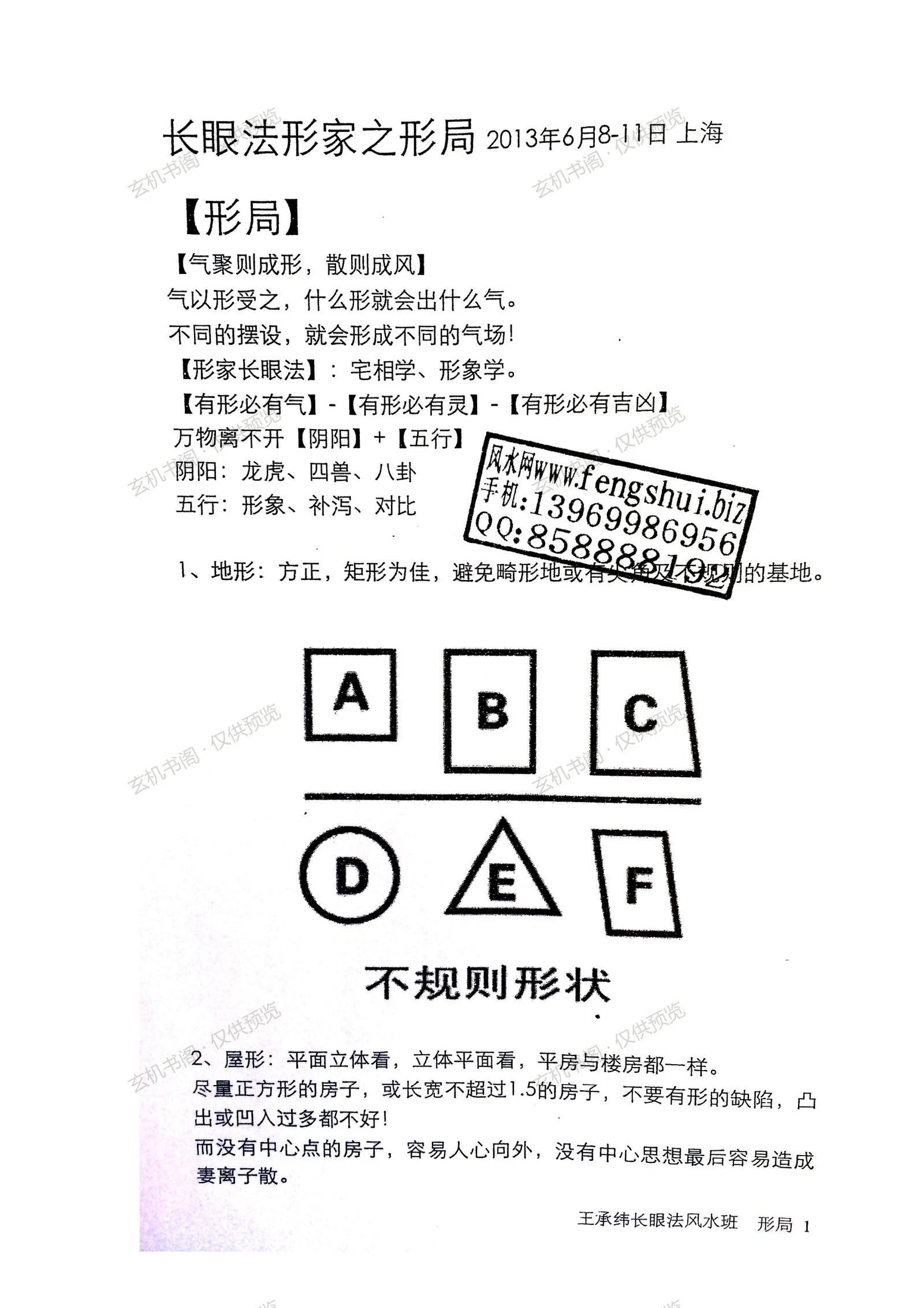
This is a lecture handout from Wang Chengwei's Long-Eye Method feng shui class in Shanghai, focused on the 'form configuration' of dwellings. It opens with the Form-School principle that qi follows form, so every shape produces a corresponding qi and therefore fortune or misfortune, grounded in yin-yang, the five elements, the dragon-tiger four animals and the bagua. The text first sets out basic rules for land and building shapes, favoring square and rectangular forms and warning against irregular plots, deformed outlines and buildings without a center point. The bulk of the booklet catalogues specific building shapes and their supposed effects, including polygonal, triangular, pointed, circular, bagua-shaped, butterfly-shaped, narrow, flat, isolated, protruding, concave, missing-corner, L-shaped, sawtooth and arc-shaped buildings, as well as circular balconies, enclosed rear balconies, iron-sheet houses, glass houses, asbestos-tile roofs and glass-curtain towers. Each entry links shape to health, marriage, career, wealth and family relations. With numerous diagrams, it serves as a practical reference for Form-School dwelling assessment.
Contents
General principles: qi gathers with form
Basic rules for land and building shapes
Irregular shapes and missing corners
Building shapes and effects, part one
Building shapes and effects, part two
Materials and balcony violations
Key Points
Qi follows form; shape determines qi and fortune.
Square and rectangular shapes are preferred over irregular ones.
A building should have a center point and balanced proportions.
Pointed and triangular shapes are considered harsh and accident-prone.
Missing corners in the Qian and Kun sectors are especially feared.
Materials such as iron sheets and glass affect health and qi gathering.