Reading guide
Content guideOverview
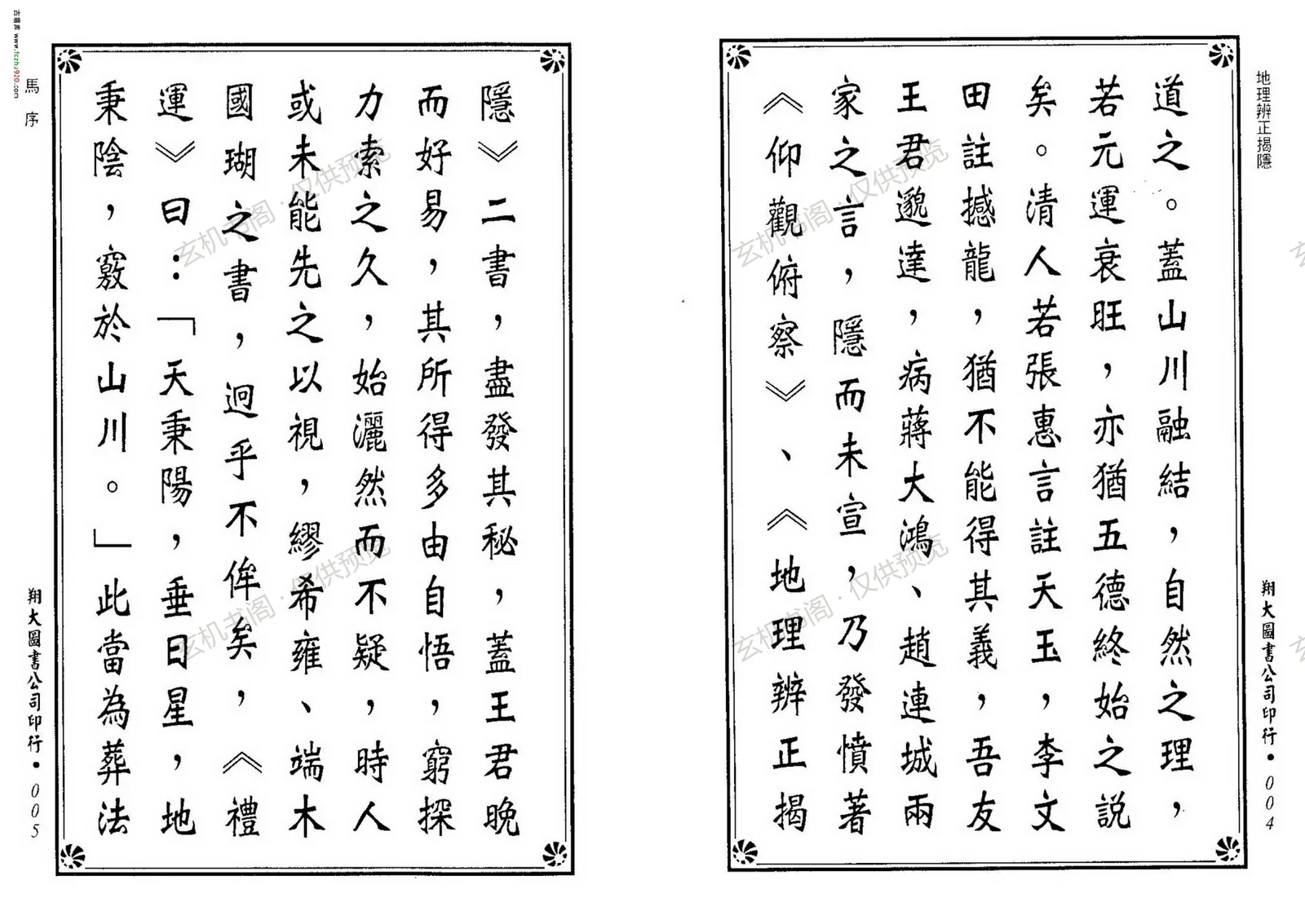
This work by Li Zongyang is a commentary, or 'revelation of hidden meanings,' on the classic Dili Bianzheng. It seeks to uncover the profound methods of burial that unite Xuan Kong (Mysterious Void) principle with the forms of mountains and waters. The book opens with a reader's note followed by two prefaces by Ma and Deng. The Ma preface grounds geography in the Yijing's statement that heaven displays images and reveals fortune and misfortune, arguing that the sage observed above and below and that geomantic practice rests on yin-yang and numerical patterns rather than mere physical form. It cites the Yang, Zeng, Liao and Lai schools along with texts such as the Qingnang and Tianyu, stressing the need to obtain both qi and form. The Deng preface traces Xuan Kong learning to Jiangxi and its transmission through the four great families from Tang and Song times, down to Jiang Dahong and Zhao Liancheng of Wuning in the Ming-Qing transition, whose lines divided between north and south. The author's great-uncle received Zhao's legacy and refined it, making the Xuan Kong school more precise. Together the prefaces establish the book's scholarly lineage and purpose, marking it as an exegetical work on Dili Bianzheng suited to readers with a foundation in fengshui who wish to study Xuan Kong and burial methods in depth.
Contents
Reader's note on the publisher's aims and selected texts
Ma preface: Yijing-based arguments on form and qi
Ma preface continued: Yang, Zeng, Liao, Lai and key classics
Deng preface: Xuan Kong transmission and Zhao Liancheng's line
Deng preface continued: family learning and compilation
Key Points
Grounds geography in Yijing images and numbers, uniting form and qi
Emphasizes the four great schools and classics like Qingnang and Tianyu
Traces Xuan Kong lineage from Jiang Dahong to Zhao Liancheng
Stresses that burial must obtain both qi and form, not mere physical remains
A Jieyin commentary on the classic Dili Bianzheng