Reading guide
Content guideOverview
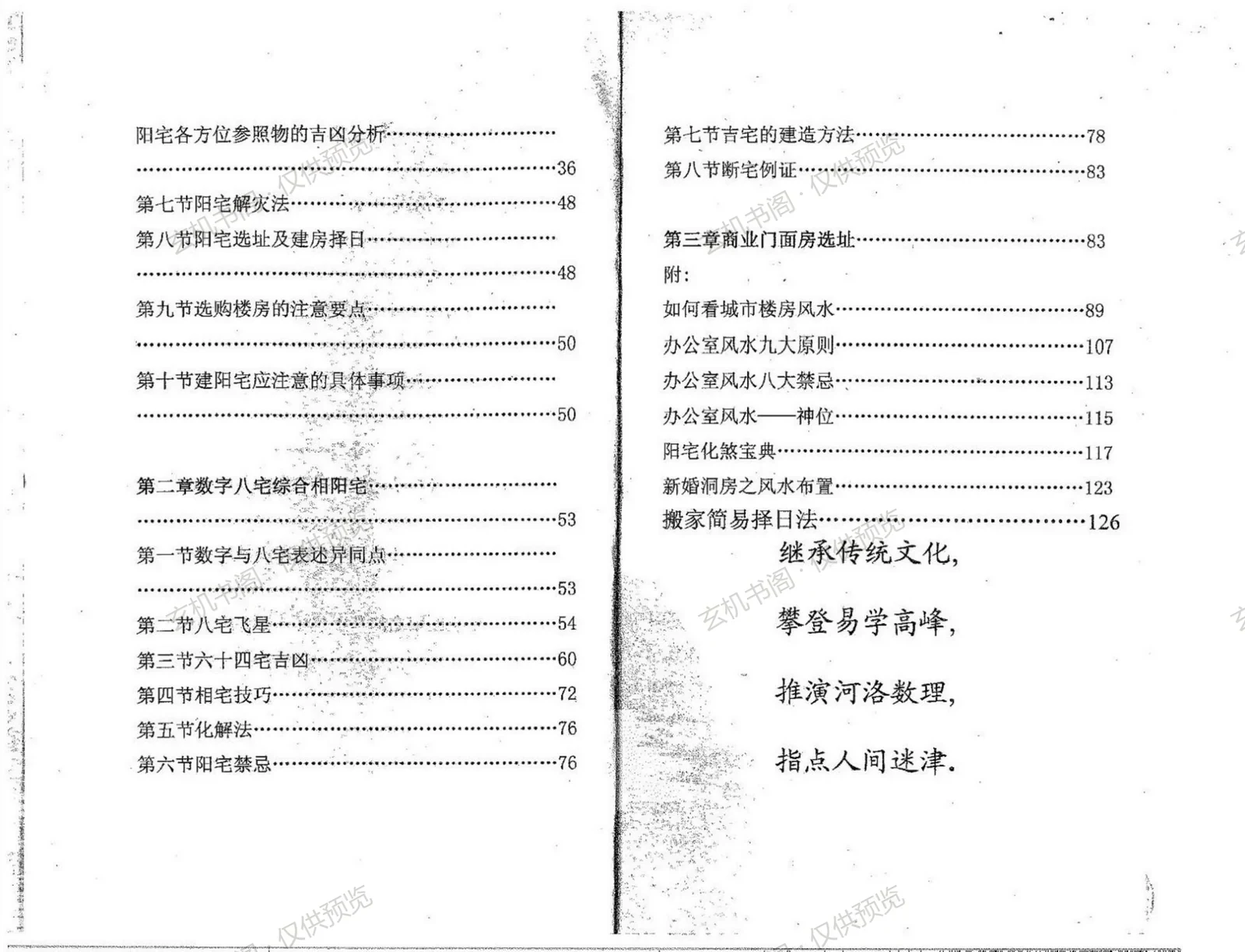
This is an internal disciples' textbook by Pan Fuxing, centered on a system called 'numerical information for judging yang dwelling feng shui.' The preface explains that it is not limited to one school of form or compass feng shui; instead, it derives numbers 0–12 from the bagua and maps them to objects in the magnetic fields of time, human time, and geography. Auspiciousness and inauspiciousness are judged by the generating and overcoming relationships among numbers. The book has three chapters: the first covers basic knowledge—yin-yang and the five elements, numerical six clashes and eight absolutes, five-element attributes of numbers, determining the taiji point of a dwelling, the twelve divisions of door, main hall, and stove, and methods of casting hexagrams; the second discusses comprehensive numerical Eight Mansion assessment, including flying stars, the fortune of sixty-four dwellings, techniques, and remedies; the third and appendices address commercial site selection, urban apartment feng shui, office feng shui principles and taboos, deity placement, sha remedies, bridal chamber arrangement, and moving date selection. The author emphasizes a people-centered approach, combining family members' birth numbers with the dwelling's numbers.
Contents
Ch.1: Basics of numerical yang dwelling feng shui
Taiji point and twelve divisions of door, hall, stove
Hexagram casting and basic judgment techniques
Ch.2: Comprehensive numerical Eight Mansion assessment
Flying stars and fortune of sixty-four dwellings
Ch.3: Commercial storefront site selection
Appendix: urban apartments, office feng shui, remedies
Appendix: bridal chamber and moving date selection
Key Points
Numbers 0–12 correspond to objects and five elements; fortune judged by their interactions
People-centered: combines family birth numbers with dwelling numbers
Integrates Eight Mansion theory with door, hall, stove and flying stars
Covers site selection, construction dates, home buying, and office feng shui