Reading guide
Content guideOverview
This short handout, compiled by Ma Shenglun, offers an illustrated introduction to the structure of the feng shui luopan. Opening with a quotation from the Zangshu on how the compass captures qi and identifies auspicious sites, it presents a full luopan image and explains its rings one by one: the central needle for orientation, the Later Heaven bagua symbols and names, the yin-yang and five-element correspondences of the eight directions, their human and material associations, the stems, branches and zodiac, the clashes and combinations of the branches, the four seasons, and the twenty-four solar terms. The main text lists the twenty-four mountains under each bagua, their yin-yang divisions, regional groupings, and two systems of five-element attribution. A separate section covers the magnetic needle, explaining terrestrial magnetism and how to detect interference, sticking, or deviation, with advice to zero the compass and keep away from metal. It serves as a quick reference for beginners learning to read the luopan.
Contents
Quotation from the Zangshu on the luopan and qi
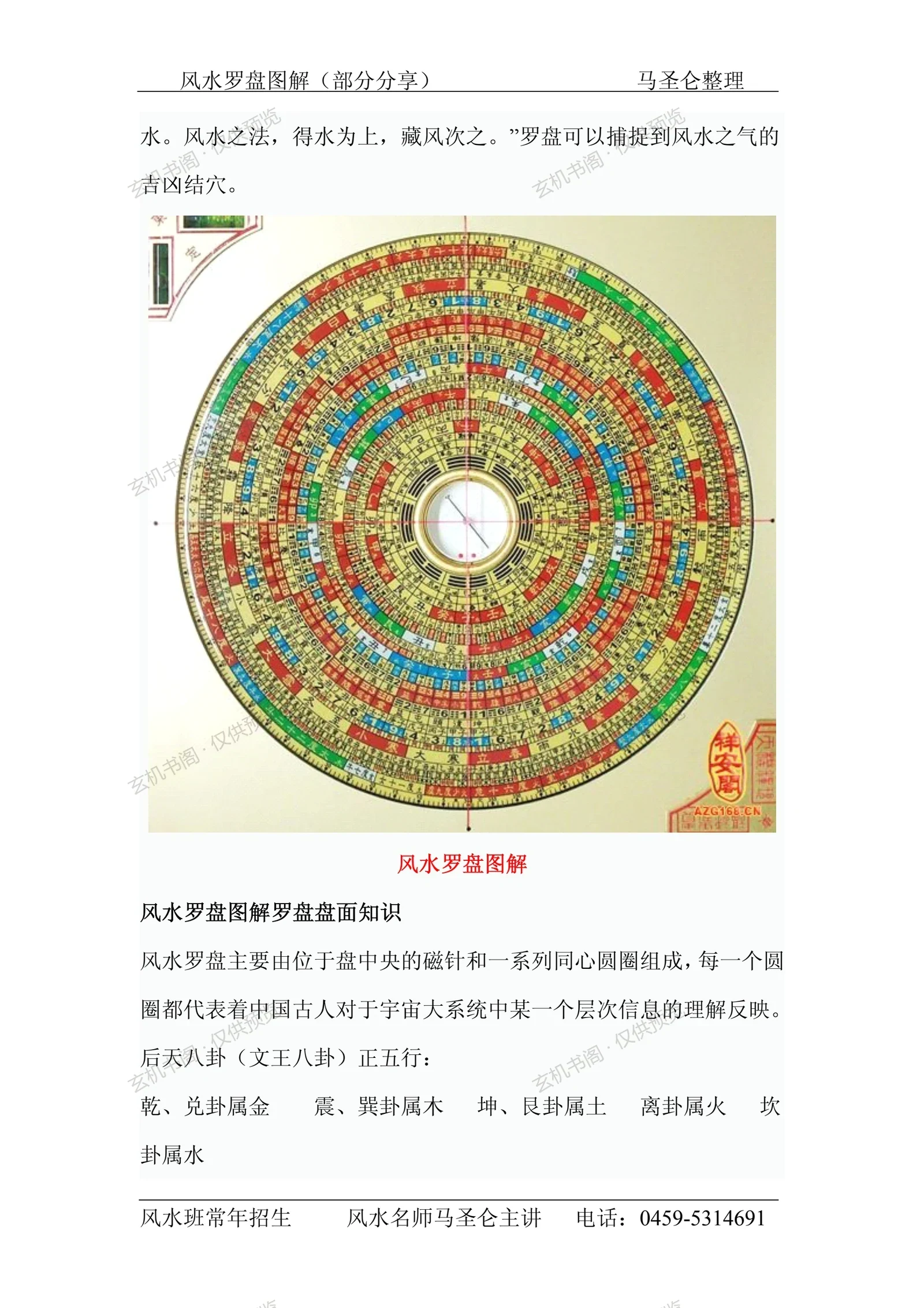
Full luopan image and plate structure
Rings one to nine explained
Twenty-four mountains, yin-yang and five elements
Magnetic needle principles and fault diagnosis
Measurement precautions: avoid metal interference
Key Points
The luopan consists of a central needle and concentric rings, each encoding a layer of cosmological information.
Each Later Heaven bagua governs three mountains, forming the twenty-four mountains with yin-yang and five-element attributes.
Two five-element systems are given: Doushou and Zhengwuxing.
The needle responds to terrestrial magnetism; nearby magnets cause sticking or deviation.
Zero and check the compass before use, and keep away from steel and metal.