Reading guide
Content guideOverview
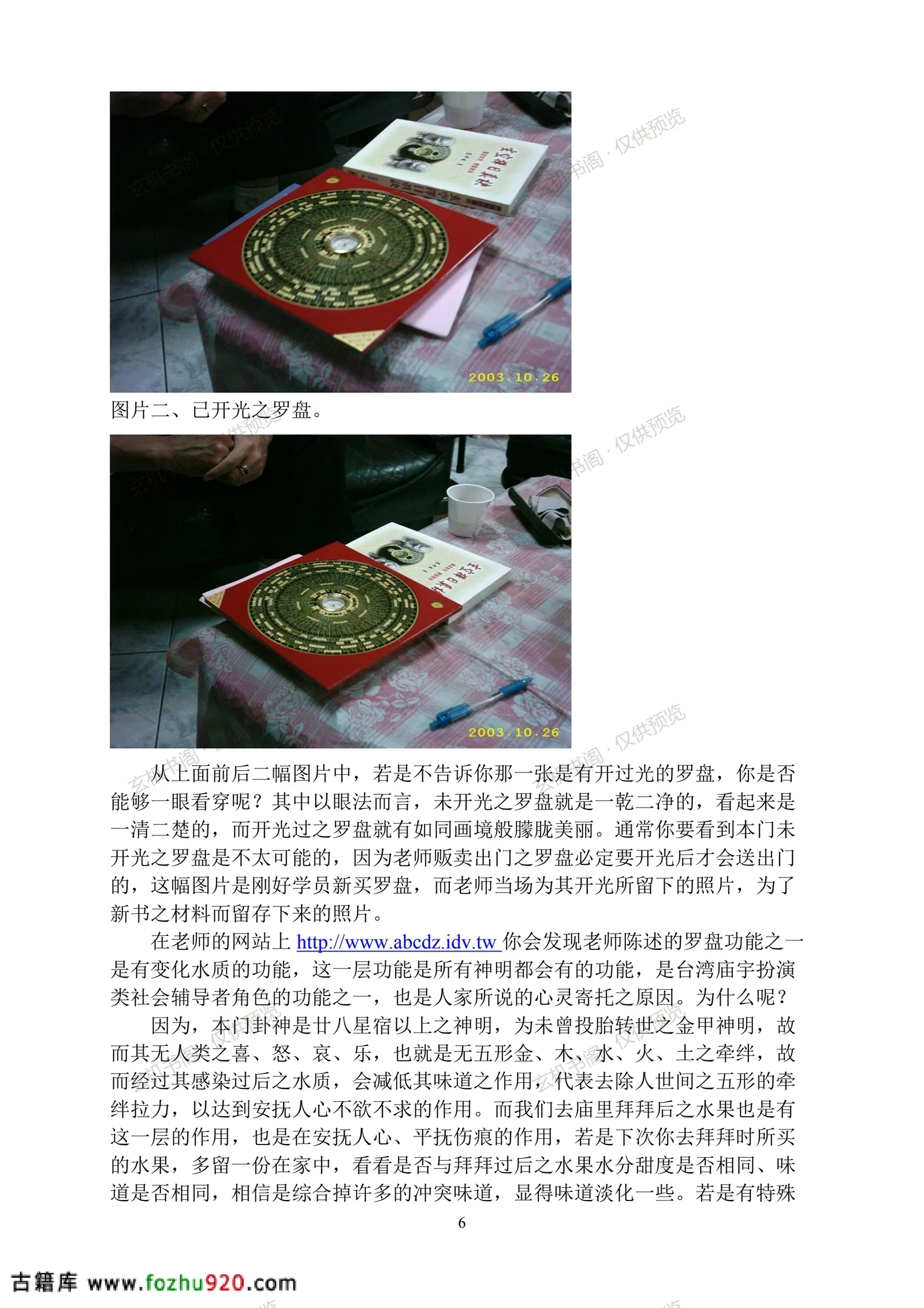
True Words on Feng Shui opens with Chapter One, "Consecration and Spirit Bodies." The preface explains that the book is written as a lecture course on how dragon lairs form and how to find them, treating feng shui as a testable esoteric discipline rather than empty mystery. The teacher sets out five stages of study: master four foundation texts on堪舆, yang-dwelling feng shui, dou-sha, and xuan-kong date selection; locate yin and yang sites; verify a site's pull through real cases; explain the theory to others; and finally cultivate merit. Anecdotes about students in Chiayi and Yonghe illustrate that using oracle spirits for date selection or luck alteration requires merit, or it backfires with dizziness and illness. The second section asks what consecration and spirits are, discussing universal animism, yin-yang energies, and divine power, and uses a case of a Guanyin statue occupied by a yin spirit plus before-and-after photos of a consecrated luopan to show how consecration invokes divine presence and turns yin into yang.
Contents
Chapter One: Consecration and Spirit Bodies
Section 1: Preface and five stages of feng shui study
Four foundation texts and entering dragon-lair finding
Oracle-spirit cases and the role of merit
Section 2: What is consecration and what are spirits?
Divine power versus yin spirits in statues
Photo comparison of unconsecrated and consecrated luopan
Key Points
Feng shui study follows five stages: foundations, site finding, verification, transmission, merit.
Four required texts: 堪舆真言, 阳宅风水真言, 阳宅斗煞真诀, 玄空择日真诀.
Oracle-spirit cases show that without merit the practice fails or harms the practitioner.
Consecration invokes divine energy into an image; yin-occupied images feel cold.
Before-and-after luopan photos teach the eye method for sensing qi.