Reading guide
Content guideOverview
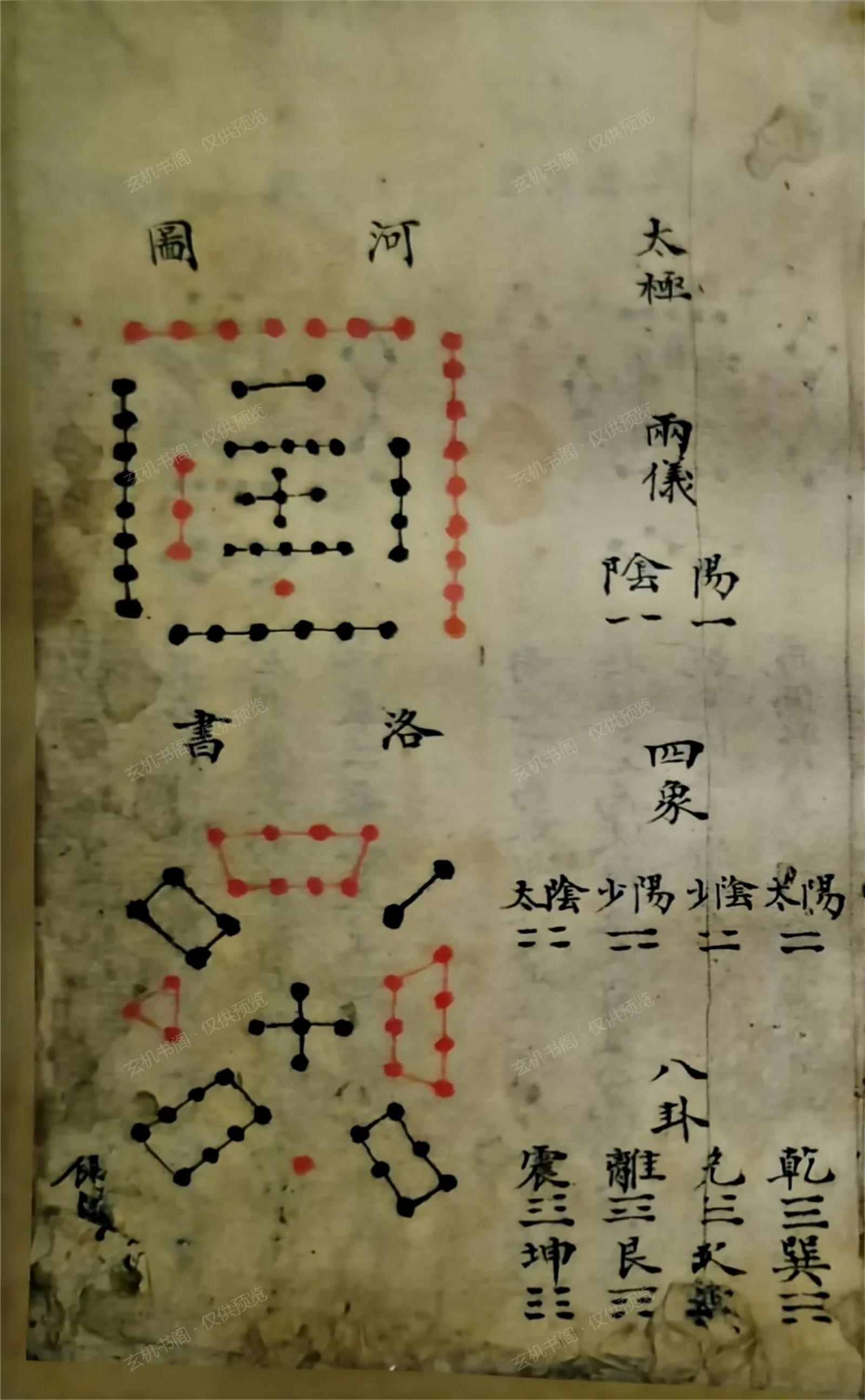
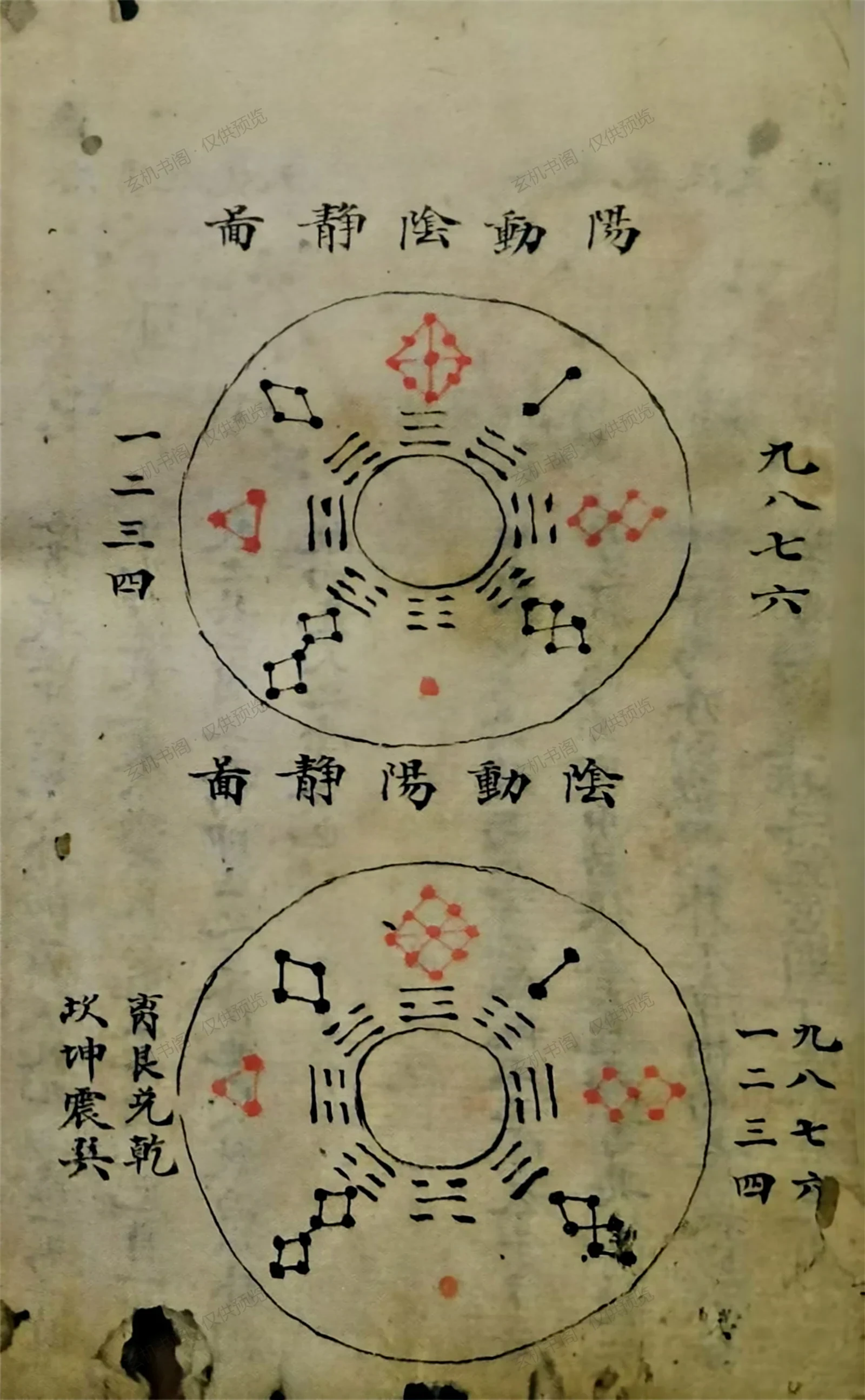
The cover reads "Hetu and Luoshu." The manuscript is built around hand-drawn dot diagrams accompanied by brush-written commentary. It first shows the Hetu and Luoshu point arrays alongside the Taiji, yin-yang, the four images, and the eight trigrams, illustrating the sequence from Taiji to yin-yang, four images, and bagua. Later pages pair the Hetu with the Earlier Heaven bagua and the Luoshu with the Later Heaven bagua, with directional diagrams and text explaining the correspondences of one-six with water, two-seven with fire, three-eight with wood, four-nine with metal, and five-ten with earth, as well as the waxing and waning of yin and yang described as "yang inside, yin outside on the left" and the reverse on the right. The final page uses circular diagrams to show "yang moving, yin still" and "yin moving, yang still," with the numbers 1-2-3-4 and 9-8-7-6 and the bagua order Qian-Dui-Li-Zhen-Xun-Kan-Gen-Kun. The book is brief, image-heavy, and text-light, serving as elementary material for understanding the relationship between the Hetu, Luoshu, and the Earlier and Later Heaven bagua.
Contents
Hetu dot diagram with Taiji, two modes, four images, bagua
Luoshu dot diagram beside bagua figures
Hetu matched to Earlier Heaven bagua, with commentary
Luoshu matched to Later Heaven bagua, with commentary
Luoshu nine numbers assigned to bagua (1 Kun, 9 Qian, etc.)
Circular diagrams of yang moving / yin still
Key Points
Dot diagrams visually present the number and direction patterns of Hetu and Luoshu
Pairs Hetu with Earlier Heaven bagua and Luoshu with Later Heaven bagua
Explains the five-phase numbers: 1-6 water, 2-7 fire, 3-8 wood, 4-9 metal, 5-10 earth
Circular diagrams show the relation between yin-yang movement and bagua directions