Reading guide
Content guideOverview
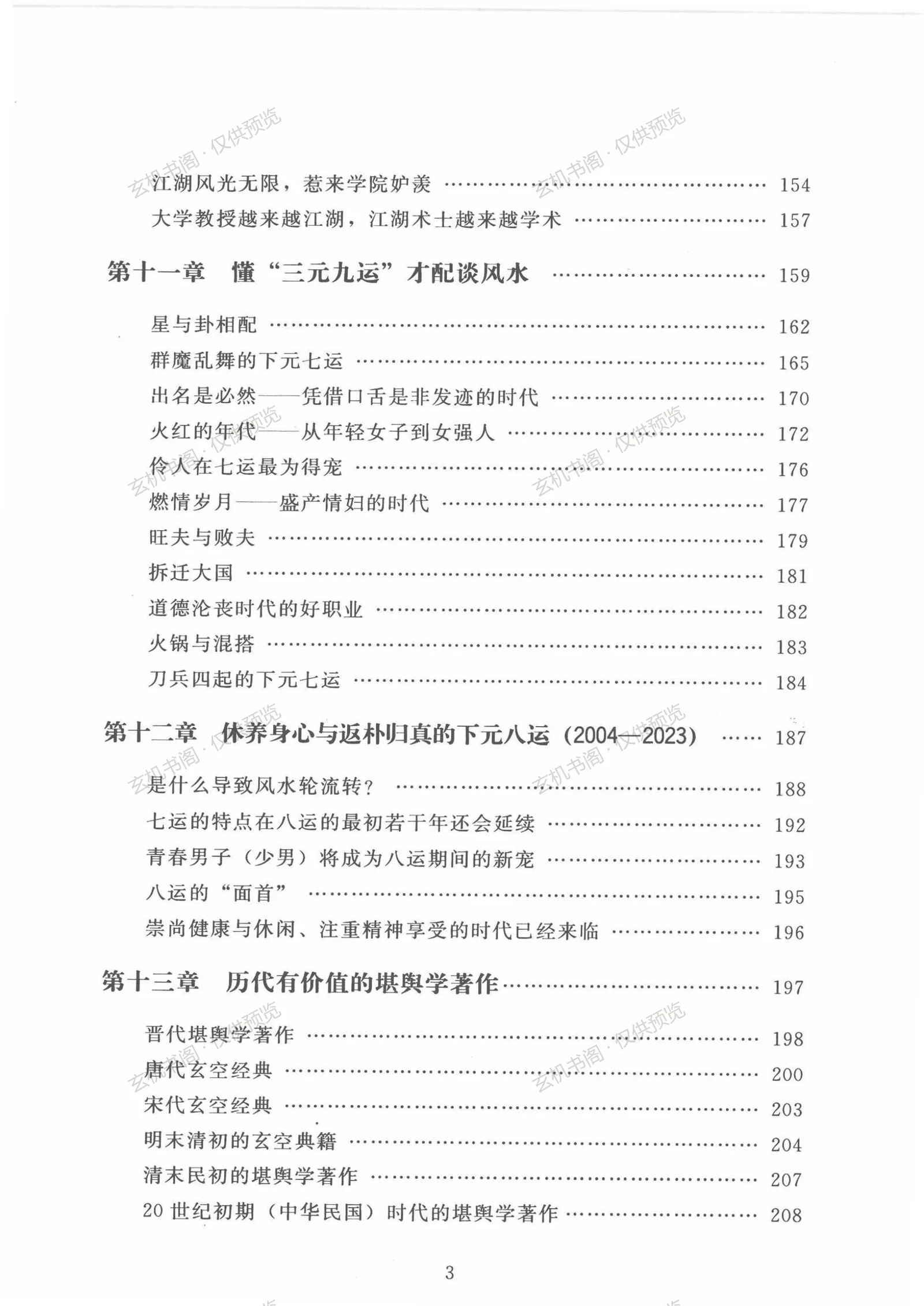
Published by Hualing Press in 2013 and written by Bao Tong, Secrets of Kanyu is subtitled 'A Feng Shui Master's Path of Insight.' Its table of contents shows a discursive, essayistic book rather than an operating manual: it begins by locating divination, the Yijing and fangshu at the root of Chinese culture, then examines the fraught relationship between feng shui and science and the occult interests of major scientists. Middle chapters discuss feng shui's popularity worldwide, phenomena in Hong Kong, Taiwan and Macau, and the author's teaching and media work abroad. Later sections turn practical—household feng shui, five-element colours, lucky numbers, date selection and aesthetics—and deliver a 'pseudo-technique appraisal' that questions feng shui trinkets and the Eight Mansions school. Chapters eleven and twelve apply the Three Cycles and Nine Periods to the social character of Period 7 and Period 8 (2004–2023), while the final chapter surveys valuable kanyu works by dynasty, from Jin and Tang to the Republican era.
Contents
Preface: the author's background and approach
Divination, Yijing and fangshu as cultural roots
Feng shui and science: twins of superstition and reason
Scientists and the occult: compass, gunpowder, Newton, Leibniz
World heritage and the China-Korea feng shui application dispute
Feng shui around the world: Hong Kong, Taiwan, bank architecture
Understanding household feng shui: nature, spirit, five-element colour
Feng shui culture and taste: numbers, date selection, aesthetics
Appraising pseudo-techniques: trinkets, Eight Mansions, landscape
Feng shui polemics and academic fraud: the north-south debate
Three Cycles and Nine Periods: social faces of Periods 7 and 8
Valuable kanyu works through the dynasties
Key Points
Traces kanyu back to divination, the Yijing and Daoist traditions.
Uses anecdotes about scientists to address whether feng shui is 'scientific'.
Discusses feng shui phenomena in Hong Kong and Taiwan and the UNESCO bid controversy.
Household feng shui is treated conceptually, with little compass technique.
Links Period 7 and Period 8 of the Three Cycles to social and cultural trends.
Criticises feng shui trinkets, the Eight Mansions school and 'master' culture.