Reading guide
Content guideOverview
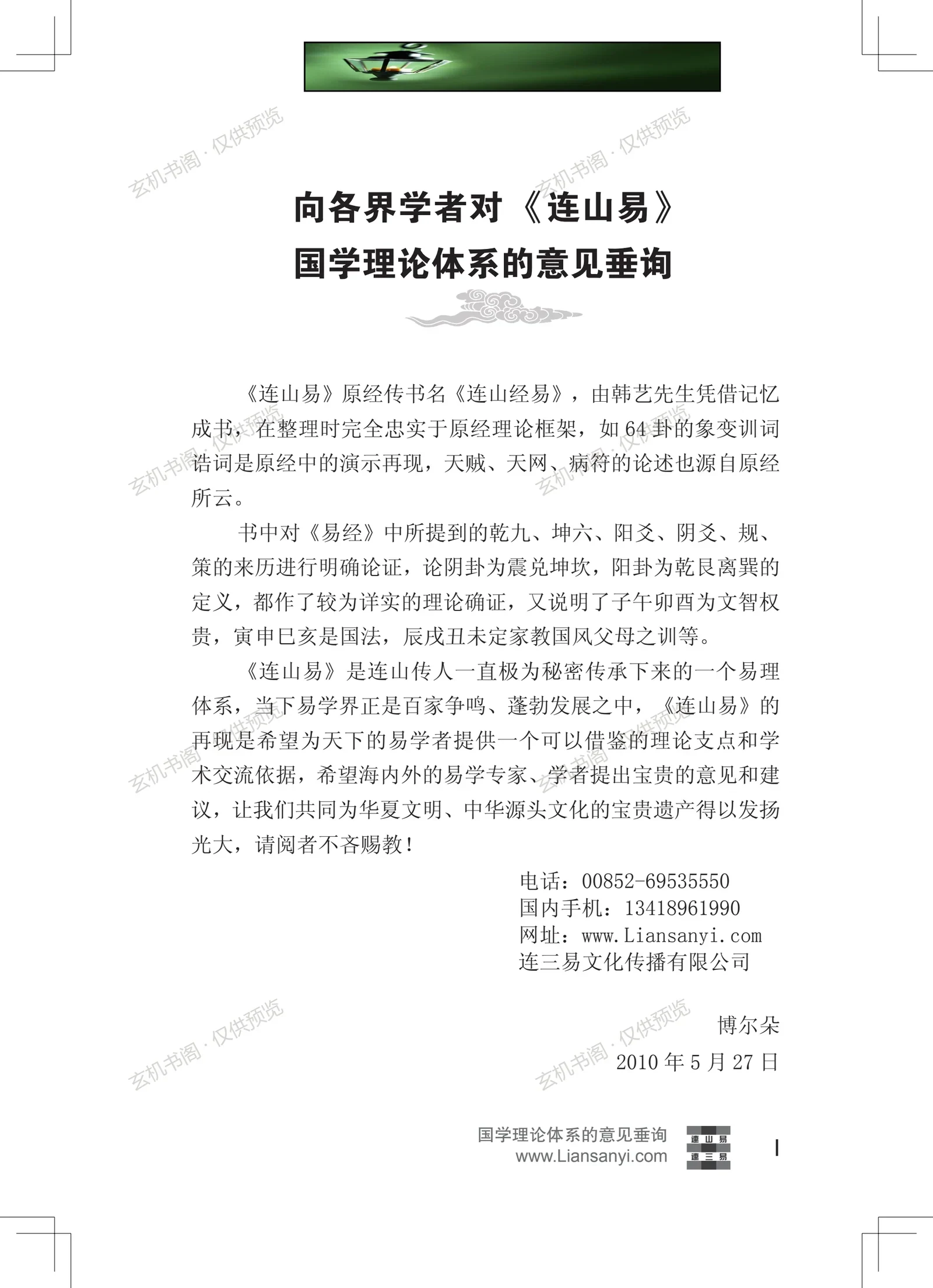
Co-authored by Han Yi and Bo Erduo and published in 2010, this book presents a secret-transmission framework of the lost Lian Shan Yi, subtitled as a treasure of governance and divination from the Three Sovereigns and Five Emperors. The preface explains that the original text was called Lian Shan Jing Yi and that the book preserves 64 hexagram image-transform terms along with discussions of concepts such as Tiandzei, Tianwang, and Bingfu. It also argues for definitions of yin and yang trigrams and traces the origins of Qian nine, Kun six, and the yarrow stalk rules. The table of contents divides the work into six sections: an introduction to Lian Shan divination with三元甲子, life hexagram methods, and twelve flying talismans; a discussion of the先天八卦; a treatment of heavenly stems and earthly branches in relation to Chinese characters; a collection of essays comparing Lian Shan Yi with Zhou Yi and exploring military thought and management; an introduction to Lian Shan feng shui; and a section on Lian Shan naming theory. The book suits readers interested in Yi learning, traditional divination, feng shui, and name analysis.
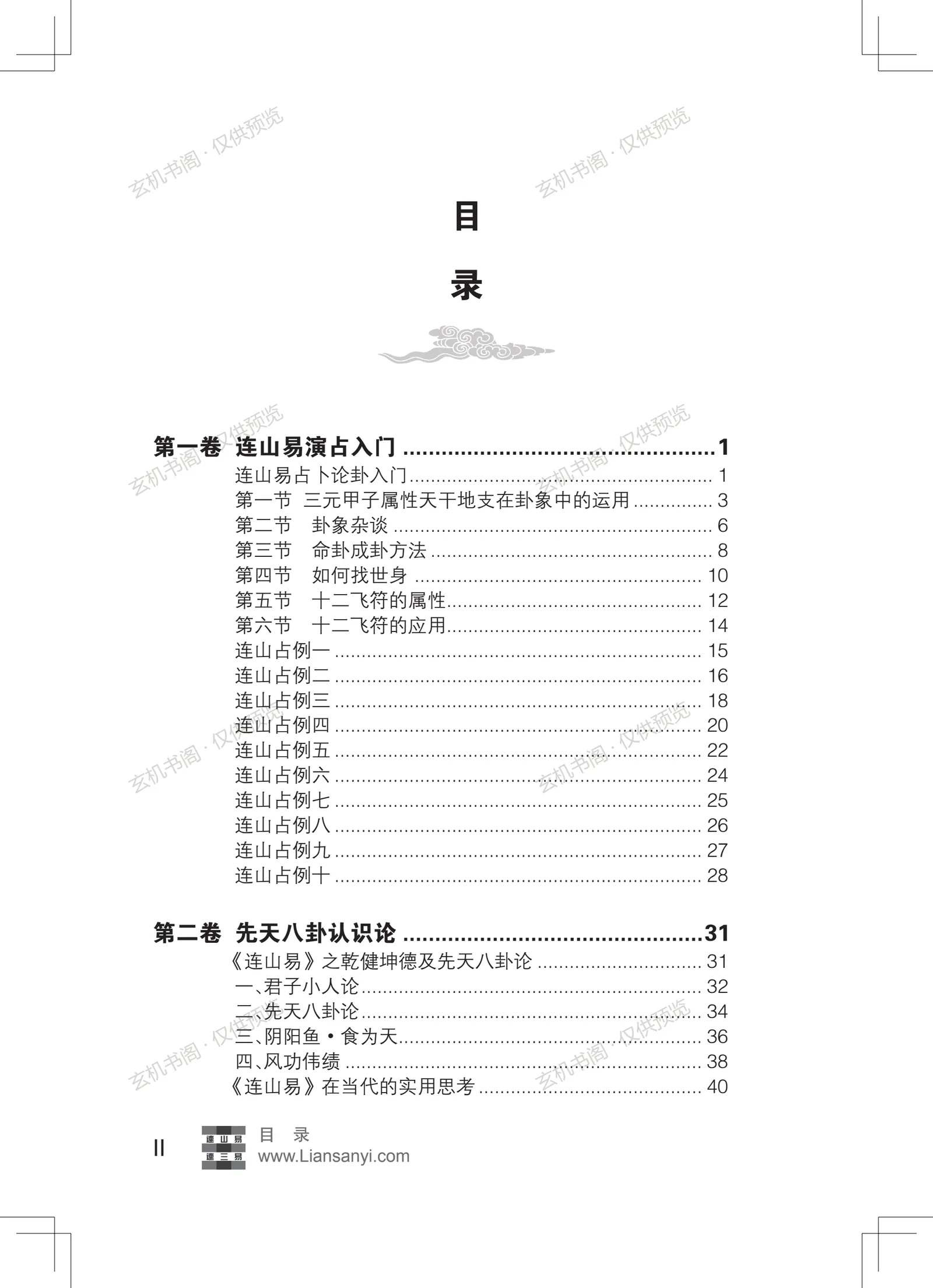
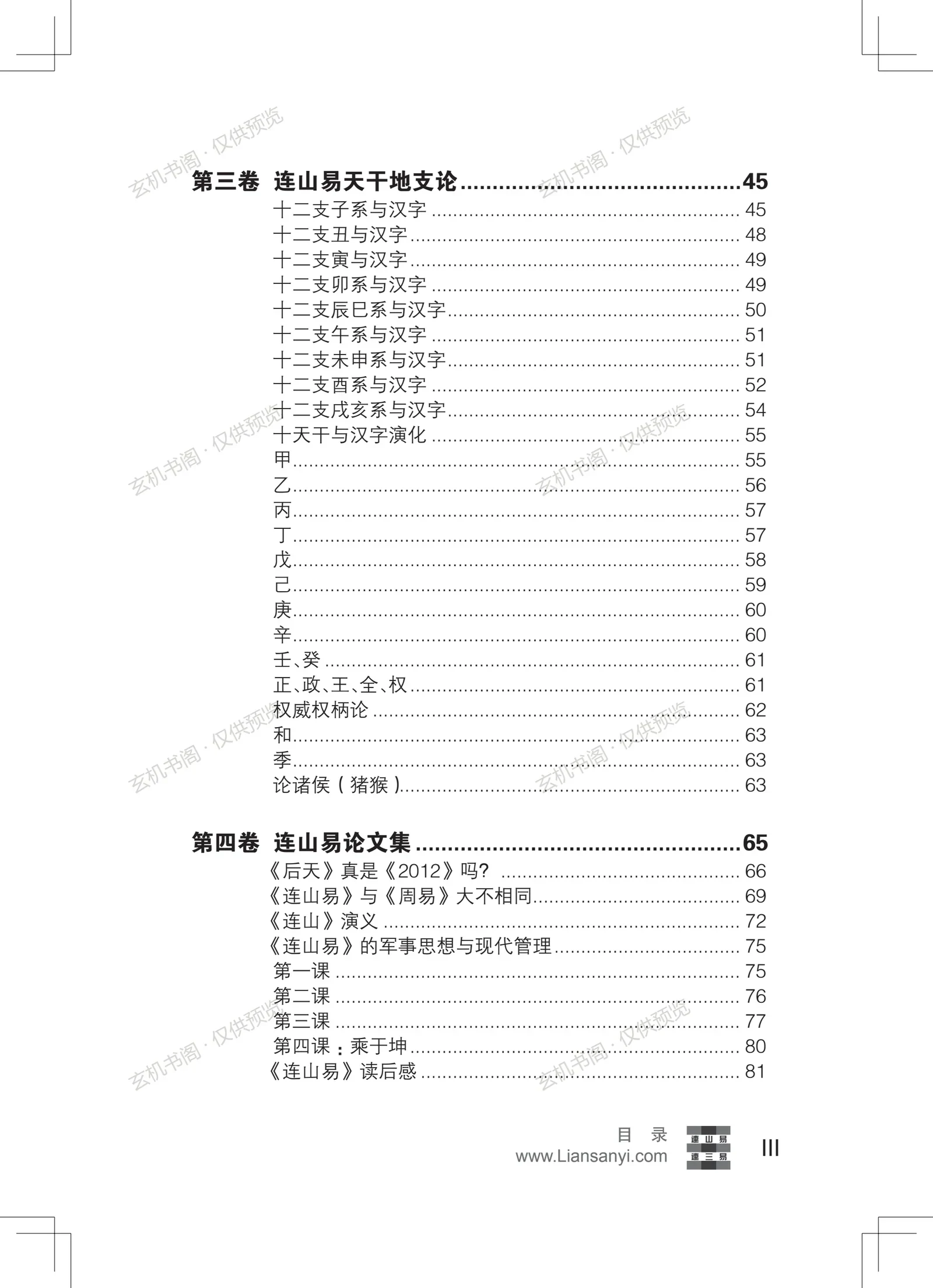
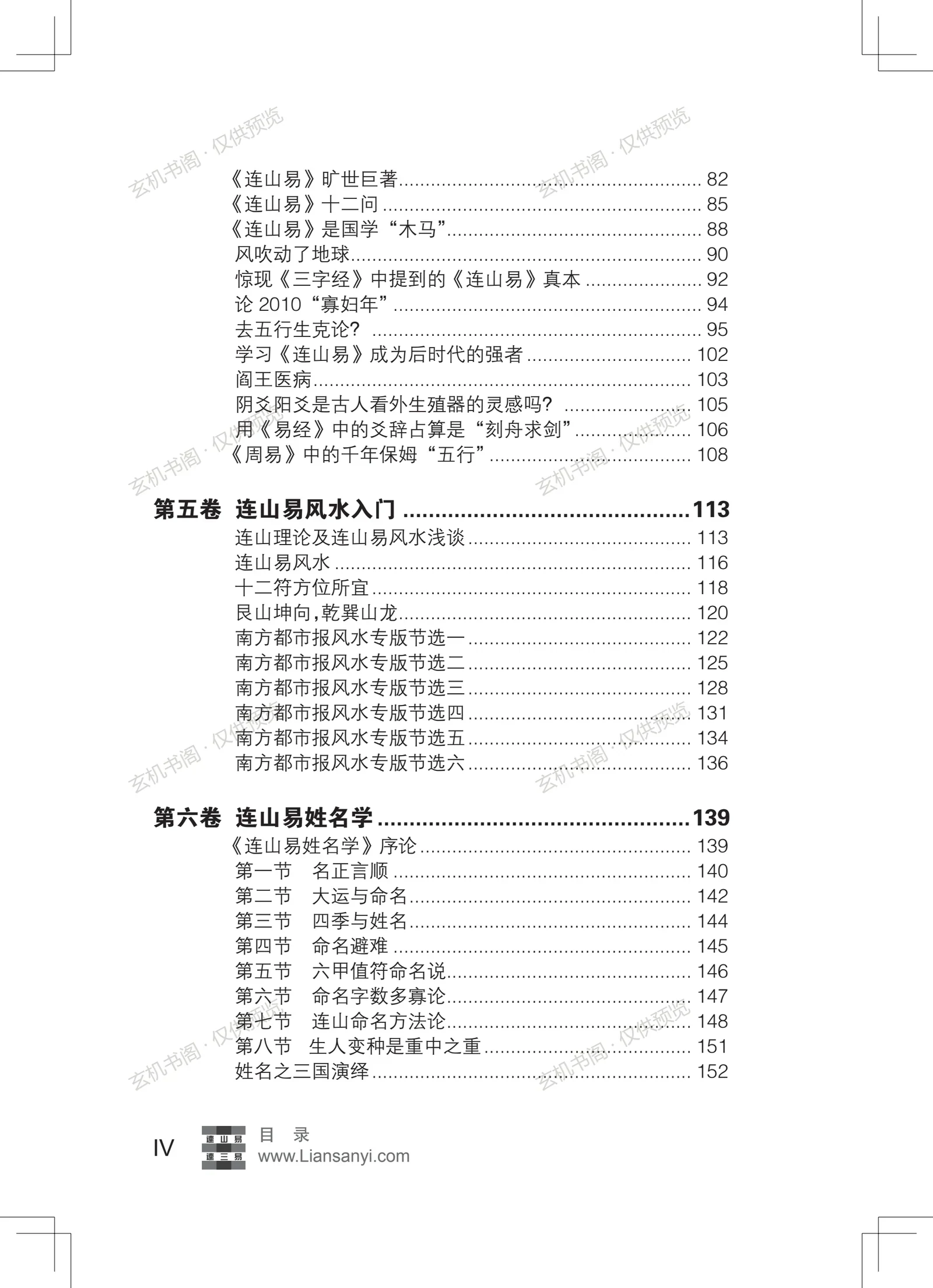
Contents
Vol. 1: Lian Shan divination basics, life hexagrams, twelve flying talismans, and examples
Vol. 2: Pre-heaven bagua theory, Qian-Kun virtues, yin-yang fish, and modern reflections
Vol. 3: Heavenly stems and earthly branches linked to Chinese character evolution
Vol. 4: Essays comparing Lian Shan Yi with Zhou Yi, military thought, and management
Vol. 5: Lian Shan feng shui basics, directional suitability, and Gen-Kun orientation
Vol. 6: Lian Shan naming theory, naming methods, and major cycles
Key Points
Reconstructs 64 hexagram image-transform terms and related secret concepts within a Lian Shan framework
Defines yang trigrams as Qian, Gen, Li, Xun and yin trigrams as Zhen, Dui, Kun, Kan, with supporting arguments
Connects earthly branches and heavenly stems to Chinese character evolution and concepts of authority
Builds a divination method using twelve flying talismans, life hexagram formation, and locating the worldly body
Extends Lian Shan theory into feng shui directional analysis and naming practice