Reading guide
Content guideOverview
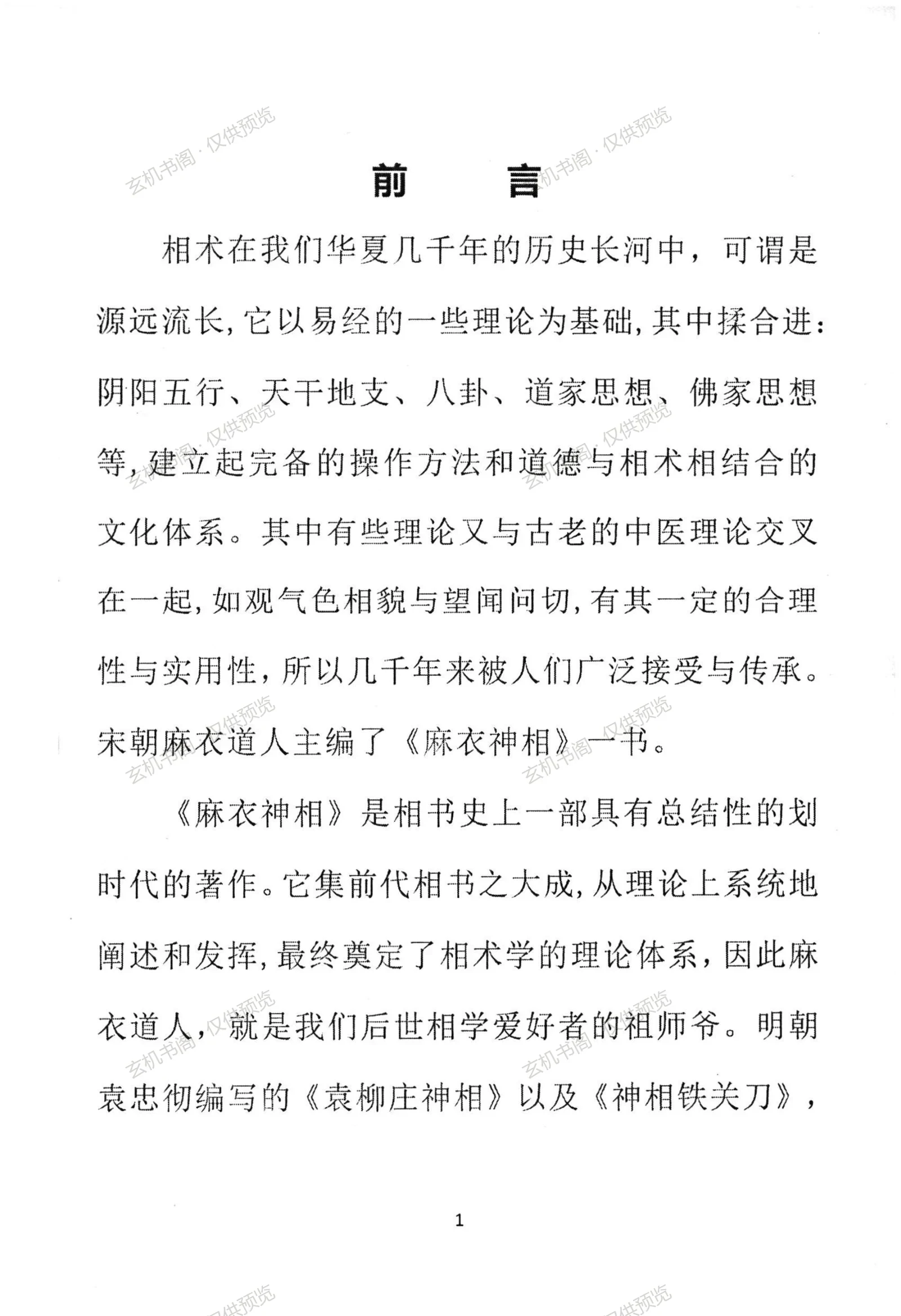
This is an introductory physiognomy (face reading) book by Tian Lianping, subtitled “Beginner Physiognomy.” The cover promises a basic, self-study-friendly entry point. The preface traces the tradition: it rests on Yijing theory, blends yin-yang and the Five Elements, the sexagenary cycle, and the eight trigrams, and draws on Daoist and Buddhist thought; it also notes overlaps with traditional Chinese medicine's observation of complexion. The Song-dynasty Ma Yi Daoren's Ma Yi Shen Xiang is presented as a landmark synthesis that shaped the theoretical system, followed by Yuan Zhongche's Yuan Liu Zhuang Shen Xiang and Shen Xiang Tie Guan Dao, and the Jianghu Hui school's oral judgments. The author says the book gathers Ma Yi, Liu Zhuang, Hui-school, and family-lineage material with decades of experience, illustrated with examples. Visible pages show a face diagram labeling positions such as Tian Ting, Ri Jiao, Yue Jiao, Fu Tang, Yi Ma, Tian Cang, Jian Men, Ming Men, Yin Tang, Shan Gen, Nian Shou, Zhun Tou, Xian Ku, Di Ku, Fa Ling, Cheng Jiang, and Ge Di, with judgments like “ke fu” and “ke mu.” A hand diagram marks the heart, head, and life lines with age scales. The book works mainly as a term-and-position primer.
Contents
Preface: origins of physiognomy and the Ma Yi / Liu Zhuang schools
Key judgments such as “ke fu” and “ke mu” and their locations
Face diagram: Tian Ting, Yin Tang, Shan Gen, Zhun Tou, and more
Palm diagram: heart, head, and life lines with age scales
Basic concepts and terminology for beginners
Key Points
Aimed at complete beginners, starting with terms and conventions
Draws on Ma Yi Shen Xiang and Yuan Liu Zhuang Shen Xiang
Face diagram labels forehead, brow, nose, and mouth positions
Includes a palm-line age chart with three major lines
Traditional judgments such as “ke fu” and “ke mu” appear