Reading guide
Content guideOverview
This book is a compiled lecture series on face reading by folk physiognomist Shi Jizhao. It opens with a personal account of his lineage, which he traces to his great-uncle Chang Mingyue and describes as a folk tradition combining face and palm reading with Liuyao, Jin Kui Jue and Sanhe Bafang feng shui, with emphasis on judging by the face alone rather than by birth charts. The main chapters cover the Three Stops and Six Palaces, dividing the face into upper, middle and lower sections governing parents, early life, middle age, character, and old age; the Five Officers, discussing the auspicious and inauspicious forms of eyebrows, ears, eyes, nose and mouth; the Nine Provinces and Eight Trigrams as mapped onto the face; and the Five Peaks and Four Waterways, which relate facial bone structure and the sense organs to mountains and rivers. Written in plain language and illustrated with the author's own case observations, it offers beginners a structured overview of folk physiognomy and its practical reasoning.
Contents
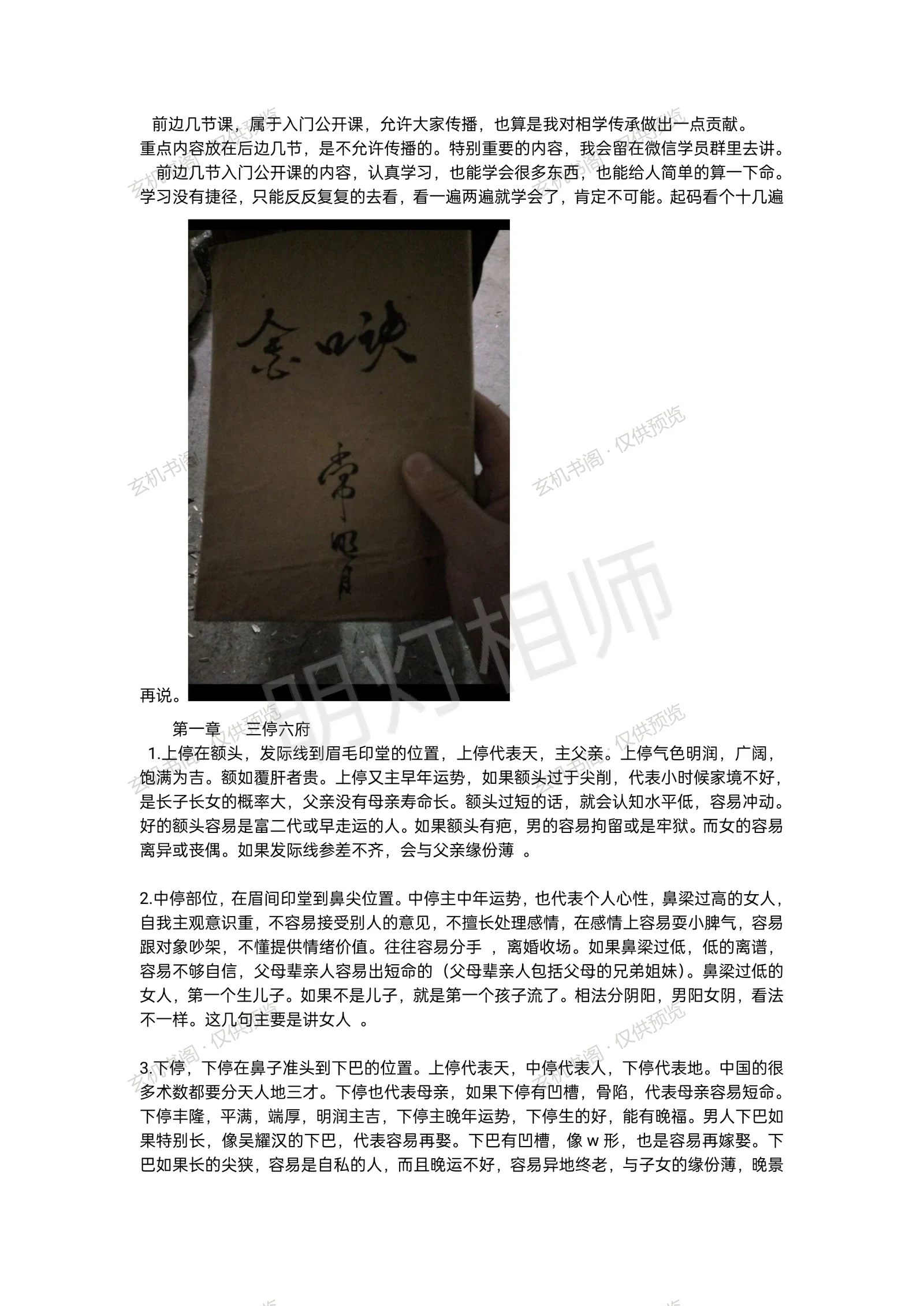
Author's preface and folk lineage
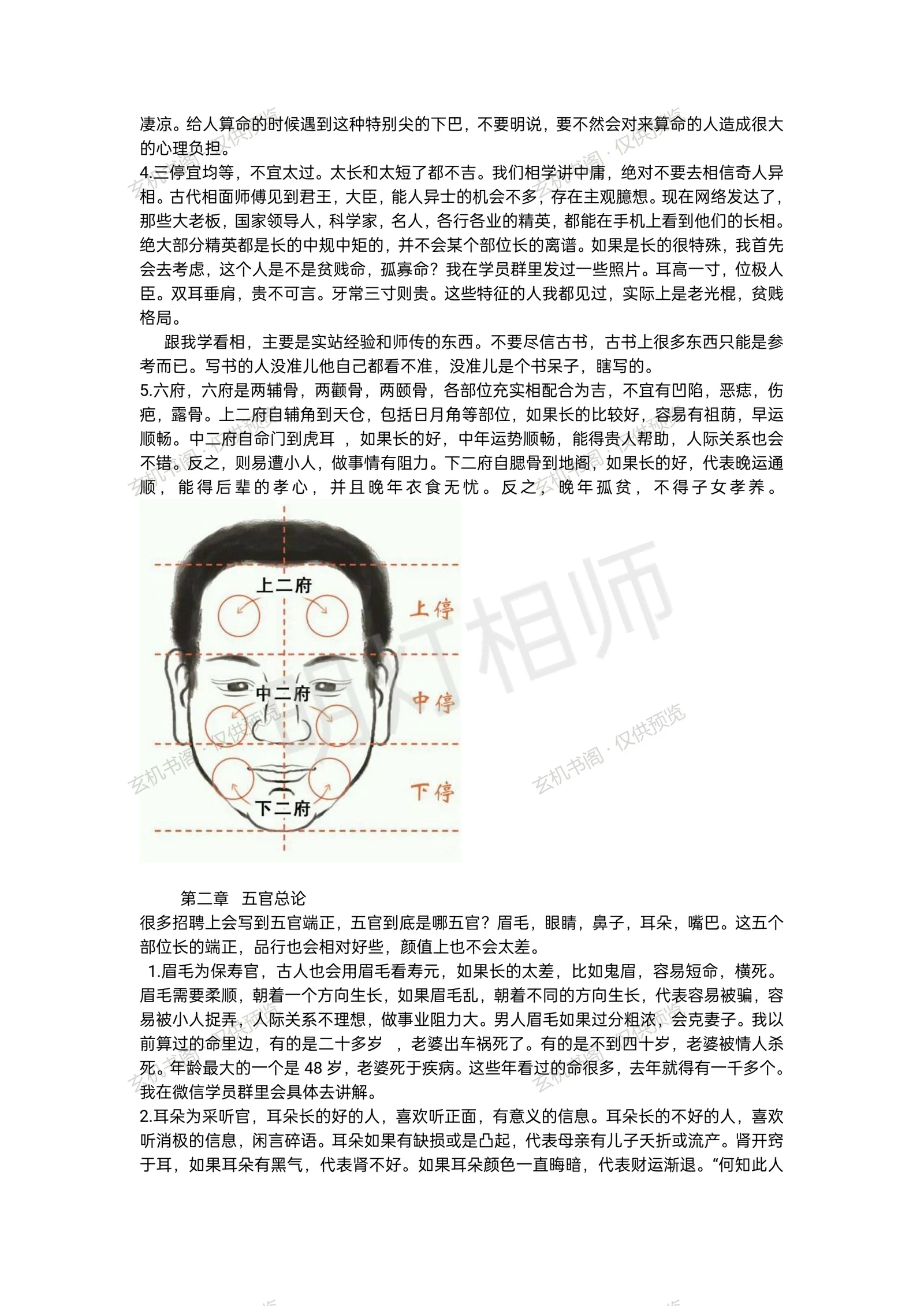
Chapter 1: Three Stops and Six Palaces
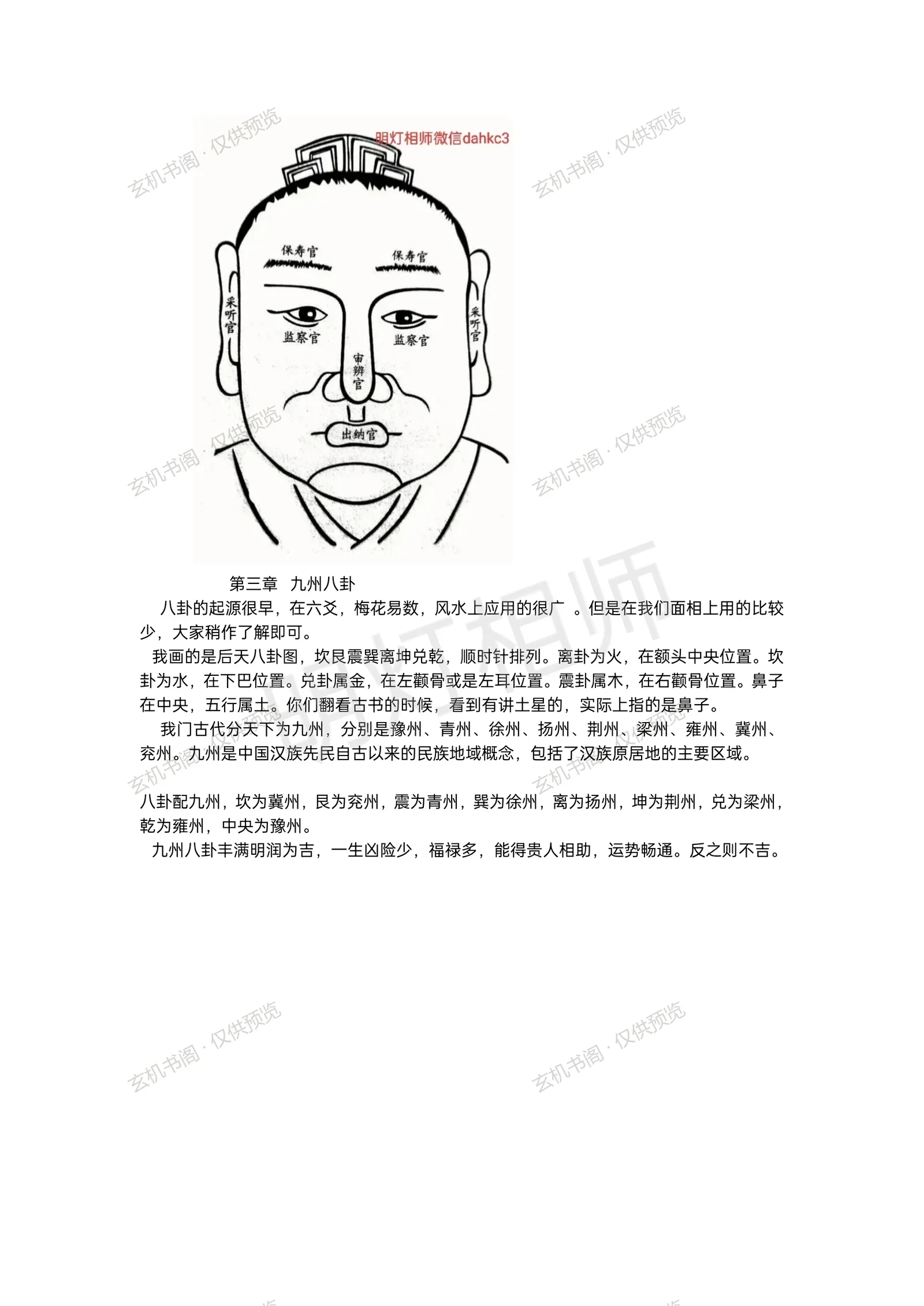
Chapter 2: General Discussion of the Five Officers
Chapter 3: Nine Provinces and Eight Trigrams
Chapter 4: Five Peaks and Four Waterways
Key Points
The Three Stops correspond to early, middle and late life, as well as parents and character.
The Six Palaces concern the cheekbones, jawlines and auxiliary bones, which should be full rather than sunken.
Each of the Five Officers has a function: eyebrows for longevity, ears for hearing, eyes for observation, nose for judgment, mouth for expression.
The Nine Provinces and Eight Trigrams map Later Heaven trigram positions onto the face.
The Five Peaks and Four Waterways emphasize harmony between facial bones and features.