Reading guide
Content guideOverview
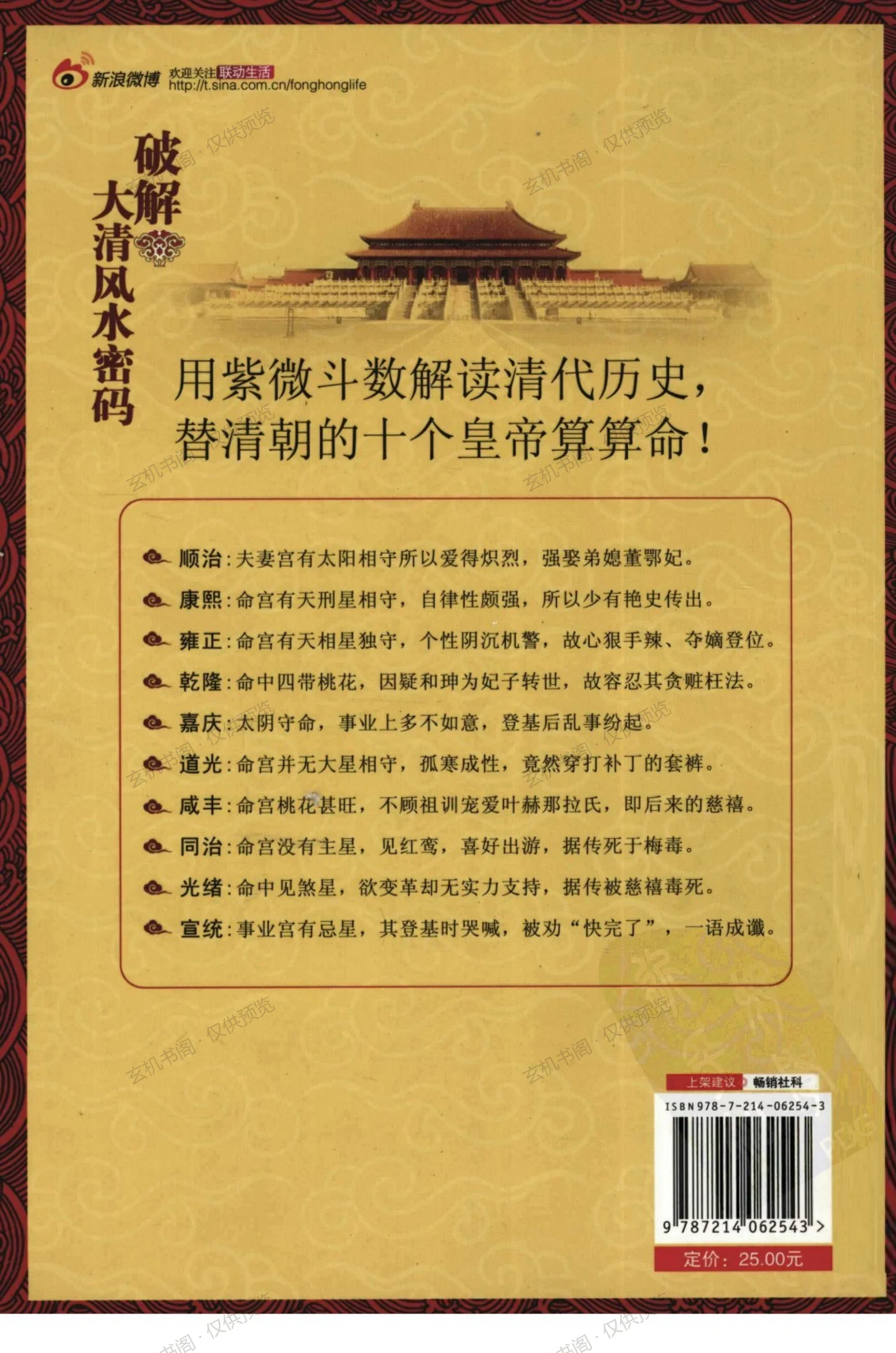
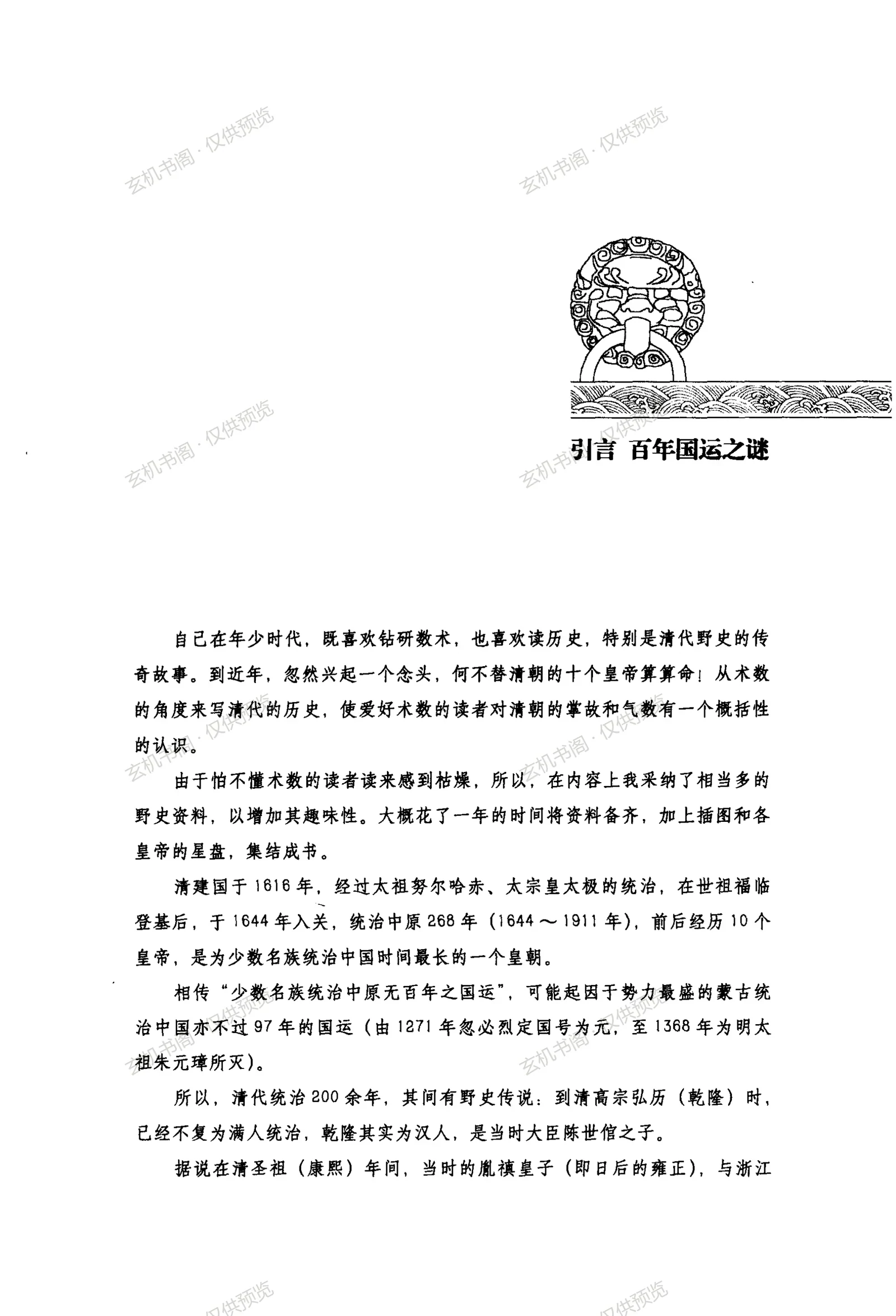
This popular work by Ziwei Yang reads Qing history through the lens of Chinese astrology. In the introduction the author explains that, having long enjoyed both divination and Qing-era anecdotes, he set out to cast horoscopes for the ten emperors from Shunzhi to Xuantong. Each emperor is given a Zi Wei Dou Shu chart and a horoscope, interpreted alongside hexagrams from the Huangji Jingshi and interwoven with official history and unofficial legends. The back cover summarizes each ruler's chart: Shunzhi's spouse palace guarded by the Sun, Kangxi's self-discipline under Tianxing, Yongzheng's solitary Tianxiang and ruthless character, Qianlong's peach-blossom stars and disputed parentage, Xianfeng's strong peach blossom linked to Empress Dowager Cixi, Tongzhi's empty life palace, and the evil stars in Guangxu's and Xuantong's charts. The book also discusses the saying that minority dynasties rarely rule China for a century. It is valuable as a demonstration of how Zi Wei Dou Shu is applied to historical figures, and appeals to readers interested in astrology and Qing history alike.
Contents
Introduction: the riddle of a century of dynastic fortune
Shunzhi: the Sun in the spouse palace
Kangxi: Tianxing and self-discipline
Yongzheng: solitary Tianxiang and the succession
Qianlong: peach blossom and disputed birth
Jiaqing to Daoguang: the Moon and isolation
Xianfeng to Tongzhi: peach blossom and an empty palace
Guangxu to Xuantong: evil stars and prophecy
Key Points
Analyzes the ten Qing emperors through Zi Wei Dou Shu charts
Combines Huangji Jingshi hexagrams to speculate on dynastic fortune
Draws on both official history and unofficial legends
The back cover lists chart highlights for each emperor
Discusses the saying that minority rule seldom lasts a century