Reading guide
Content guideOverview
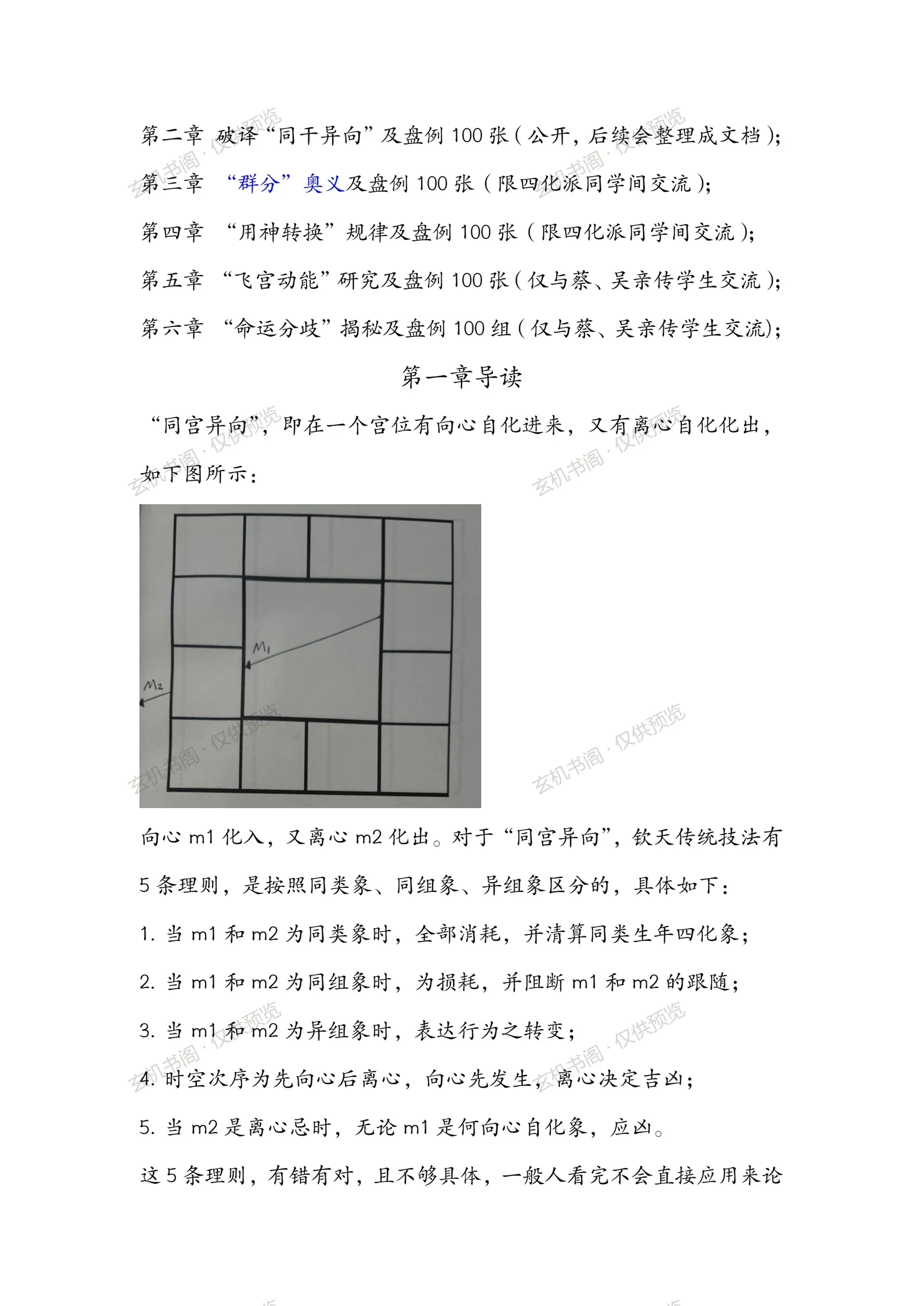
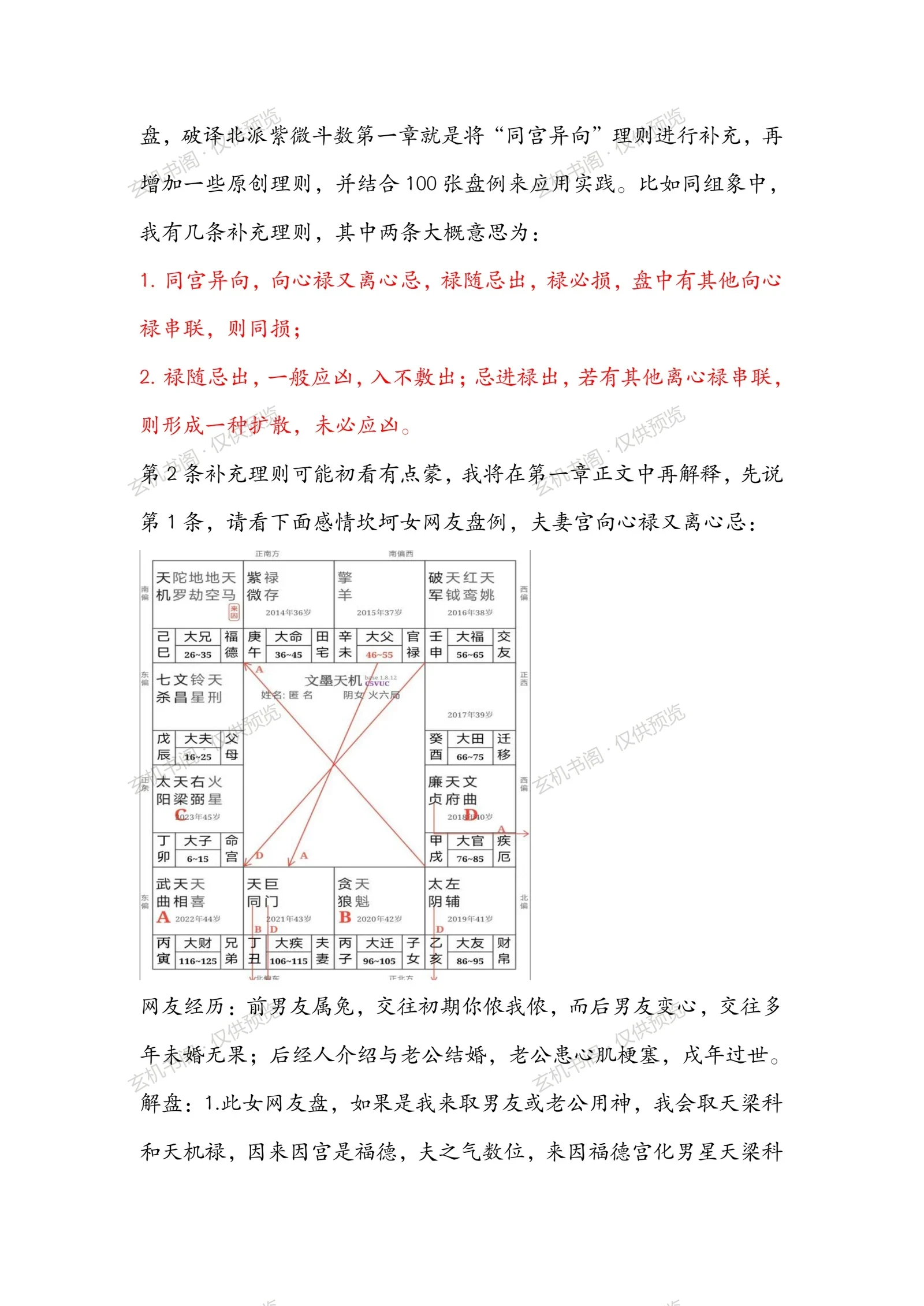
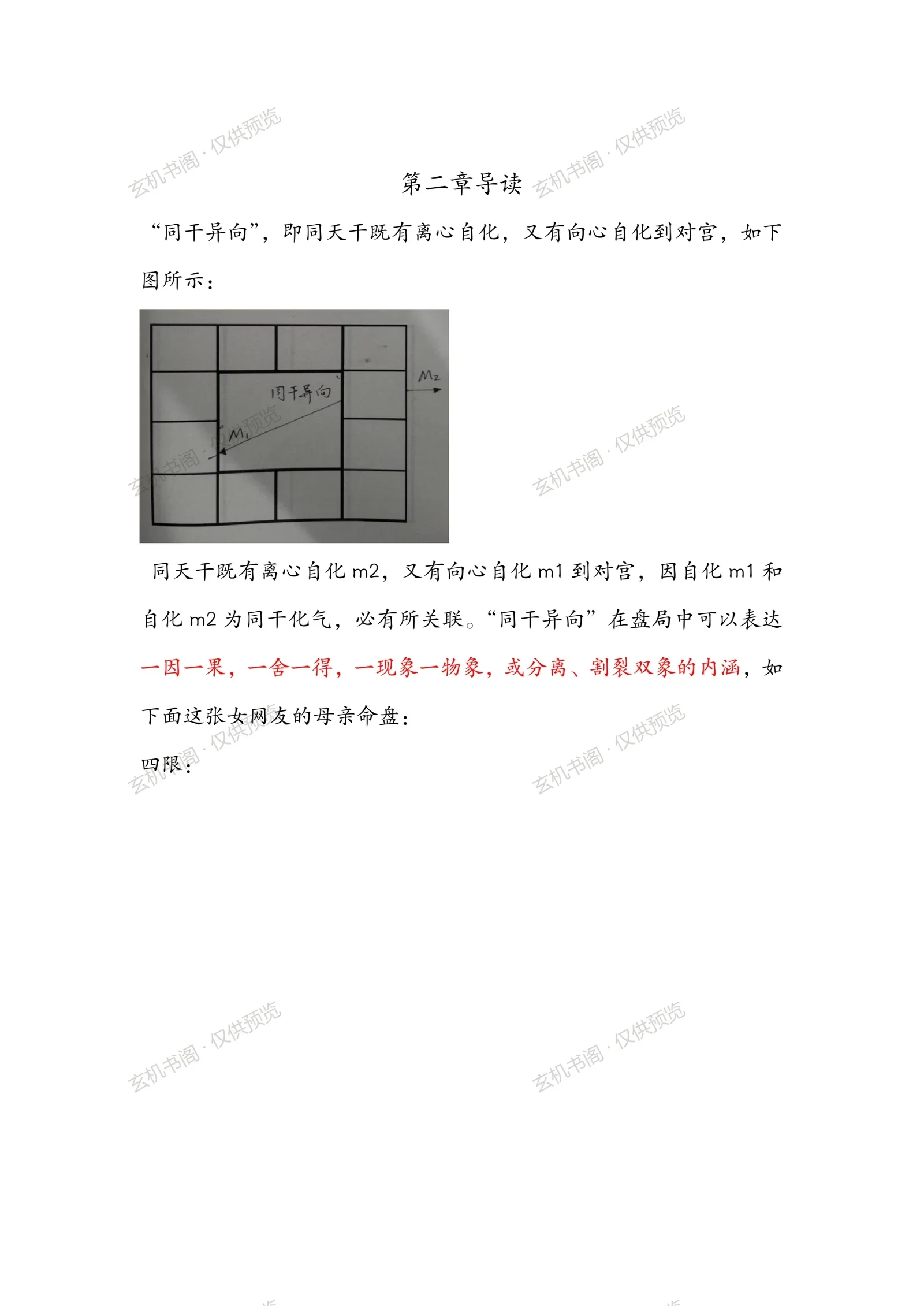
This book records the author's research on Northern School Zi Wei Dou Shu in six chapters, moving from the technique of 'same palace, opposite directions' toward full chart interpretation. The first five chapters pair each topic with roughly one hundred charts drawn from relatives, friends, online acquaintances and public figures; the sixth compares identical charts to discuss diverging fates. According to the preface, chapters one and two are publicly released, chapters three and four are limited to fellow students of the four-transformations school, and chapters five and six are restricted to students in the Cai and Wu lineages. The visible portion is the introduction to chapter one: when a palace contains both an inward self-transformation entering and an outward self-transformation leaving, five traditional rules are given according to same-category, same-group and different-group images, supplemented by the author's own rules such as 'when wealth follows trouble out, wealth is damaged' and 'trouble in, wealth out is not necessarily inauspicious.' A woman's chart is then analyzed throughout to trace her marital difficulties and her husband's fatal heart attack. The chapter two introduction presents 'same stem, opposite directions,' where one heavenly stem both emits an outward self-transformation and receives an inward one from the opposite palace, expressing cause and effect, gain and loss, or a split image.
Contents
Chapter 1: Decoding 'same palace, opposite directions' with 100 charts
Chapter 2: Decoding 'same stem, opposite directions' with 100 charts
Chapter 3: The meaning of 'group division' with 100 charts
Chapter 4: Rules of 'useful-god conversion' with 100 charts
Chapter 5: Research on 'flying palace dynamics' with 100 charts
Chapter 6: Revealing 'fate divergence' through chart comparison
Key Points
Treats 'same palace, opposite directions' as a core four-transformation technique with inward and outward self-transformations
Surveys five traditional rules for same-category, same-group and different-group images and notes their limits
Adds original rules such as 'wealth follows trouble out and is damaged' and 'trouble in, wealth out may not be bad'
Walks through real charts to demonstrate choosing the useful god, locating events and timing
Introduces 'same stem, opposite directions' as a way to read cause-effect and split images