Reading guide
Content guideOverview
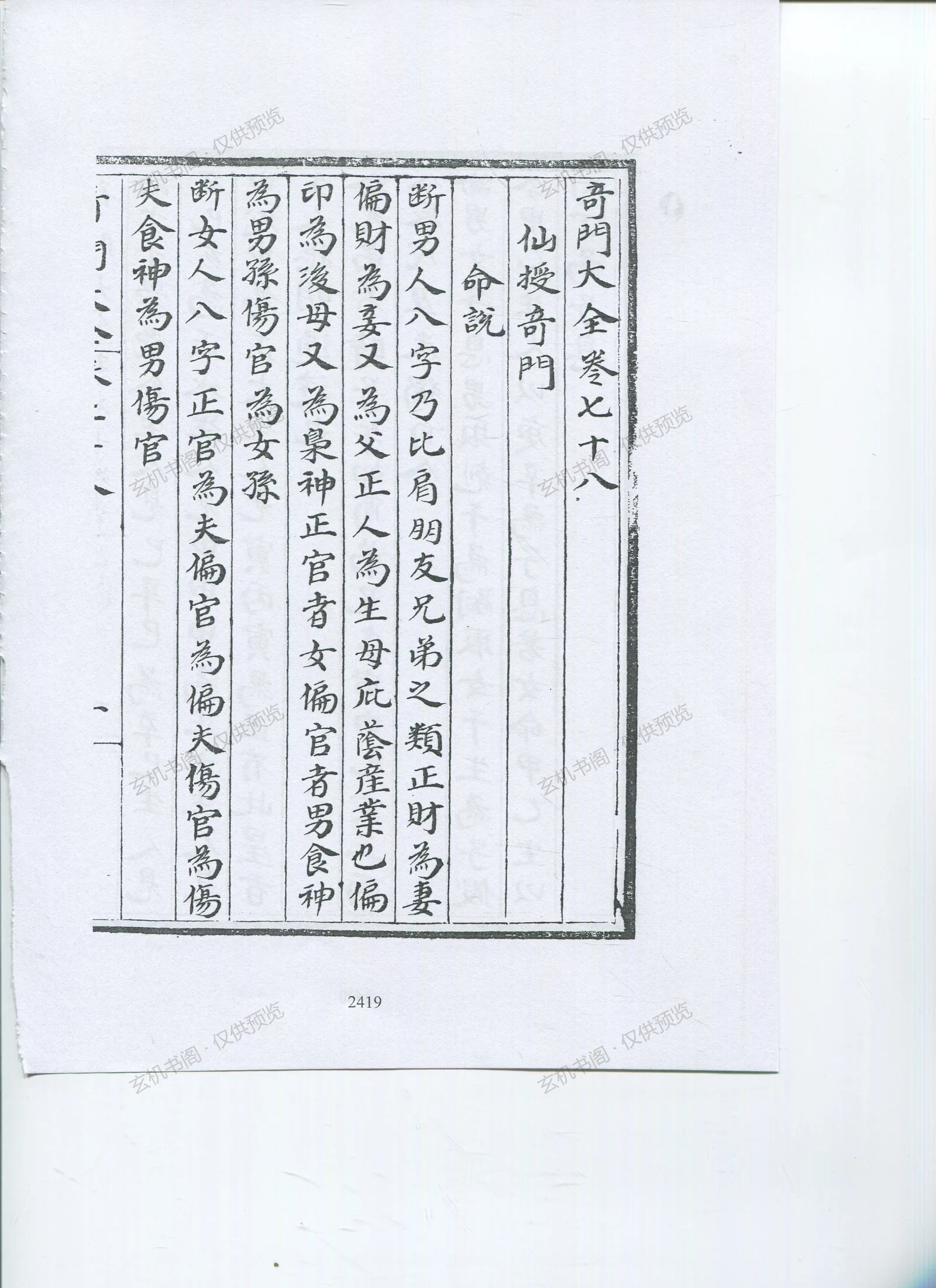
These pages come from the end of volume 77 and the opening of volume 78 of the *Qimen Daquan*. The text is set in vertical traditional characters within a double-ruled frame, numbered 2414 to 2419. Volume 77 works from the palace occupied by one's birth year and the interactions of year, month, day and hour, tracing how water, wood, fire, metal and earth generate or overcome one another across the natal and opposing palaces. From this it derives judgments on grandparents, parents, siblings, spouse and children, on auspicious and inauspicious years and months, on chances of wealth, on leaving home to build a career, and on study and reputation. Concrete cases such as 'the fate of Zhang Zi' and 'one born in the guiyou year seated in the western Dui palace' are used to demonstrate the rules. Volume 78 is headed 'Immortal-Transmitted Qimen Fate Discourse' and maps the ten gods—biqian, zhengcai, piancai, zhengguan, pianguan, yin, shishen and shangguan—onto kinship roles, noting differences between male and female charts. Only a fragment is visible, with no preface or statement of the whole book's structure.
Contents
Vol. 77: five phases and kinship fortunes
Reading a life from the birth-year palace
Yearly and monthly fortunes and timing of wealth
Judgments on leaving home and on study
Vol. 78: Immortal-Transmitted Qimen Fate Discourse
Ten gods as kinship: biqian, wealth, officer, seal, food/injury
Key Points
Fortunes judged from the natal palace against year, month, day and hour
Five-phase generation and overcoming mapped to kinship closeness and harm
Worked examples such as the fate of Zhang Zi and the guiyou native in Dui
Month-by-month yearly judgments covering wealth, career and study
Vol. 78 assigns kinship via the ten gods, differing for male and female charts