Reading guide
Content guideOverview
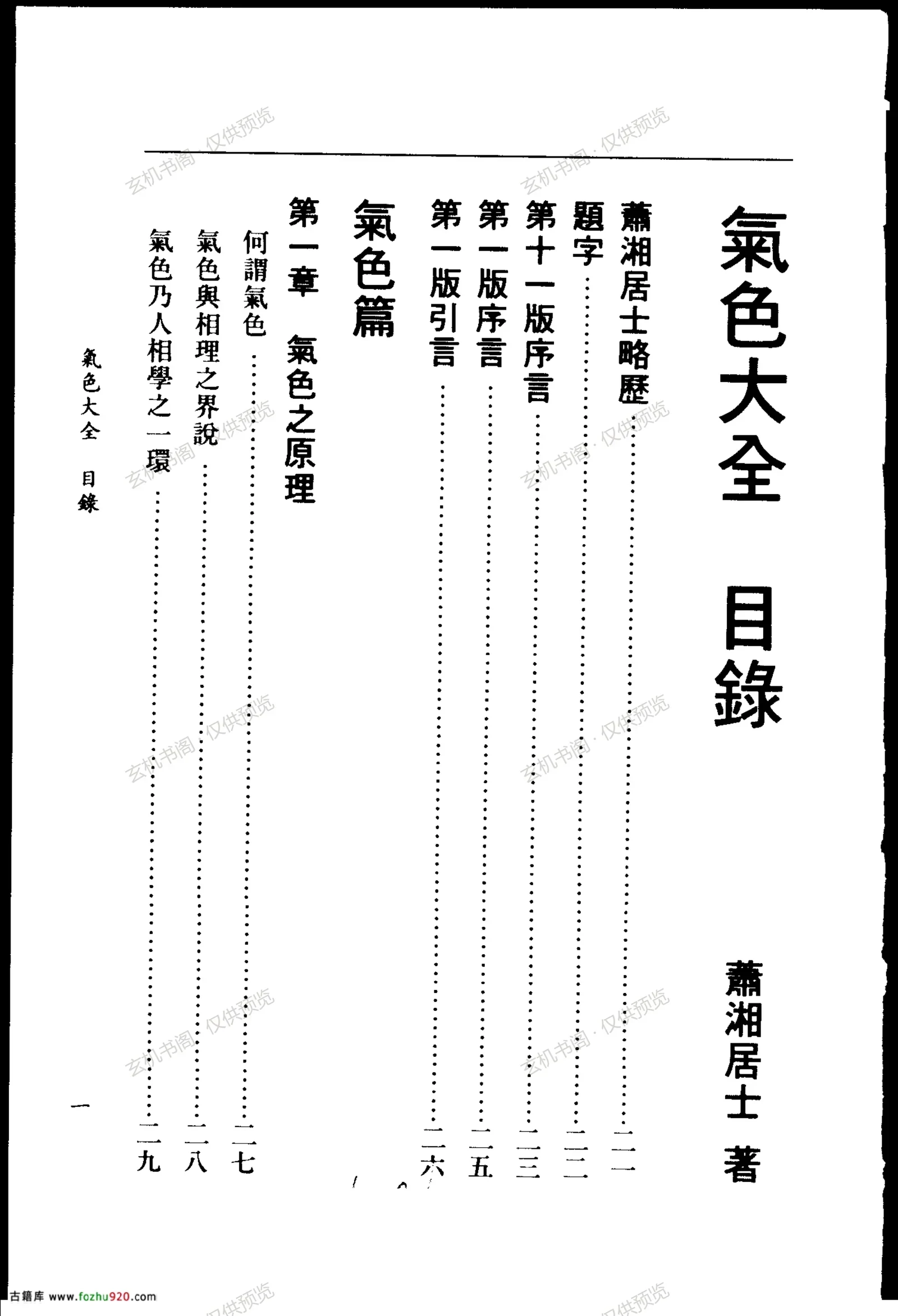
This is the opening section of Xiao Xiang Jushi's Comprehensive Guide to Complexion and Qi Color, including inscriptions, prefaces, a author biography, and the table of contents. The main text begins with the chapter on the principles of complexion and qi color, distinguishing them from skin color, pigment, or blood circulation, and identifying essence, spirit, qi, and color as its four components. It differentiates this art from TCM inspection, philosophy, and religion, stressing that changes in complexion relate to a person's major life events. The second chapter sets out observation rules for the emergence and recession of colors—green, yellow, white, black, red, crimson, and purple—along with methods for judging depth and density, and the auspicious or inauspicious directions and timing of the five-phase colors. The third chapter addresses seasonal observation by spring, summer, autumn, winter, and month by month. The structure is clear and makes it a useful reference for the study of traditional facial complexion theory.
Contents
Inscriptions, prefaces, and author biography
Chapter 1: Principles of complexion and qi color
Chapter 2: Rules for observing the emergence of colors
Individual discussion of green, yellow, white, black, red, crimson, purple
Five-phase colors: auspicious directions and timing
Chapter 3: Seasonal observation methods
Month-by-month observation (first to seventh month)
Key Points
Complexion is not skin color, pigment, or blood circulation; it comprises essence, spirit, qi, and color
Related to but distinct from TCM inspection, philosophy, and religion
Seven colors discussed individually for their emergence and recession
Five-phase correspondence with auspicious directions and timing
Seasonal and month-by-month observation rules