Reading guide
Content guideOverview
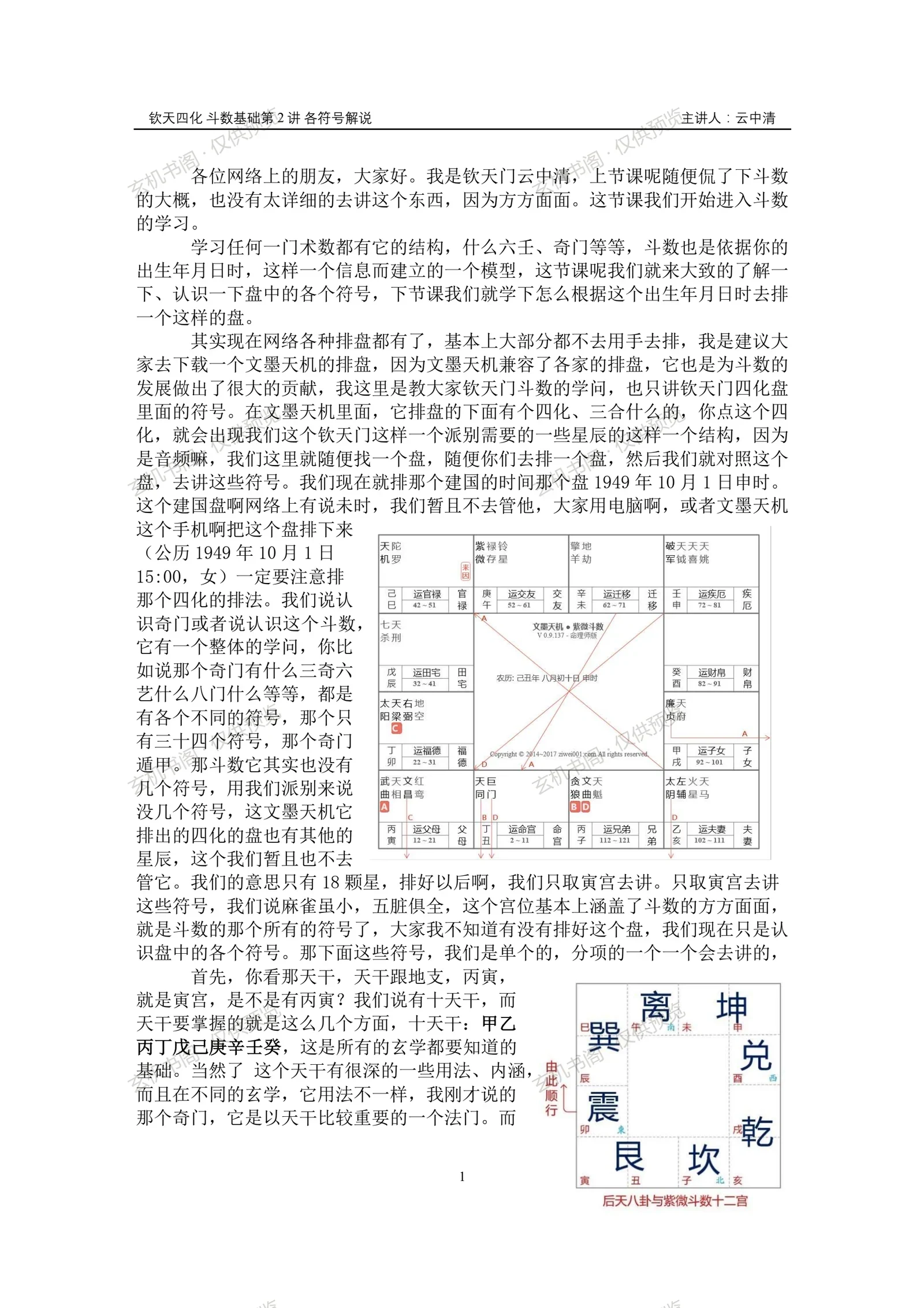
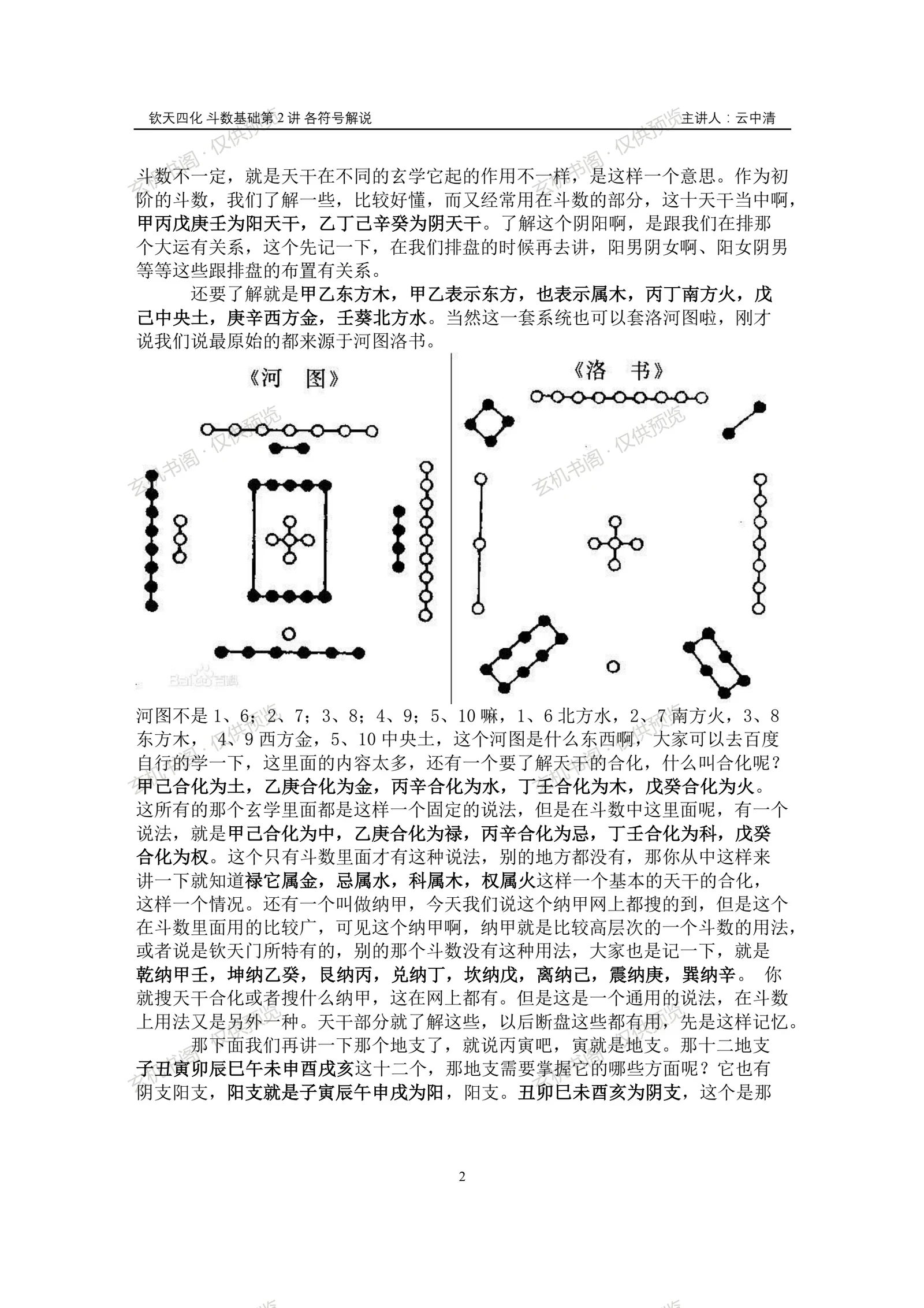
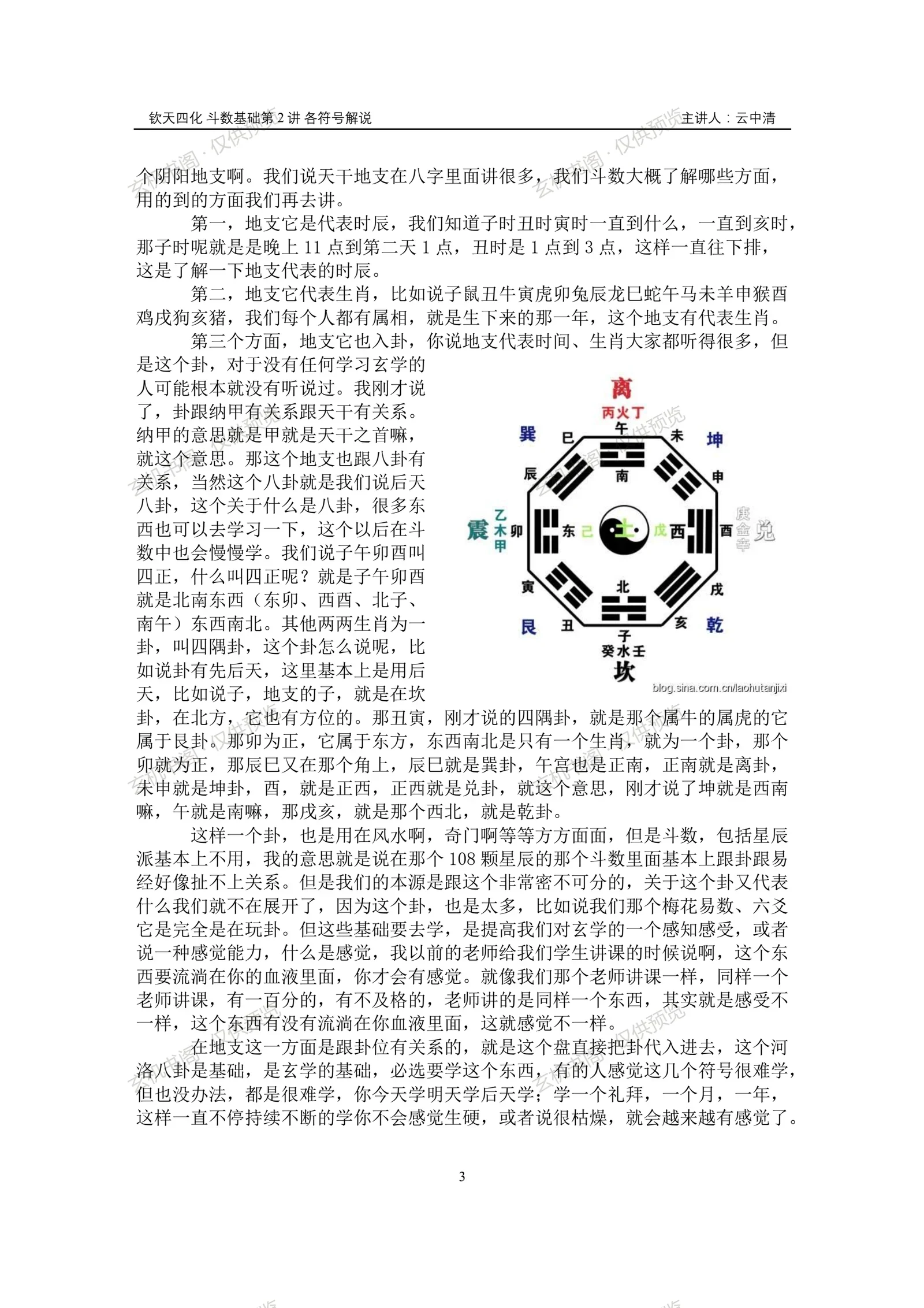
Compiled from Yun Zhongqing's lectures, the visible pages cover Lecture 1, 'Understanding Dou Shu,' and the start of Lecture 2, 'Explaining the Symbols.' Lecture 1 presents the Qintian school's framework of eighteen stars (fifteen participating in the Four Transformations in this course), stresses returning to the underlying pattern-principle-image-number cosmology rooted in the Yijing, and criticizes schools that transmit techniques without theory. It illustrates how a star's original palace shapes its meaning, using Tan Lang in the Palace of Fortune. Lecture 2 moves to chart symbols: it introduces the Wenmo Tianji charting tool, uses a 1949 sample chart, and explains the ten heavenly stems' yin-yang and five-element assignments, Hetu Luoshu numbers, stem combinations, the school's specific Four Transformations correspondences, and najia. It then covers the twelve earthly branches as hours, zodiac signs, and trigram positions, with a Later Heaven Bagua chart. The tone is conversational, aiming at conceptual grounding rather than ready-made judgments.
Contents
Lecture 1: Dou Shu cognition and Qintian lineage
Lecture 1: Pattern-principle-image-number and original star palaces
Lecture 1: Basic chart layout by year stem, month, and hour
Lecture 2: Charting tools and overview of chart symbols
Lecture 2: Ten stems, five elements, combinations, and Four Transformations
Lecture 2: Hetu Luoshu numbers and najia
Lecture 2: Twelve branches as hours, zodiac, and trigrams
Key Points
Qintian school uses eighteen stars; fifteen take part in the Four Transformations here
Emphasis on pattern-principle-image-number and Yijing roots
A star's original palace shapes its core meaning, e.g. Tan Lang in the Fortune Palace
Stem combinations map to lu, quan, ke, and ji in Dou Shu
Earthly branches serve as hours, zodiac signs, and Later Heaven trigram positions