Reading guide
Content guideOverview
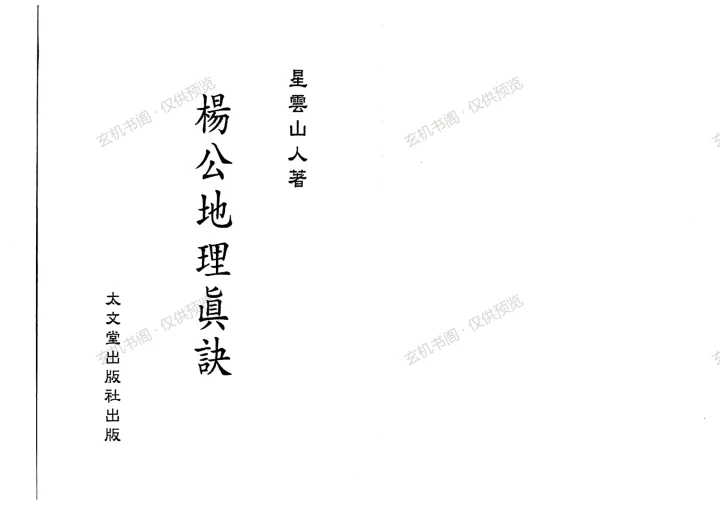
This book by Xingyun Shanren, published by Taiwen Tang, presents a systematic treatment of San Yuan (Three-Origin) principle-qi (liqi) in feng shui. The cover subtitle identifies it as a summary of terrestrial studies, Yang Gong's core methods, and a complete synthesis. The preface criticizes sectarian disputes in kanyu and calls for returning to Yang Gong's authentic transmission, framing San Yuan liqi as that lineage's key. The table of contents moves from the Three Great Hexagrams of Xuan Kong and the true meaning of Xuan Kong into yin-yang, the Great Five Phases, the Xuan Kong supreme polarity, city-gate water mouths, the luopan's sixty-four hexagram forward and reverse rules, and tomb-hall water mouths. Later sections cover setting the central five in grave alignment and double-mountain double-facing, followed by appendices on textual criticism of Pingsha Yuchi, form-principle general discussions, and a postscript to Dili Bianzheng Shu. In the introduction the author positions himself within the Yang Gong and Jiang Dahong lineage while correcting earlier writers such as Zhang Xinyan. The result is both an accessible outline of San Yuan Xuan Kong concepts and a partisan textual correction, best read with some prior grounding in kanyu terminology and luopan layers.
Contents
Preface: critique of sectarian kanyu, Yang Gong methods upheld
Introduction: origins of San Yuan liqi and the book's purpose
The Three Great Hexagrams of Xuan Kong and its true meaning
Yin-yang, Great Five Phases, Xuan Kong supreme polarity
City-gate water mouths and luopan hexagram rules
Central five alignment and double-mountain double-facing
Appendices: Pingsha Yuchi criticism, form-principle essays
Key Points
Organizes San Yuan Xuan Kong principle-qi around Yang Gong's methods.
Moves from core hexagram and five-phase theory to water mouths and luopan practice.
Engages critically with Dili Bianzheng and related commentaries.
Appendices supply textual and doctrinal background for further study.