Reading guide
Content guideOverview
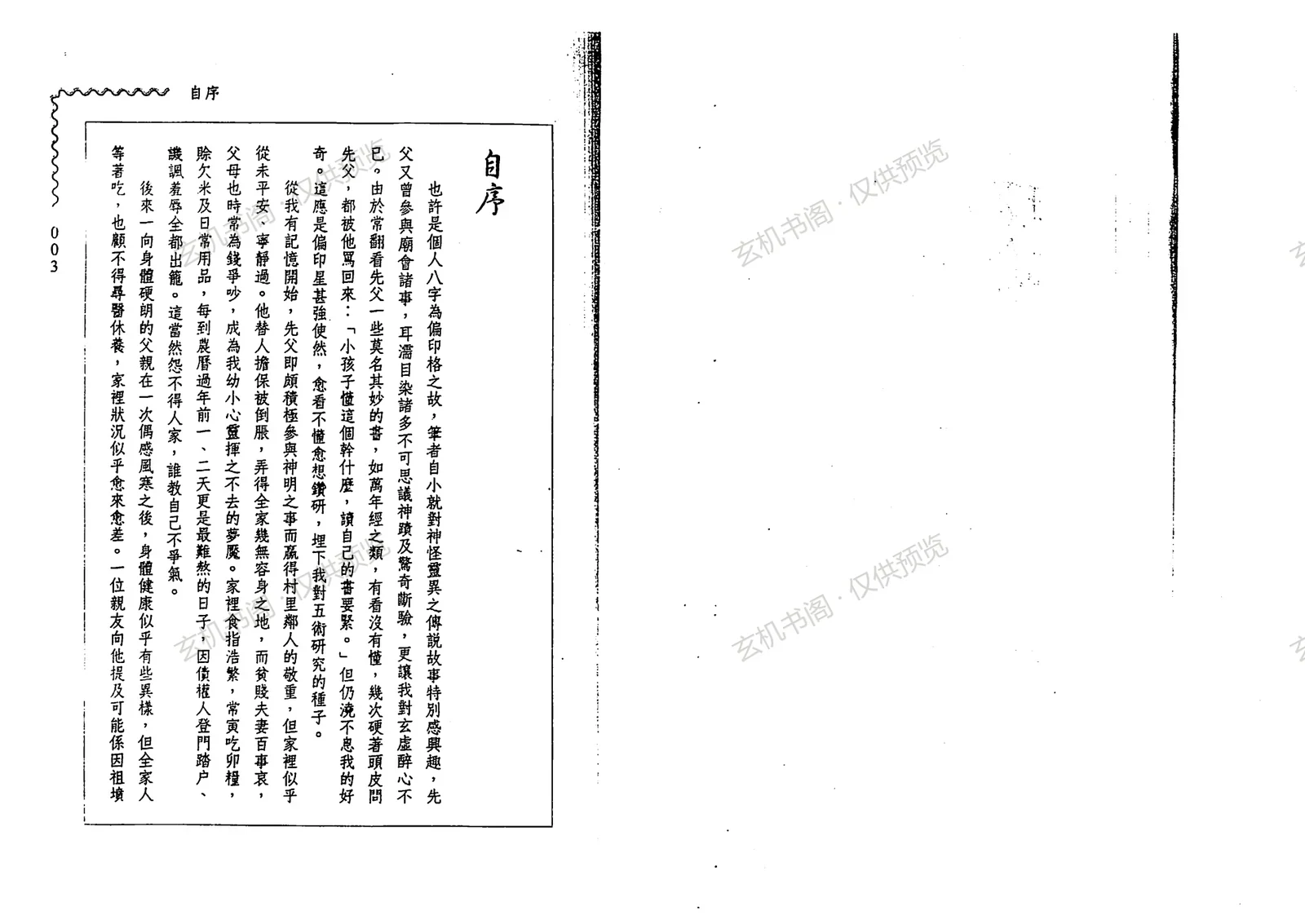
This book by Qin Ruisheng is a dedicated study of Three-Yuan Xuan-Kong feng shui for yang dwellings. The preface recounts how the author's family experiences led him into the five arts; after encountering San-He, Nine-Star, and Longmen Ba-Da-Ju methods, he settled on Three-Yuan Xuan-Kong. The work begins with the mechanisms of feng shui, discussing qi, yin-yang and the five phases, the He Tu and Luo Shu, and the eight trigrams. It then organizes the Xuan-Kong compass and hexagram-line correspondences, explains the Three-Yuan Nine-Period cycle and its applications, and details the Tian-Xin central pivot, Xuan-Kong flying-star principles, basic patterns, and form judgments. Later chapters cover key methods and facing rules, Pai-Long establishing the acupoint, annual purple-white flying stars, Xuan-Kong judgment methods, and methods for neutralizing voids and killing qi. A section on interior yang-dwelling arrangements is also included. The title emphasizes both theory and verification; the book closes with 67 case studies interpreted through classical Xuan-Kong principles, making it a practical reference for students of Xuan-Kong yang-dwelling feng shui.
Contents
Ch.1 Preliminary study of feng shui mechanisms
Ch.2 Organization of the Three-Yuan Xuan-Kong compass
Ch.3 Meaning and application of the Three-Yuan Nine Periods
Ch.4 Tian-Xin pivot and Xuan-Kong flying-star principles
Ch.5 Basic Xuan-Kong patterns and form judgments
Ch.6 Key methods and facing rules
Ch.7 Pai-Long and establishing the acupoint
Ch.8 Annual purple-white flying stars
Ch.9 Xuan-Kong judgment methods and applications
Ch.10 Neutralizing and transforming killing qi
Ch.11 Interior arrangement essentials for yang dwellings
Key Points
Explains the 180-year Three-Yuan Nine-Period cycle through astronomy and physics.
Organizes the Xuan-Kong compass and flying-star principles from classical sources.
Covers Pai-Long, annual purple-white stars, and judgment methods.
Includes interior yang-dwelling arrangements such as doors, stoves, and bedrooms.
Appends 67 case studies to verify Xuan-Kong theory in practice.