Reading guide
Content guideOverview
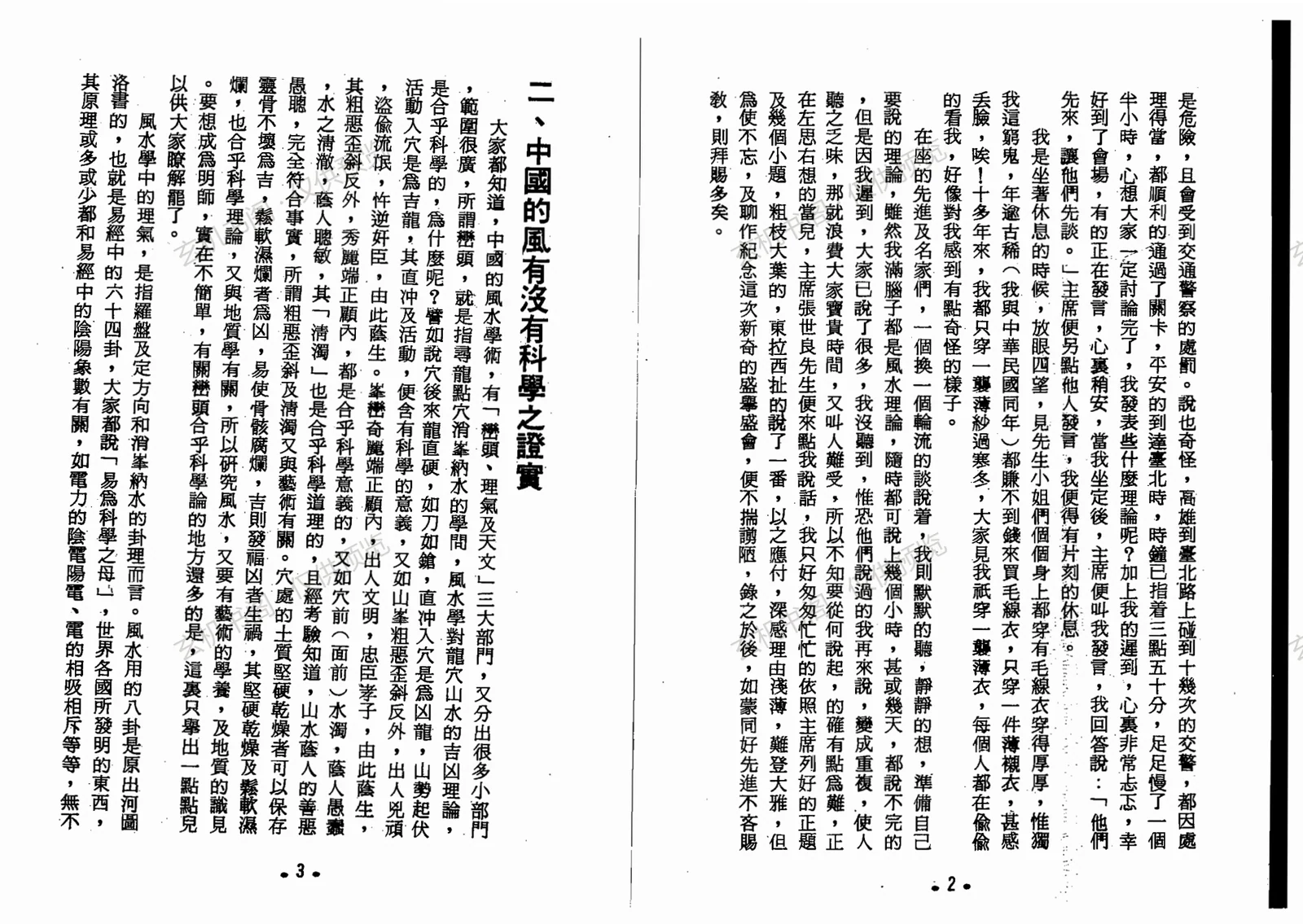
This is Zeng Zinan's Lectures on Three-Yuan Date Selection, marked on the cover as internal material not for outside circulation. The first six pages show the cover, a book-list advertisement, and the opening five sections of the main text. The preface explains that the author could not attend a 1982 Kaohsiung symposium asking whether modern people should believe in feng shui, so he responded in writing. Section two argues that Chinese feng shui has scientific verification, drawing on yin-yang, the Hetu and Luoshu, and the eight trigrams. Section three surveys the major schools and their lineages, including San Yuan, San He, and Nine Star methods, and the Yang Junsong–Zeng Wenchan transmission. Section four discusses the troubles modern feng shui practitioners commonly face, criticizing charlatans and money-making schemes. Section five looks ahead, using acupuncture as an analogy for testing whether feng shui works. The text is a spoken-style lecture record focused on concepts and school distinctions rather than step-by-step date-selection formulas.
Contents
Preface: origin of the symposium and the written response
Does Chinese feng shui have scientific proof?
Modern schools, their features, and lineages
Common troubles of modern feng shui practitioners
Prospects for the future
Key Points
Written in a lecture Q&A style, answering doubts about believing in feng shui
Uses yin-yang, Hetu-Luoshu, and trigrams to argue feng shui has verifiable principles
Surveys San Yuan, San He, and Nine Star schools and the Yang-Zeng lineage
Criticizes practitioners who exploit clients or pose as masters
Uses acupuncture as an analogy for testing feng shui's efficacy