Reading guide
Content guideOverview
Written by Canglong Jushi (Li Lixian), this book presents a family-transmitted approach to mountain-dragon feng shui. Opening with a preface, an introduction, and the author's account of learning from his father, it proceeds to Chapter One, 'The Mountain Dragon.' The chapter begins with a general survey, then treats the mountain dragon's posture, forms, passes, branching, four guardian animals, bright hall, remaining energy, water mouth, and flowing-water patterns in eleven sections. The author criticizes popular mountain-form manuals as derivative and aims to reveal what constitutes a true site and great land. The text also mentions companion works on xuan kong day selection and principle-based feng shui, showing an integrated approach of form and principle. Readers gain a framework for reading mountains, though the book is one lineage's view and should be compared with classical texts, as the title page contains watermarks and contact information.
Contents
Preface: critiques of current mountain-form and day-selection practices
Introduction: a scholar's dream and the name Canglong Jushi
Author's preface: learning mountain dragons from his father
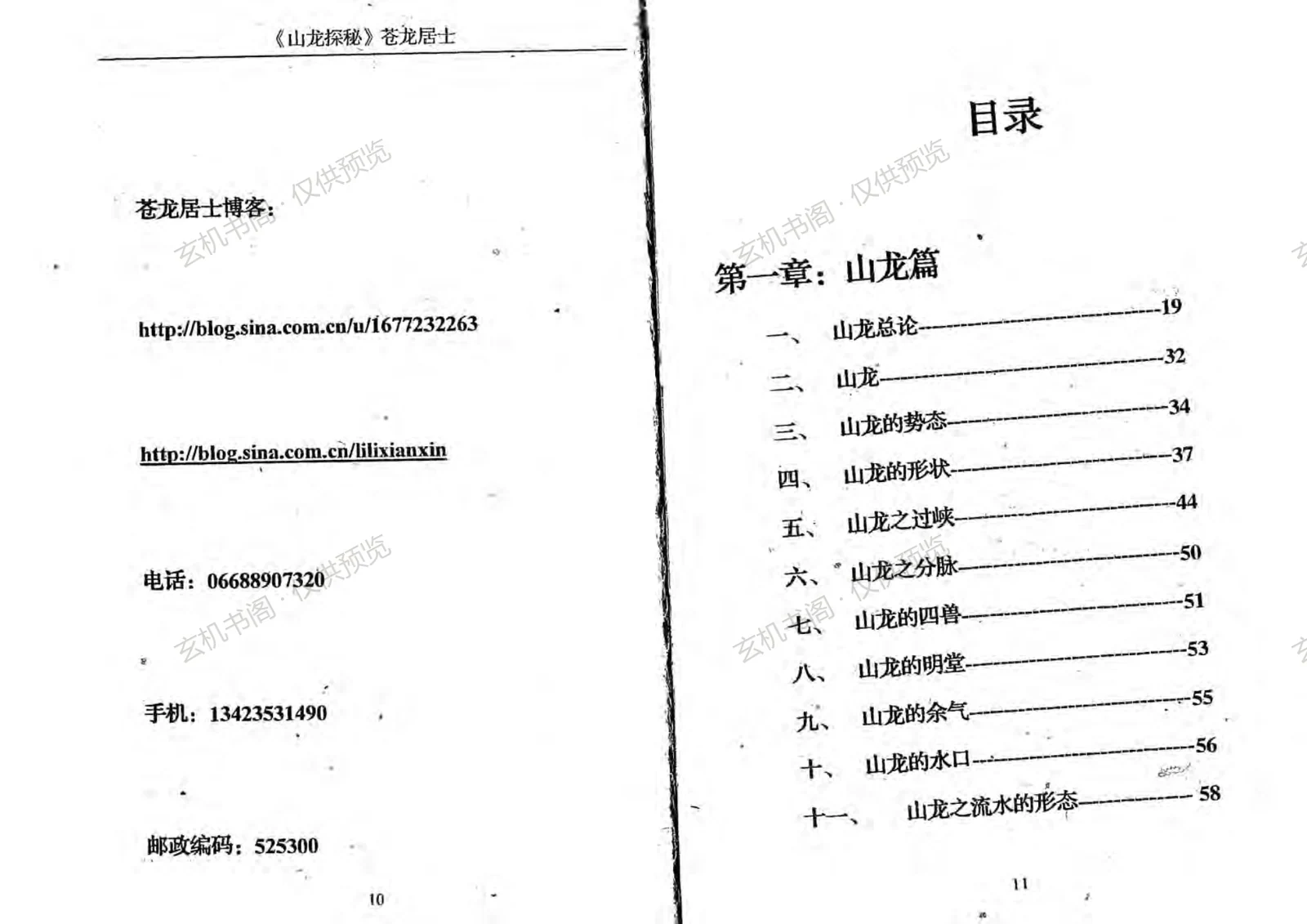
Chapter One: general survey of the mountain dragon
Posture, forms, and passes of the mountain dragon
Branching, guardian animals, and bright hall
Remaining energy, water mouth, and flowing-water patterns
Key Points
Centered on family-transmitted mountain-form methods, stressing true sites versus great land.
Starts from a general survey and unfolds posture, forms, passes, and branching.
Emphasizes guardian animals, bright hall, remaining energy, and water mouth for site assessment.
The preface traces the author's field experience from boyhood onward.