Reading guide
Content guideOverview
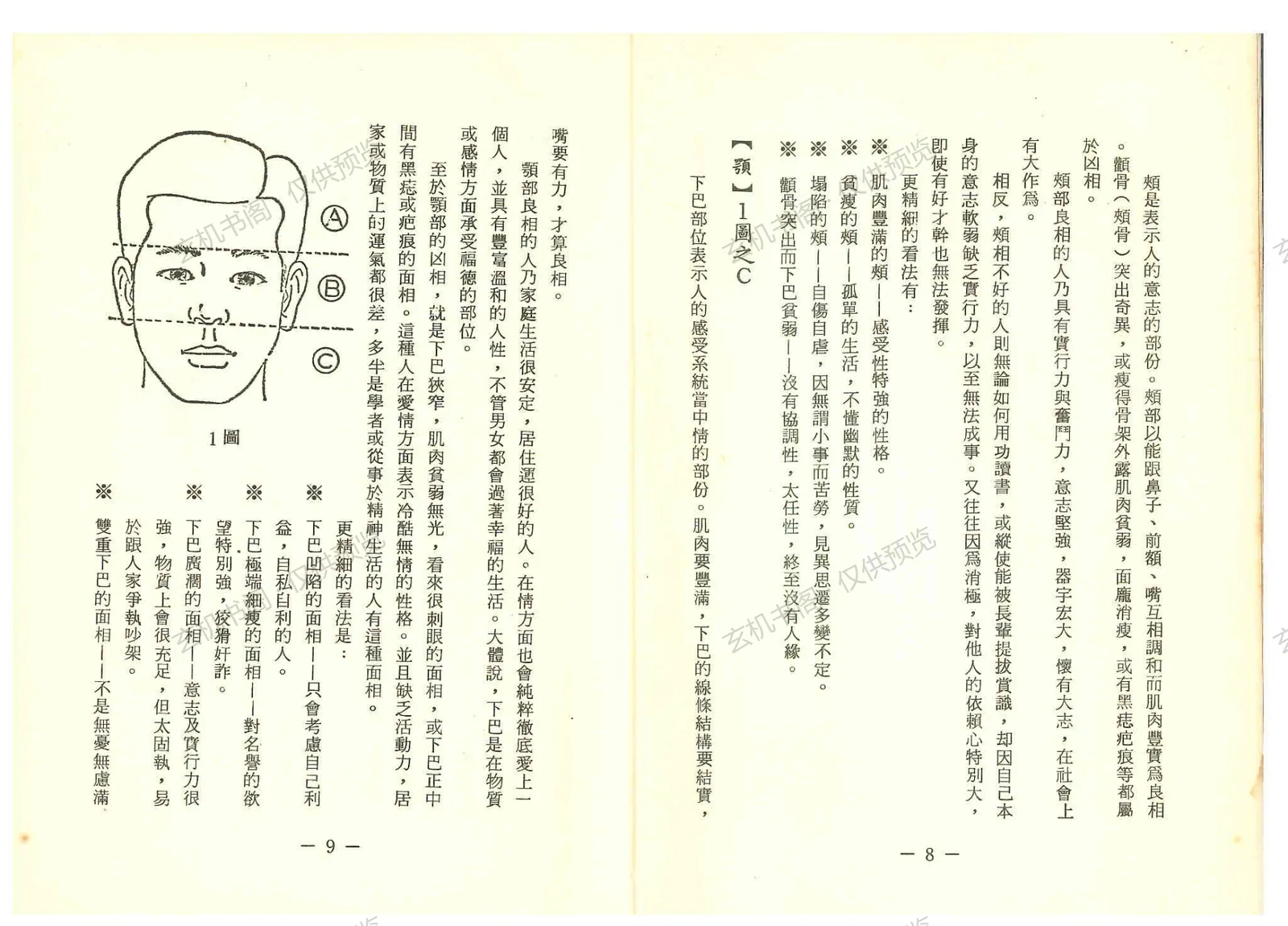
This is the second volume of the Complete Compendium of World Physiognomy and Fate, compiled by Gao Shanqing and labeled on the cover as affiliated with the Department of Philosophy at National Taiwan University. The subtitle is 'Face Reading and Blood Type.' A preface defines physiognomy as a comparative, typological study between facial appearance and character, built on a chain of reasoning from appearance to personality to destiny, and cites traditional sayings such as 'rat's mouth and monkey's cheeks' to explain how facial analogies to animals became character judgments. The table of contents divides the book by body part: the face, eyes, ears, mouth, eyebrows, nose, moles, and complexion, with page numbers running from 6 onward past 36. The sample chapter on reading the face divides it into three zones—forehead, brow-to-nose-tip, and below-nose-to-chin—and lists judgments linking forehead bones, horizontal wrinkles, and moles to character and fortune, accompanied by schematic face diagrams. The book is a popular survey of traditional Chinese physiognomy, with some comparison to blood-type personality theory, useful as a reference for understanding the format and rhetoric of mid-twentieth-century Taiwanese fortune-telling literature.
Contents
Preface: the reasoning chain from appearance to character to destiny
Contents: face, eyes, ears, mouth, brows, nose, moles, complexion
Three facial zones and forehead physiognomy
Jaw, cheekbone, and chin judgments
Schematic face diagrams and body-part correspondences
Key Points
Uses the chain appearance → character → destiny as its core framework
Divides the face into upper, middle, and lower zones
Lists wrinkles, bone structure, moles, and scars with fortune judgments
Includes blood-type and personality comparisons
Relies heavily on traditional animal metaphors and formulaic verdicts