Reading guide
Content guideOverview
This six-page document is a Chinese-language printout of the English Wikipedia article on palmistry. It begins by defining palmistry, or chiromancy, as the art of character assessment and foretelling through the study of the palm, noting its lack of empirical support and its classification as pseudoscience in academia. The history section traces palmistry from ancient India, Tibet, China, Persia, Sumeria, and Babylonia through its suppression by the Catholic Church in the Middle Ages and its revival in the modern era. Modern palmistry covers the founding of chirological societies in Britain and America, key figures such as Cheiro and Edward Heron-Allen, and basic techniques. Later sections discuss the significance of the left and right hands, four hand shapes (Earth, Air, Water, Fire), and the major lines and mounts of the palm. The final page presents criticism and references to palmistry in films and television. It serves as an introductory reference for basic concepts and terminology of Western palmistry.
Contents
Definition and status of palmistry
Ancient origins and spread
Medieval suppression and modern revival
Modern palmistry societies and figures
Left/right hand and hand shapes
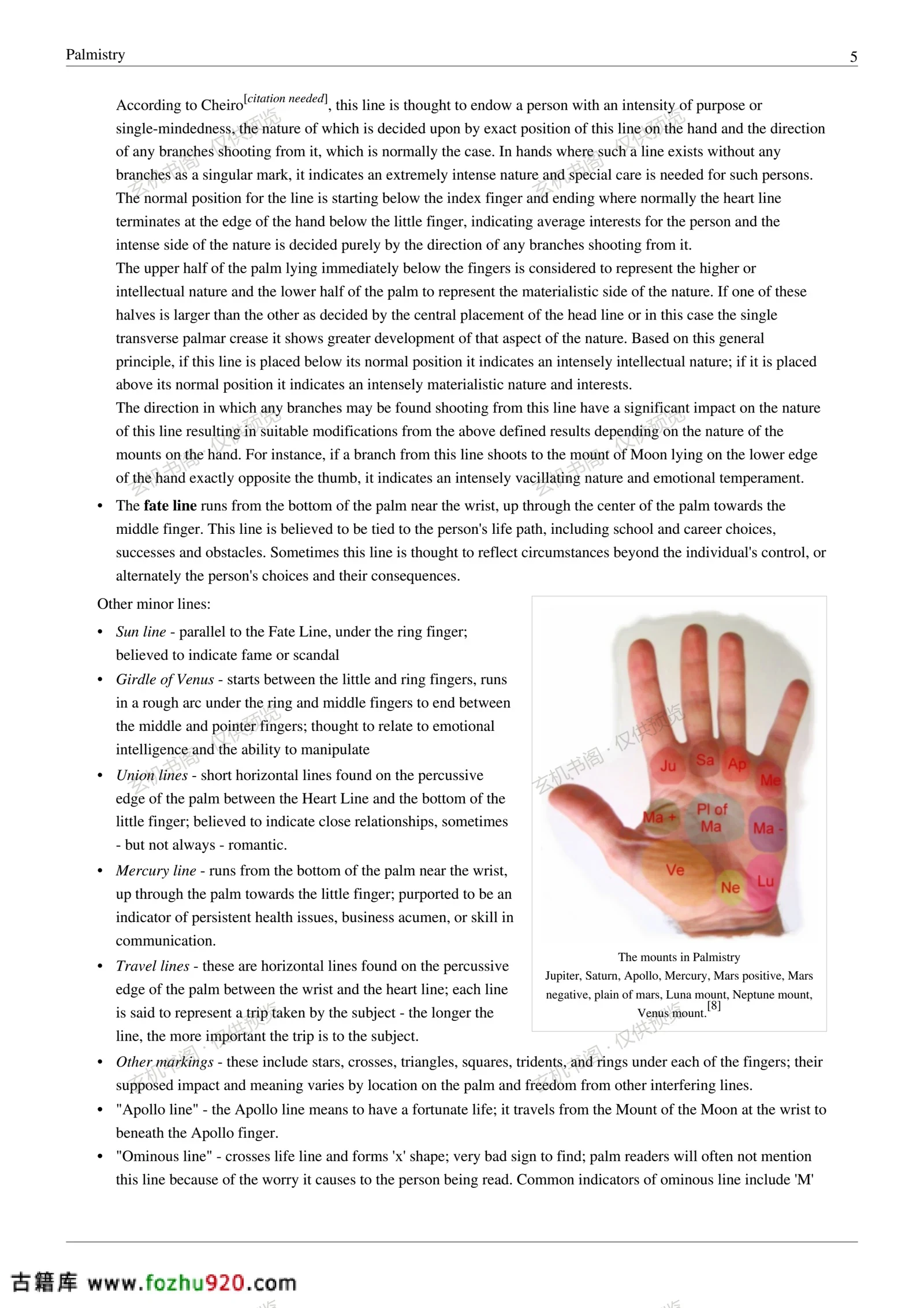
Major lines and mounts
Criticism and media references
Key Points
Palmistry interprets character and future through lines, hand shapes, and mounts.
Academia generally regards palmistry as pseudoscience due to lack of empirical evidence.
Hands are often classified into Earth, Air, Water, and Fire types.
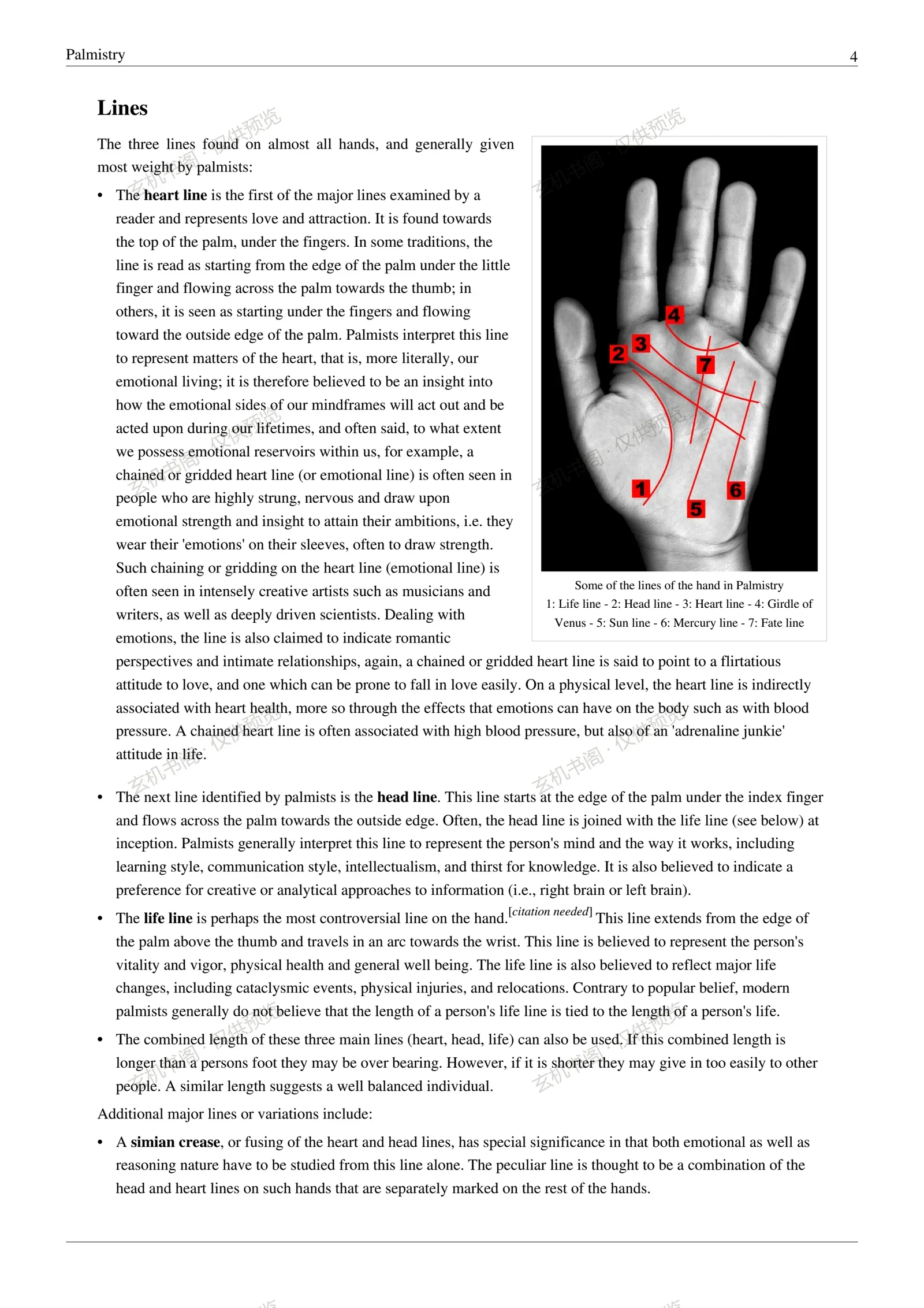
The three major lines are the heart line, head line, and life line.
The left and right hands are assigned different meanings depending on tradition.