Reading guide
Content guideOverview
Published by Dunhuang Literature and Art Press and written by Shao Weihua, this book presents the theory and method of Four-Pillar prediction, commonly known as Bazi. It treats the stem-branch combination of a person's birth year, month, day, and hour as a coded record of life destiny, and interprets it through yin-yang and the Five Elements, the relationships of generation and restraint, and the cycles of major and minor luck periods and annual influences. The author places this system within the broader tradition of the Yijing, framing it as a practical method for anticipating misfortune and seeking good fortune. The opening chapters also draw analogies between stem-branch information and the body's meridians, and discuss longevity markers and specific judgment categories. Written in accessible prose, the book is suitable for readers seeking a structured introduction to traditional Bazi terminology and its basic interpretive framework.
Contents
Cover: taiji, bagua, and stem-branch diagram
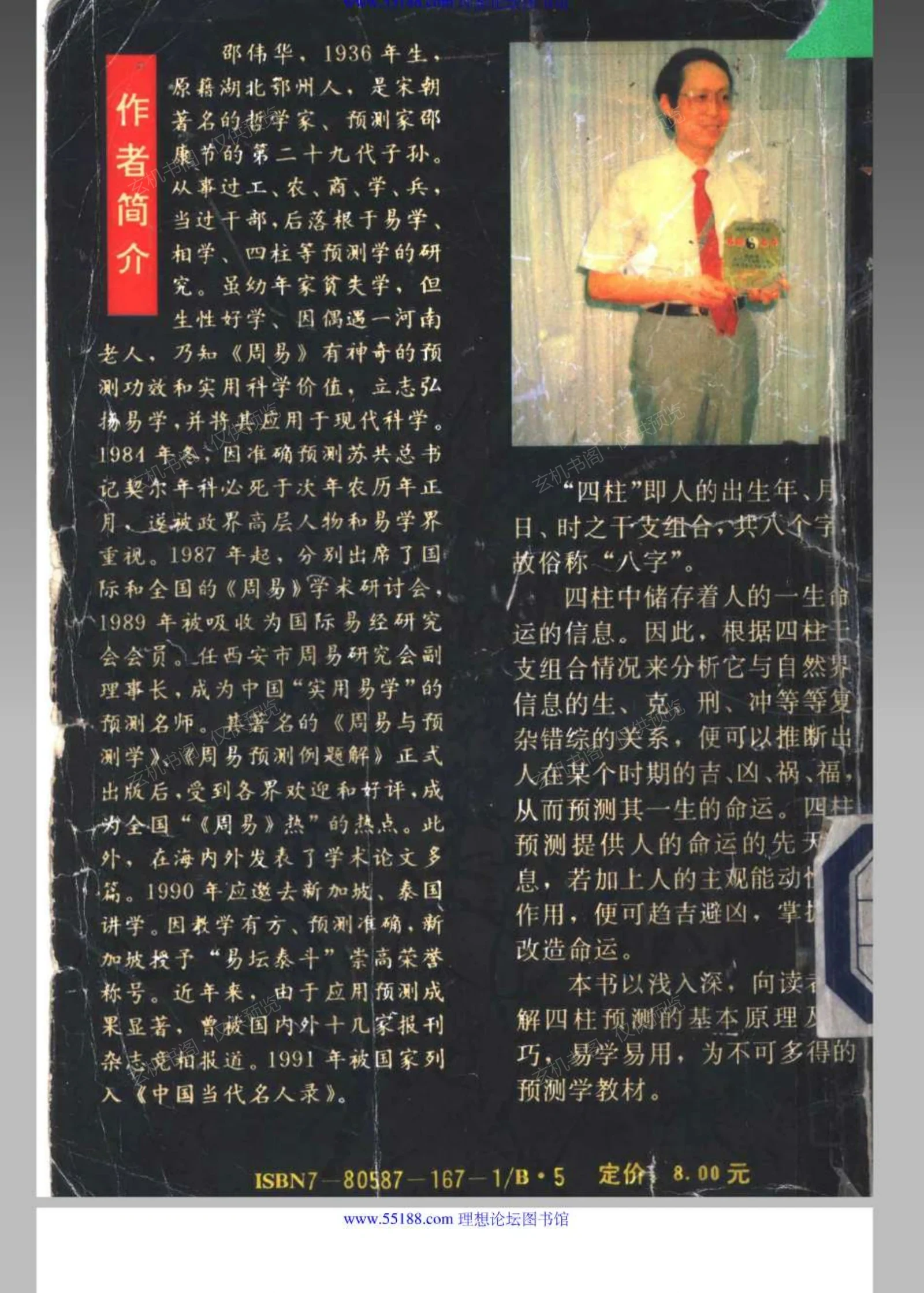
Author profile and overview of Four-Pillar prediction
Title page and publication details
Preface: fate prediction compared to medical advice
Positioning and theoretical basis of Four-Pillar study
Stem-branch information, luck cycles, and fortune judgment
Key Points
The Four Pillars are the stem-branch components of birth year, month, day, and hour
Yin-yang and Five Elements generation and restraint form the core interpretive rule
Major luck periods and annual influences locate the timing of events
Stem-branch information is compared to the body's meridian network
Specific topics include overlapping luck cycles and longevity thresholds