Reading guide
Content guideOverview
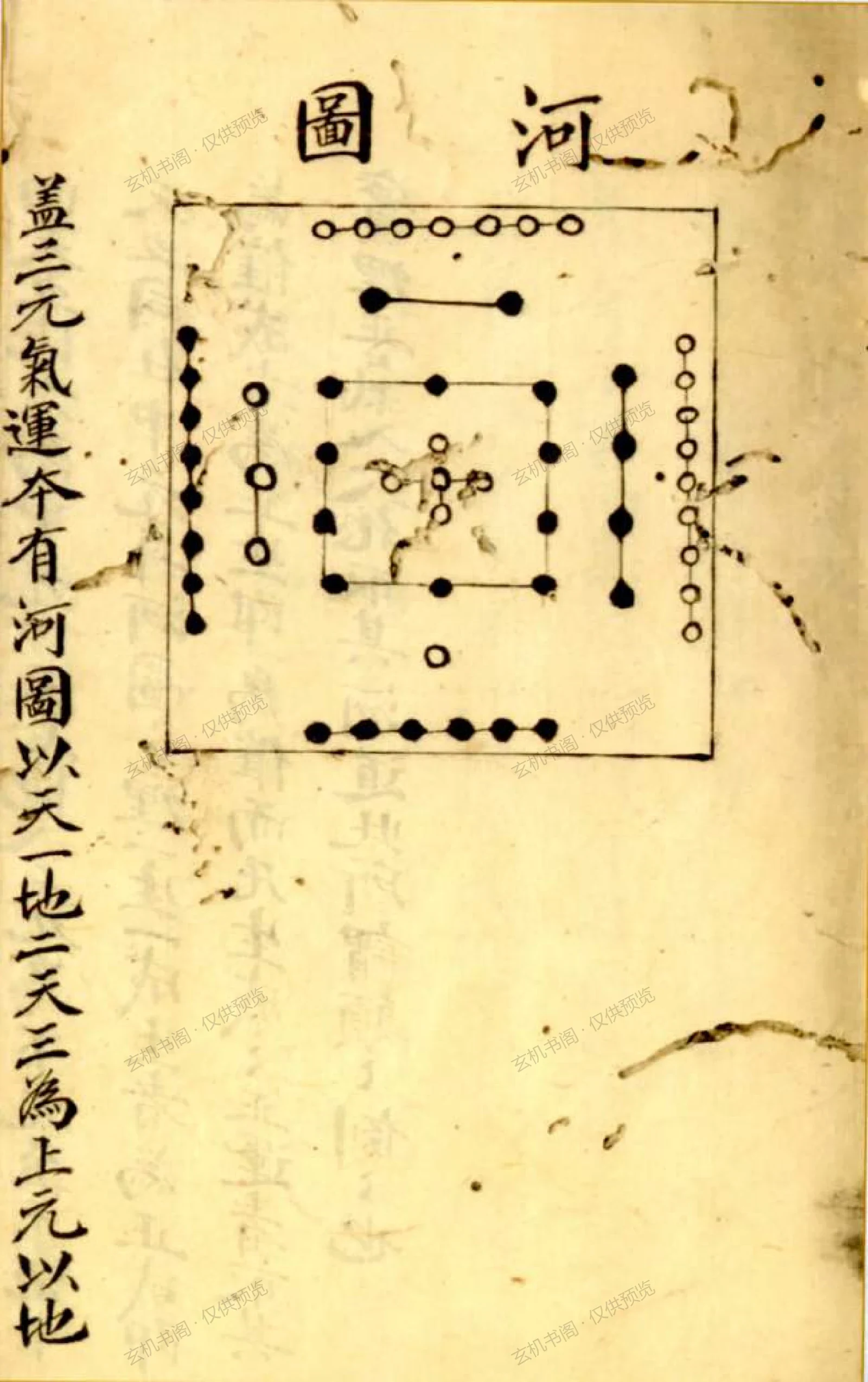
Titled Tianjing Mijue, this manuscript is dated to the thirtieth year of the Daoguang reign and attributed on its opening page to Jiang Duling Dahong, with a colophon by the later student Ouyang Yichuan. It sets out San Yuan Xuan Kong methods built on the Hetu and Luoshu, pairing the primal and later heaven trigrams to determine the 'true deity' and 'zero deity' of each cycle: when the number one governs, the true deity of six is drawn upon to assist it; when two governs, seven assists, and so on through the five phases and four directions. A section on the essence of the Hetu explains Kan as the upper-cycle dragon and Qian as its water, Qian as the lower-cycle dragon and Kan as its water, tying the three cycles to the diagram. The text closes with a dotted Hetu diagram. Written in terse, technical classical Chinese with many lacunae, it is intended for readers already grounded in Hetu-Luoshu and Xuan Kong theory.
Contents
Cover title and copyist attribution
Essence of the Hetu: upper and lower cycle dragon and water
True and zero deities paired by generation numbers
Four directions and the five phases in number
Dotted Hetu diagram and the three cycles
Key Points
Hetu generation numbers mapped to later-heaven directions
Upper and lower cycle dragon-water distinguished
Reigning true deity supported by its opposite number
Three cycles read through Hetu numerics