Reading guide
Content guideOverview
This is an introductory guide to BaZi (Four Pillars of Destiny) by Xu Wenqi, published by Shaanxi Normal University Press and marked as volume 22 in a Practical Chinese Classics series. The editor's preface, titled 'BaZi: King of Fate Prediction Arts,' distinguishes fatalistic, self-determined, and fluid views of destiny, arguing that BaZi studies the interplay of innate constitution and changing circumstance and is best understood as a probabilistic art rather than an all-purpose oracle. It also addresses why people born at the same time can have different fates, citing birthplace, weather, fetal time, ancestral graves, family background, and era. The book is organized in four parts: core rules of yin-yang, Five Elements, heavenly stems and earthly branches, clashes and combinations, chart casting, life palace and fetal origin; auxiliary theories of nayin and shensha; practical readings on family, marriage, career, and wealth; and personality analysis. It includes 200 hand-drawn illustrations, 130 tables, 900 traditional judgment phrases, and 160 celebrity case charts, designed for beginners to consult while reading.
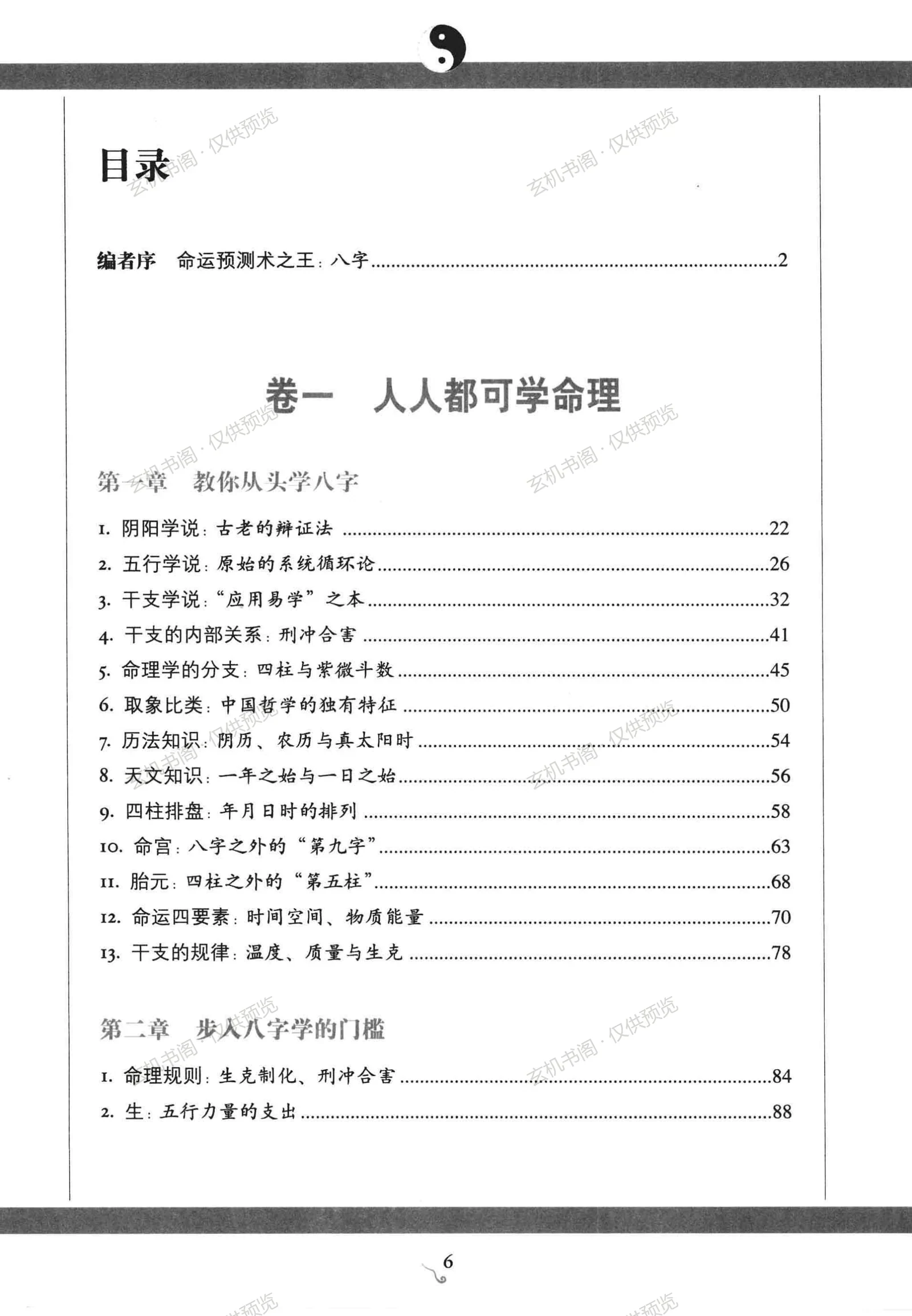
Contents
Preface: BaZi as the king of fate prediction
Part 1: Everyone can learn fate analysis—yin-yang, Five Elements, stems and branches
Chapter 1: Chart casting, life palace, fetal origin
Chapter 2: Entry threshold—generation, control, transformation, clashes and combinations
Part 2: Nayin and shensha as auxiliary theories
Part 3: Practical directions—family, marriage, career, wealth
Part 4: Personality analysis through BaZi
Key Points
Core framework built on yin-yang, Five Elements, and stem-branch interactions
Heavy use of tables and hand-drawn diagrams to lower the entry barrier
Frames BaZi as probabilistic trend prediction rather than exact fate
Adds nayin and shensha to broaden judgment criteria
Includes 160 celebrity charts and 900 traditional judgment phrases for comparison