Reading guide
Content guideOverview
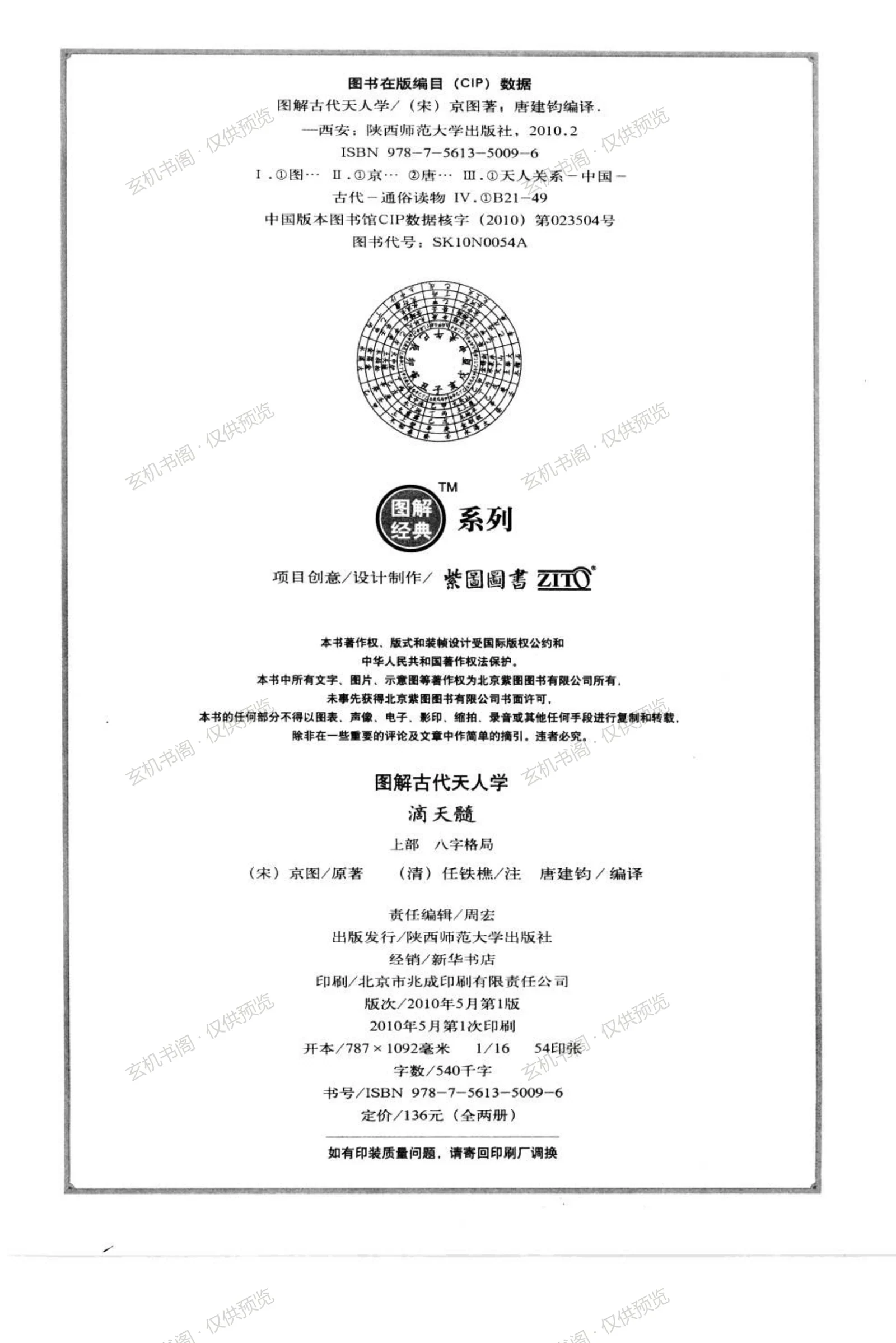
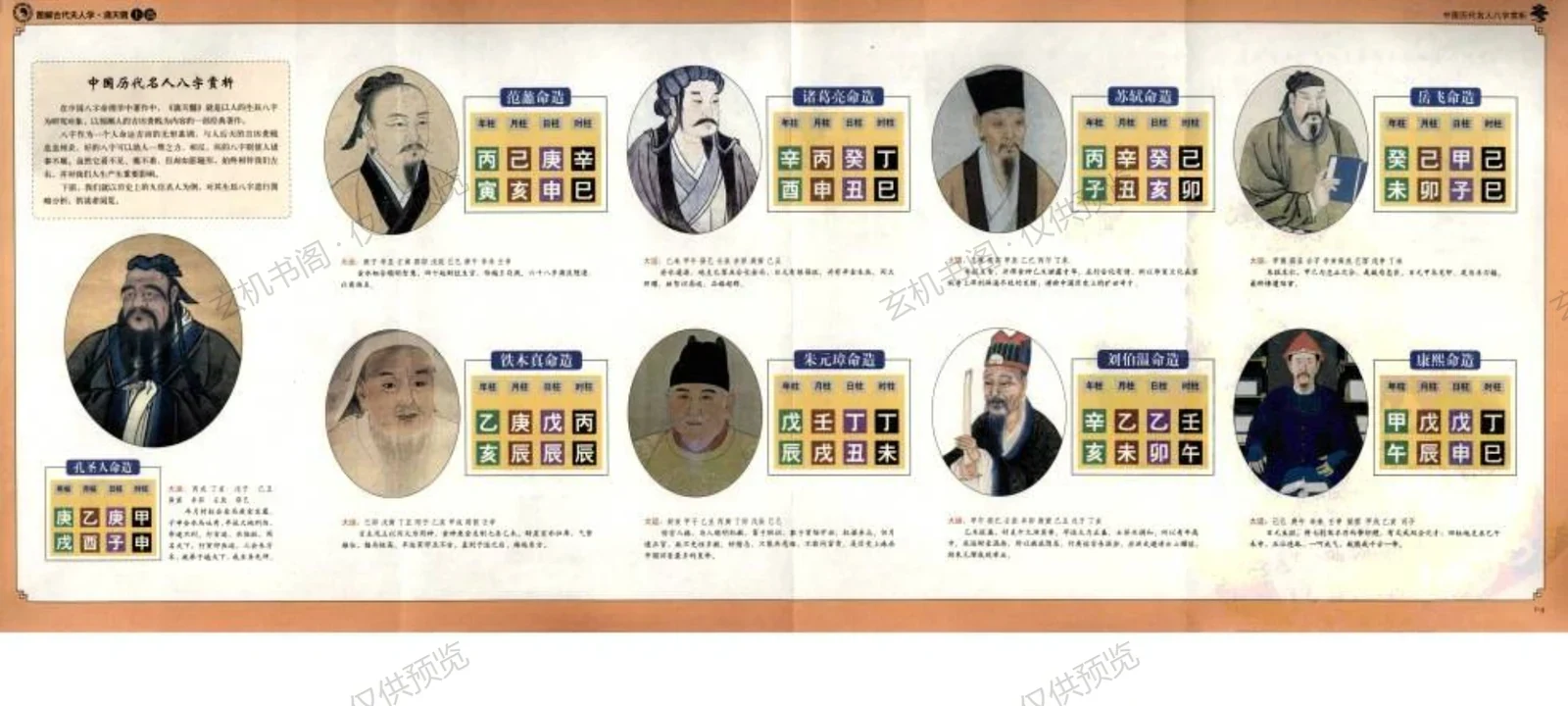
This is the upper volume, titled 'Bazi Structure,' of an illustrated edition of the classical Bazi text Ditian Sui. The cover credits Jing Tu (Song dynasty) as the original author, Ren Tiejiao (Qing dynasty) as commentator, and Tang Jianjun as compiler; the copyright page identifies Shaanxi Normal University Press, first edition May 2010. The editor's preface frames Bazi within the idea of 'heaven-human unity' and places Ditian Sui among the 'four classics of destiny studies,' alongside Sanming Tonghui, Qiongtong Baojian, and Ziping Zhenquan. Spreads show four-pillar tables for Confucius, Fan Li, Zhuge Liang, Su Shi, Yue Fei, Zhang Liang, Zhu Yuanzhang, Liu Bowen, and Kangxi, with brief judgments illustrating concepts such as strength and weakness, Shangguan, Yangren, wealth and office, and interconnected earthly branches. A historical timeline traces figures and texts from Fuxi and King Wen through Li Xuzhong, Xu Ziping, Shen Shanzhan, and Ren Tiejiao, situating Bazi in the broader history of Yijing and traditional fate calculation. The illustrated layout makes the basic context of Bazi structure accessible, though the classical text still requires the commentator and foundational terminology to understand fully.
Contents
Cover and copyright page: Illustrated Ditian Sui, Part One, Bazi Structure
Editor's preface: To learn Bazi, read Ditian Sui first
Famous historical birth charts: from Confucius to Kangxi
Timeline of Chinese Bazi history and sources
Diagram linking the solar system with Bazi studies
Case examples explaining strength, Shangguan, Yangren, and structure terms
Key Points
A vernacular illustrated edition focusing on the first section, Bazi Structure.
Credits Jing Tu as original author, Ren Tiejiao as commentator, Tang Jianjun as compiler.
Uses historical birth charts to explain strength, Shangguan, Yangren, wealth and office, and branch sequences.
Includes a historical timeline connecting Yijing and fate-calculation figures and texts.