Reading guide
Content guideOverview
A New Inquiry into the Principles of Fate is Yuan Shushan's revised edition of his earlier eight-volume work, published more than thirty years after the original. In the preface he explains that the old edition had been reprinted several times at home and abroad, and that this version adds essays on nobility and lowliness, wealth and poverty, longevity, temperament, and illness, along with insights drawn from his own practice. The book takes the Four Pillars as its framework and also incorporates the life palace, minor limits, annual cycles, and major periods, combining their stems and branches into sixteen characters to judge rise and decline and determine what is favorable or adverse. He further considers local geography, family background, and the weather at birth to refine his judgments. Yuan criticizes earlier texts for the confusing proliferation of Six Spirits terminology and instead discusses the physics of the Five Phases, approaching through the hardness or softness of qi and the transformation of forms. He first explains the eight basic structures, then discusses follow structures and transformation structures, and then the conditions in which one phase obtains qi or two phases take form, with particular attention to true and false cases within transformation structures.
Contents
Preface to A New Inquiry into the Principles of Fate
Preface to the original Inquiry into the Principles of Fate
Preface to the Runde Hall Collectanea
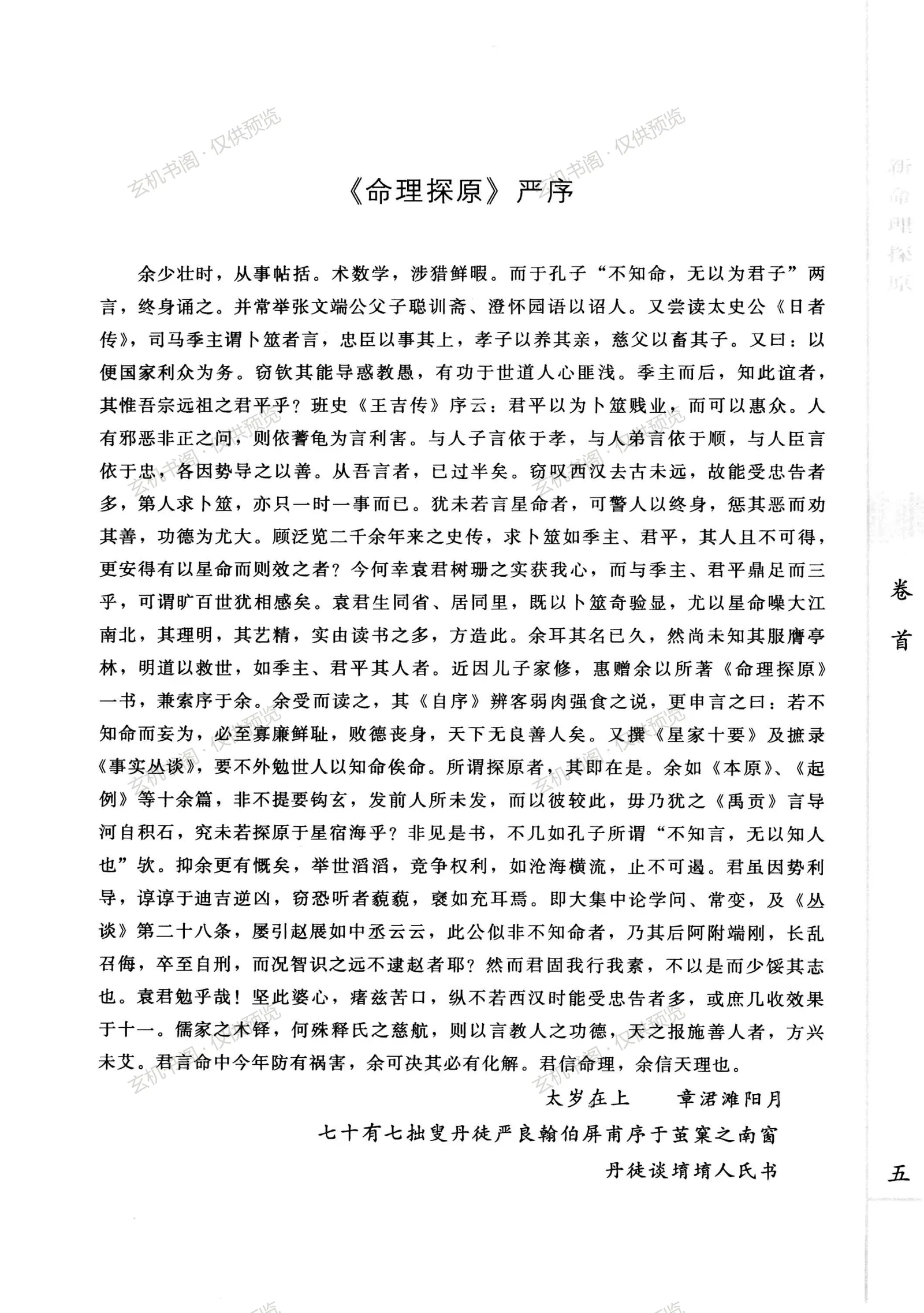
Yan's preface to the original work
The eight structures, follow structures, and transformation structures
One phase obtaining qi and two phases taking form
Essays on nobility, wealth, longevity, temperament, and illness
Key Points
Treats the Five Phases as the root of fate calculation and avoids tangled Six Spirits nomenclature
Reads the Four Pillars together with the life palace, minor limits, annual cycles, and major periods
Establishes the eight basic structures first, then distinguishes follow and transformation structures
Adds topical essays on status, wealth, longevity, temperament, and illness