Reading guide
Content guideOverview
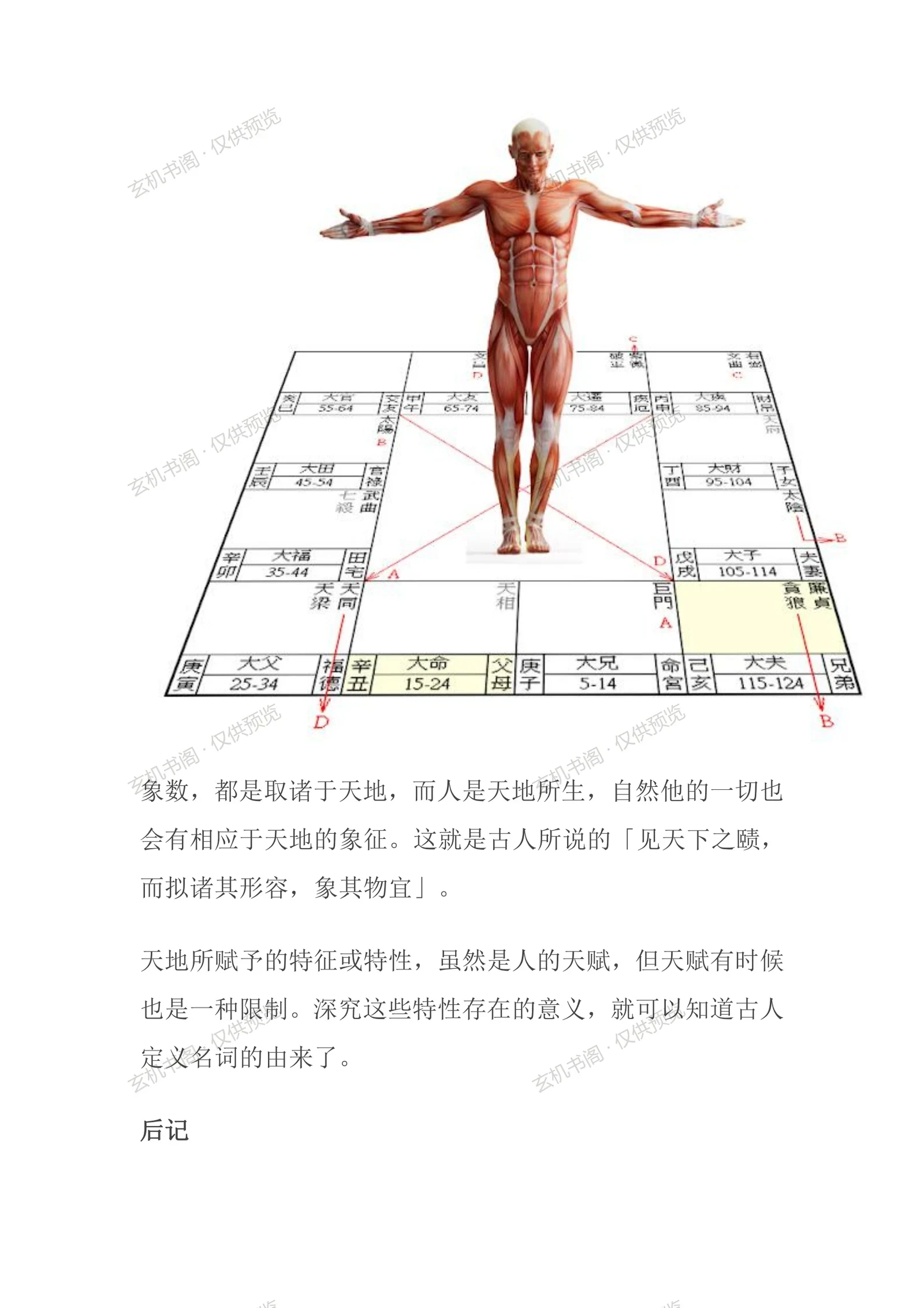
This opening section of Liu Jinfu's Zi Wei Dou Shu 'heart-method' series is introductory rather than instructional. The author begins from the premise that a destiny chart is a cross-section of the time and space of birth, and that the ancients described it through image-number terms; once those terms are understood, the picture drawn by the chart emerges naturally. A diagram overlaying a human muscular figure on the twelve palaces illustrates the classical idea of observing the world's patterns and giving them form. Liu then recounts his research path: an early 'image-number study' essay, followed by applying its hypotheses to readings, which produced the beginner and advanced course materials first titled 'Four Transformations Heart-Method,' from which the term 'image-number heart-method' arose. Later sections pose the central question of how He-Luo describes time and space and how Dou Shu describes He-Luo, using five movements and six qi and the phrase 'participating in heaven and earth and relying on number' to explain the fifteen stars of the three Dippers and the twelve palaces formed by six qi. The author admits these are speculative and provisional, best suited to readers with some Dou Shu background who want to understand the theoretical framing.
Contents
The origin of everything: a cosmological hypothesis
The image described by a destiny chart
Image-number: the starting point of Yijing study
The time and space described by He-Luo
The He-Luo described by Dou Shu
Afterword: hypothesis and verification
Key Points
A chart is a cross-section of birth time and space, drawn with image-number terms
Image-number is the key to names such as Tian Liang, Wen Qu, and the four transformations
Hypotheses are first framed, then tested through readings, yielding the heart-method courses
The core question: how He-Luo describes time-space, and how Dou Shu describes He-Luo
Five movements and six qi are used to explain the fifteen stars and twelve palaces