Reading guide
Content guideOverview
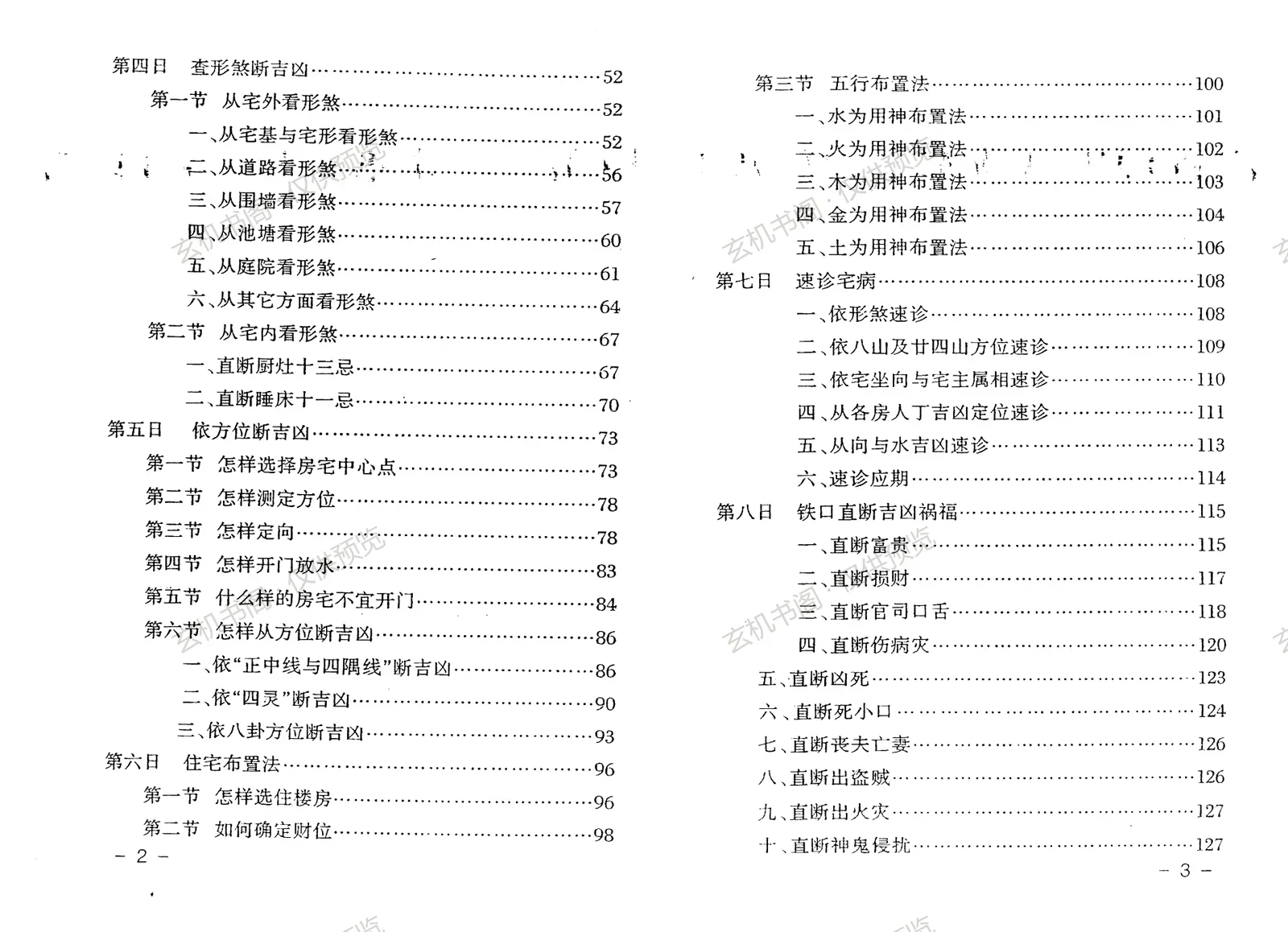
This book is a practical tutorial on yangzhai (dwelling) fengshui by Zhang Chengda, with a preface dated 2005. Responding to the complexity of traditional fengshui schools, the author advocates a simplified approach, claiming to synthesize the essentials of various schools into his own 'Dayi' or 'Yiling' method. He argues that mastering the bagua, form煞, orientation, and hexagram images is enough to assess a dwelling quickly. The book is organized as a ten-day course: Day 1 reviews schools and theoretical disputes; Day 2 covers taiji, liangyi, sixiang, bagua, and the twenty-four mountains; Day 3 collects auspicious and inauspicious verse formulas for dwellings; Day 4 examines external and internal form煞 such as roads, walls, ponds, courtyards, stoves, and beds; Day 5 discusses finding the center, measuring orientation, setting directions, doors and water outlets, and judging fortune by direction; Day 6 covers choosing apartments, locating the wealth position, and five-element placement; Day 7 offers quick diagnosis of dwelling problems; Day 8 gives direct judgments on wealth, loss, lawsuits, illness, and other outcomes; Day 9 addresses deity placement; Day 10 presents auspicious object placement and remedy/renovation methods. An appendix provides case studies from the author's practice. With formulas and practical methods side by side, it serves as an introductory and quick-reference tool for yangzhai fengshui.
Contents
Preface and Day 1: orientation to yangzhai fengshui and schools
Day 2: bagua, twenty-four mountains, and basic knowledge
Day 3: verse formulas on six sha and dwelling fortune
Day 4: external and internal form煞 diagnosis
Day 5: measuring orientation, setting directions, doors and water
Days 6–8: layout, quick diagnosis, and direct judgments
Days 9–10: deity placement and remedy methods
Appendix: selected case studies
Key Points
Advocates a simplified method based on bagua and form煞 for quick dwelling assessment.
Structured as a ten-day course from basic bagua and mountains to form煞, orientation, and remedies.
Emphasizes form煞 diagnosis, including roads, walls, ponds, stoves, and beds.
Provides operational methods for doors, water outlets, wealth position, five-element placement, and deity placement.
Includes the author's case studies for comparing diagnosis and remedy approaches.