Reading guide
Content guideOverview
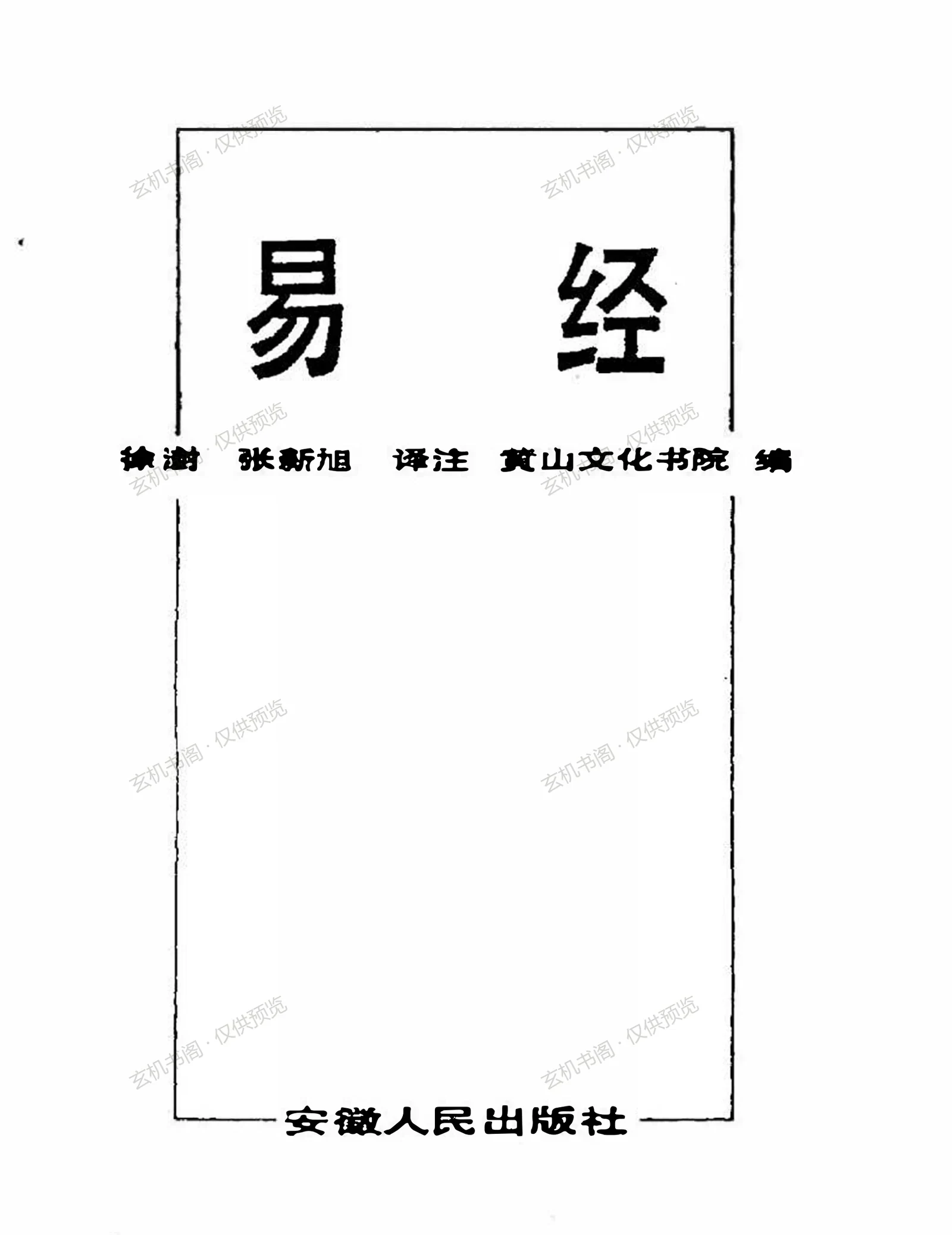
This is an annotated reading edition of the Yijing, translated and annotated by Xu Shu and Zhang Xinxu, compiled by the Huangshan Culture Academy and published by Anhui People's Publishing House in 1992. According to the editorial notes, the book takes Zhu Xi's Zhouyi Benyi as its base text and the Mawangdui silk manuscript of the Zhouyi as its collation text, while consulting Wang Bi's Commentary on the Zhouyi, Kong Yingda's Correct Meaning of the Zhouyi, Li Dingzuo's Collected Explanations of the Zhouyi and other editions. The classical text is divided into upper and lower sections; the transmitted commentaries are placed after the sixty-four hexagrams or within the relevant hexagrams, with the Wenyan commentary placed within the Qian and Kun hexagrams. Each hexagram and line is annotated separately: a brief topic explanation comes first, followed by the hexagram image, name, statement, Tuan commentary, Great Image commentary, and each line's topic, statement and Small Image commentary, with translation and annotation placed beneath the original text. The annotations are concise and follow the principle of the meaning-and-principle school, interpreting on the basis of the basic hexagram and line images without using methods such as mutual-body or complex-arrangement. The preface discusses the origins of the Yijing, its divination form and thought, and its yin-yang dialectical thinking.
Contents
Cover, title page and copyright page
Editorial notes: base text, collation text and arrangement
Preface: origins and thought of the Yijing
Preface: yin-yang concepts and dialectical thinking
Hexagram-by-hexagram and line-by-line annotation
Key Points
Uses Zhu Xi's Zhouyi Benyi as the base text and the Mawangdui silk manuscript as collation text
Consults Wang Bi, Kong Yingda, Li Dingzuo and other Yijing editions
Classical text divided into upper and lower sections; commentaries placed after or within relevant hexagrams
Each hexagram and line annotated separately with topic explanation, original text and annotation
Follows the meaning-and-principle school, omitting mutual-body and complex-arrangement methods