Reading guide
Content guideOverview
These opening pages are a transcript of an online class on the One-Palm Classic (Yizhang Jing), also called Shenji Lingshu. The instructor opens with a dedication verse, outlines a roughly twenty-session course split evenly between theory and practice, and notes that the material draws mainly on the Buddhist line while incorporating Daoist portions attributed to Guiguzi Wang Chan, with origins traced to Tang-dynasty monk Yixing. The method rests on a left-hand chart of the twelve earthly branches, each converted to a number from one to twelve; a chart is set by starting the month from the year branch, the day from the month, and the hour from the day. The lectures then assign the six realms to branch pairs—Zi/Wu to Buddha, Chou/Wei to ghost, Yin/Shen to human, Mao/You to animal, Chen/Xu to asura, Si/Hai to immortal—alongside stars such as Tiangui, Tian'e, Tianquan, Tianpo, Tianjian, Tianwen, Tianyi, Tiangu, Tianren, Tianyi and Tianshou, with substitute labels like illness, karma, friend, wealth and patience used to read temperament, fortune, accidents and trades.
Contents
Opening verse and course arrangement
Name, origins and Buddhist-Daoist fusion of the method
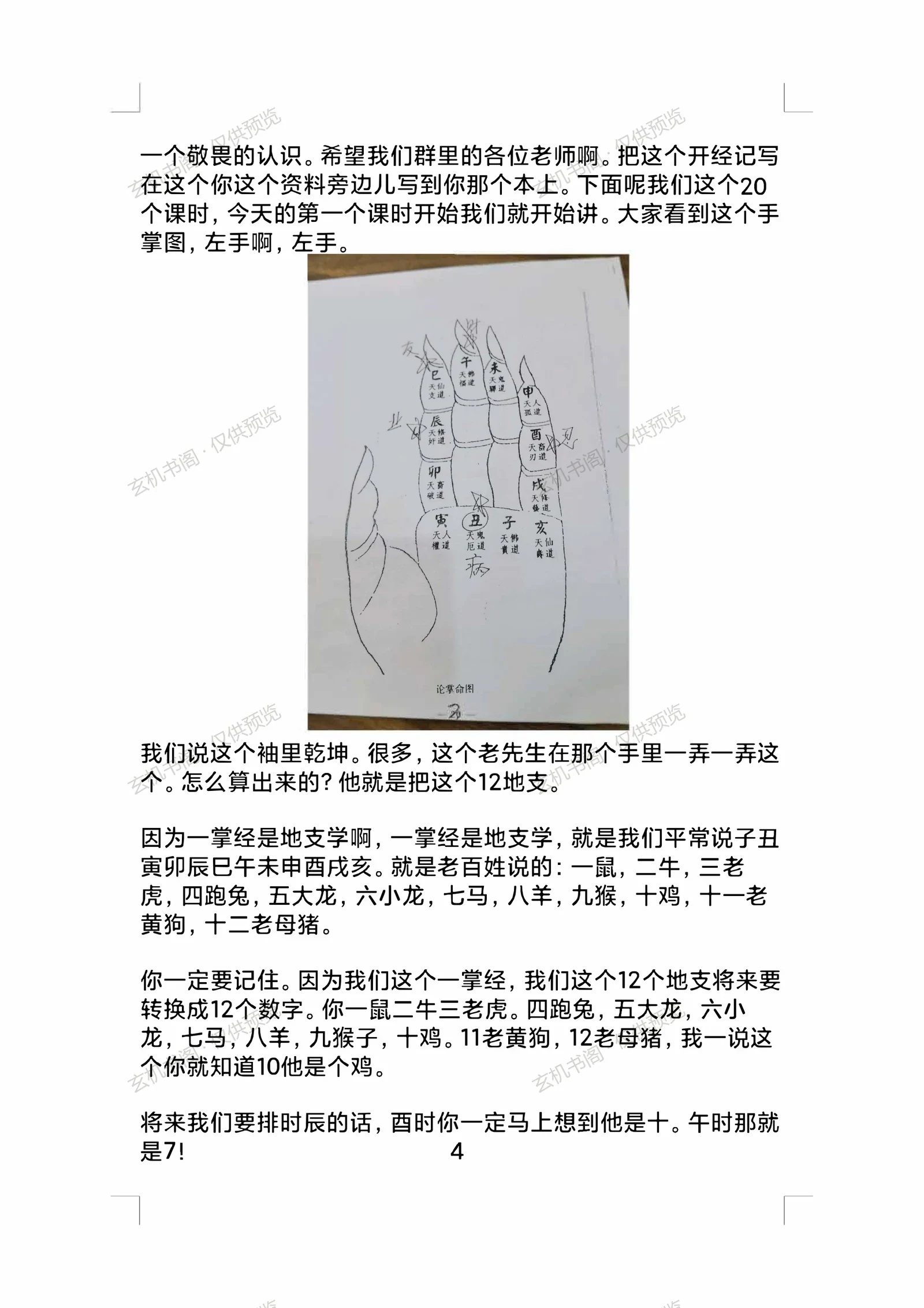
Left-hand twelve-branch chart and branch-to-number conversion
Six realms paired with the twelve branches
Twelve stars and substitute labels
Opposition pairs and case-based judgment
Key Points
Also called Shenji Lingshu; claims fast judgment without stems, solar terms or paper.
All work is done on a left-hand chart of the twelve branches converted to numbers.
Charts are set year-to-month, month-to-day, day-to-hour.
Six realms: Zi/Wu Buddha, Chou/Wei ghost, Yin/Shen human, Mao/You animal, Chen/Xu asura, Si/Hai immortal.
Twelve stars each govern a domain such as nobility, misfortune, authority, artistry.
Opposition pairs (e.g. Mao-You) are used to judge accidents and character.