Reading guide
Content guideOverview
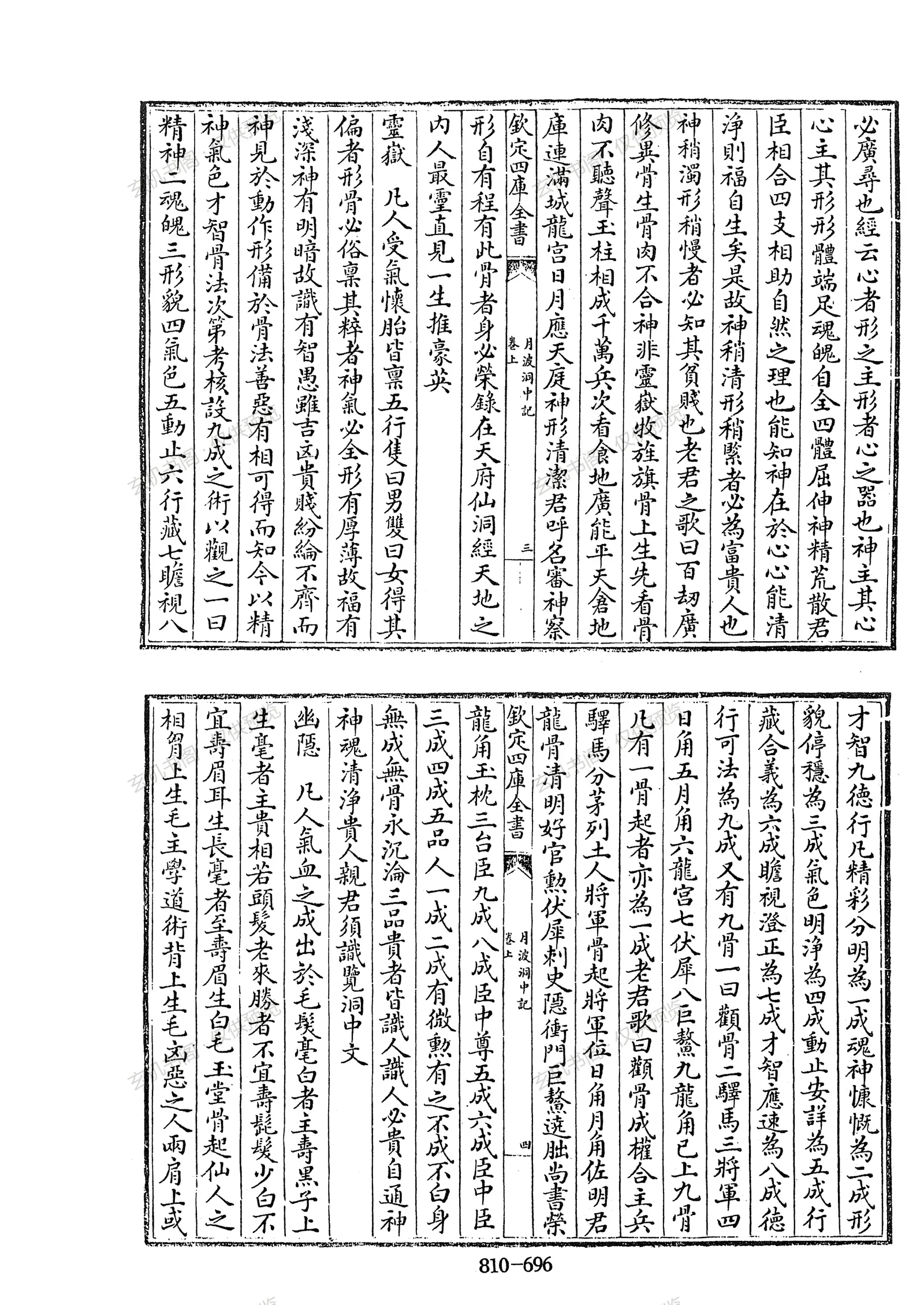
Yuebo Dongzhong Ji is a physiognomy work included in the Zibu (Masters) section, Shushu (Arts and Calculations) category of the Siku Quanshu, with no author named. The prefatory abstract cites Zheng Qiao's Tongzhi and the Songshi bibliography, noting editions of one and two juan, and relates the text to verses on physiognomy said to have been found on a stone wall at Yuebo Cave on Mount Taibai, grouping it with other physiognomy books such as Yuzhen and Shenyi Jing. The upper juan opens with a general discussion of reading a person: first observe the head and facial features, the Five Peaks and Four Waterways, then consider bone structure and complexion. It names nine bones, including the Sun-Horn, Moon-Horn, Dragon-Palace, Giant-Turtle, and Reclining-Rhino bones, explaining their locations and what they indicate about rank. It also gives mnemonic verses pairing facial regions, complexion, hair, voice, and bearing with judgments of honor, meanness, longevity, and early death. Written mostly in rhymed formulas with prose explanations, it represents the bone-reading branch of traditional physiognomy and is useful for studying classical physiognomical terminology and the Shushu texts in the Siku Quanshu.
Contents
Siku Quanshu abstract and original preface
Upper juan: general principles of physiognomy
The nine bones and their locations
Five Peaks, Four Waterways, and facial complexion
Verses on bone, flesh, spirit, hair, and voice
Examples and mnemonic verses on rank and lifespan
Key Points
Upper juan of the Siku Quanshu edition, in the physiognomy subdivision of Shushu.
Centered on bone physiognomy, listing nine bones and their fortunes.
Also discusses the Five Peaks, Four Waterways, complexion, spirit, voice, and hair.
The prefatory abstract traces its bibliography and the Mount Taibai cave legend.
Mostly rhymed mnemonic verses preserving early physiognomical terms.