Reading guide
Content guideOverview
This is an advanced textbook for Continued New Continent of Six Yao, attributed to Zhang De. After the cover and a biographical sketch of the author's path into Yijing studies, the text opens with 'Part One: Theoretical Supplement—The Root of Numerology,' then moves into a discussion of the 'useful god, world line, and palace-centered' theories. The author surveys three stages in the development of six-yao divination: the useful-god-centered approach, the world-line-centered approach, and the palace-centered approach. He criticizes classical methods for equating strength with good fortune and weakness with misfortune, and argues that the world-line-centered school never located the true taiji point, producing inconsistent methods for determining the strength of the world line. In response he proposes a palace-centered framework that reads the interaction between the useful god and the palace according to the taiji-yin-yang diagram. He describes his 'True Destiny Six Yao' system as a transformation of the New Continent system that incorporates classical techniques and makes advances in the conversion of four-value energies, the status of the palace, three-dimensional models of line interaction, original-image information, and the treatment of void, flying, advancing, retreating, and tomb storage. The book is aimed at readers who already know six-yao basics and wish to study palace-centered theory and classical method restoration in depth.
Contents
Cover and title page
Author Zhang De's biography and path into Yijing
Part One: Theoretical Supplement—The Root of Numerology
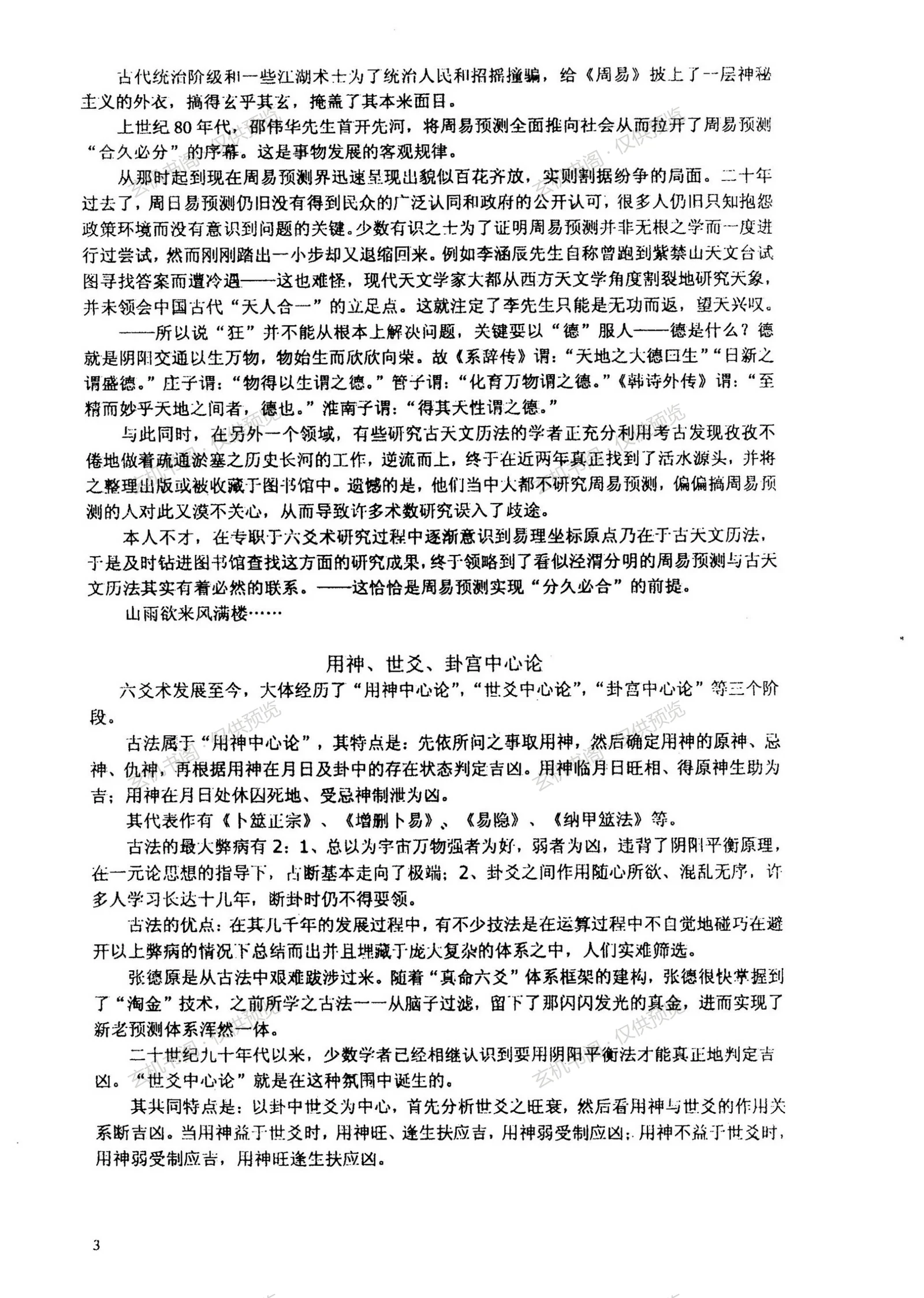
Views on the nature and origin of the Zhouyi
Three stages: useful god, world line, palace center
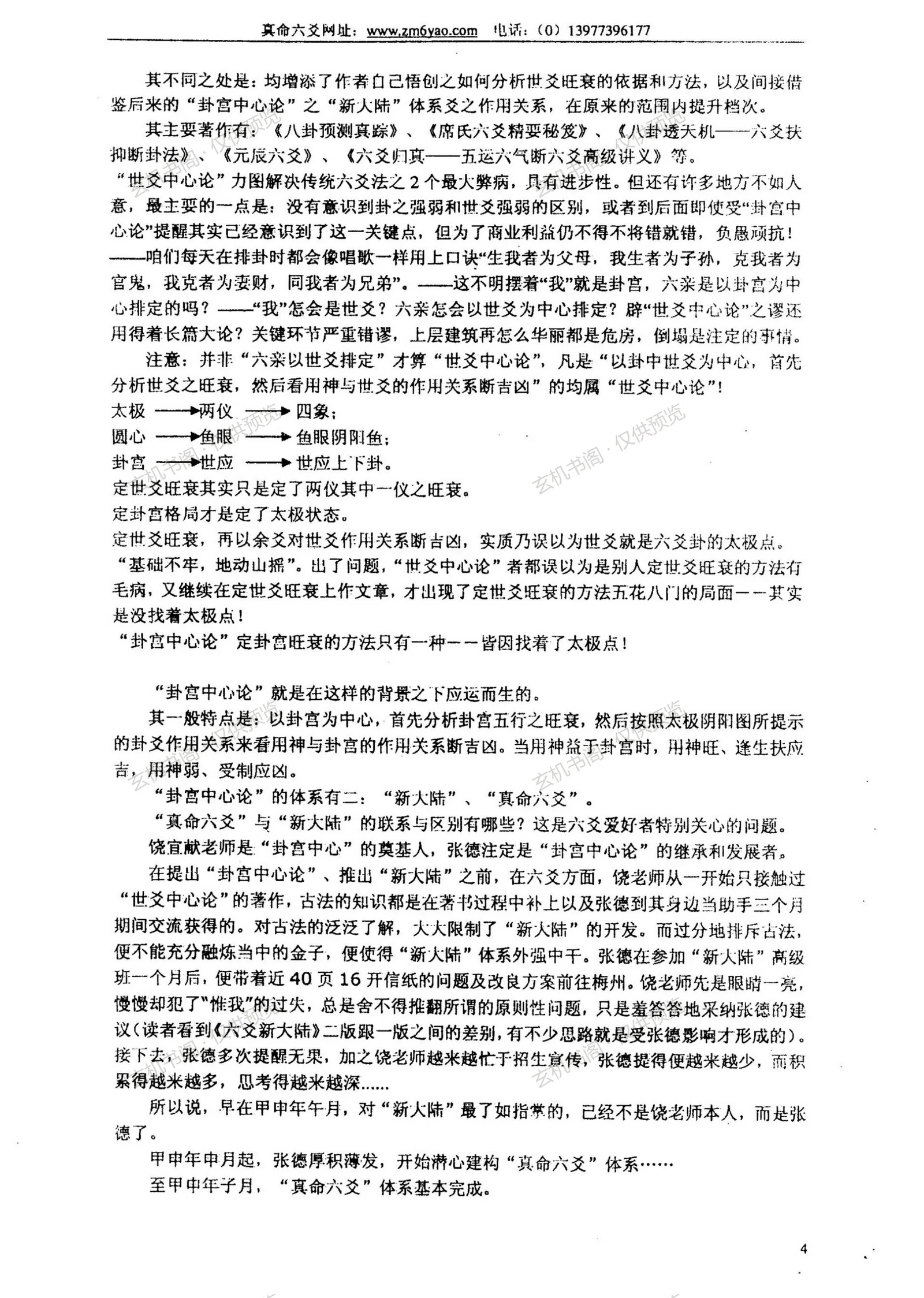
Palace-centered theory and its relation to New Continent
Advances of True Destiny Six Yao over New Continent
Author's statement and purpose in writing
Key Points
Traces three stages of six-yao theory: useful god, world line, palace center
Criticizes classical bias that strength is auspicious and weakness inauspicious
Argues the world-line school never found the taiji point
Proposes palace-centered judgment based on taiji-yin-yang relations
Claims True Destiny Six Yao integrates classical methods and advances four-value energy and three-dimensional line interaction
Treats mistaken hexagrams as a recording convention, not core technique