Reading guide
Content guideOverview
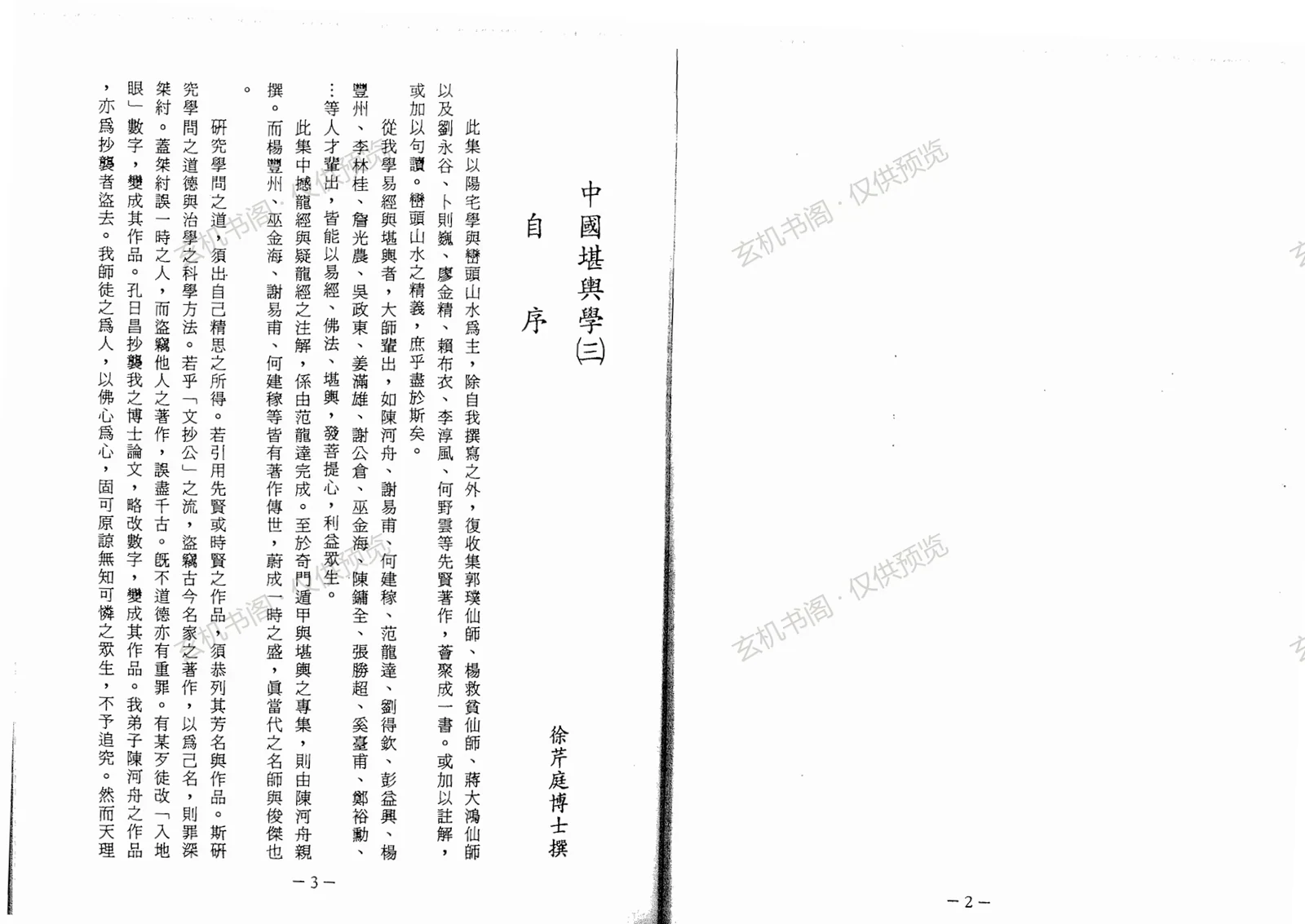
This is Volume 3 of Xu Qinting's Chinese Feng Shui Studies. Based on the table of contents and body text, this volume centers on yang-dwelling (yangzhai) theory. It opens with an introduction to yangzhai study, including its definition, scope, and study sequence, then proceeds to the division of the East-West four lives and the four auspicious and four inauspicious directions. It explains the mapping of the eight trigrams onto the nine palaces, methods for calculating East and West four lives, the three essentials of yangzhai (door, main hall, stove), and the auspiciousness and timing of the nine stars. The text includes diagrams of the eight trigrams and nine palaces, and cites classical yangzhai works such as the Jinguang Doulin Jing and Bazhai Mingjing, representing a systematization of the Eight Houses school. The author stresses in the preface that feng shui study should be grounded in classics and respect original authorship. The book suits readers with basic knowledge of yangzhai feng shui who wish to study traditional texts systematically.
Contents
Introduction to yangzhai study: definition, scope, sequence
East-West four lives and four auspicious/inauspicious
Eight trigrams and nine palaces; calculating four lives
Three essentials of yangzhai: door, main hall, stove
Nine stars: auspiciousness and timing
Classical citations and diagram analysis
Key Points
This volume focuses on yangzhai using the East-West four lives framework.
Explains eight-trigram nine-palace mapping and four-lives calculation.
Emphasizes the three essentials: door, main hall, and stove.
Cites classics such as Jinguang Doulin Jing and Bazhai Mingjing.
Includes diagrams of the nine palaces and four-lives trigram mapping.