Reading guide
Content guideOverview
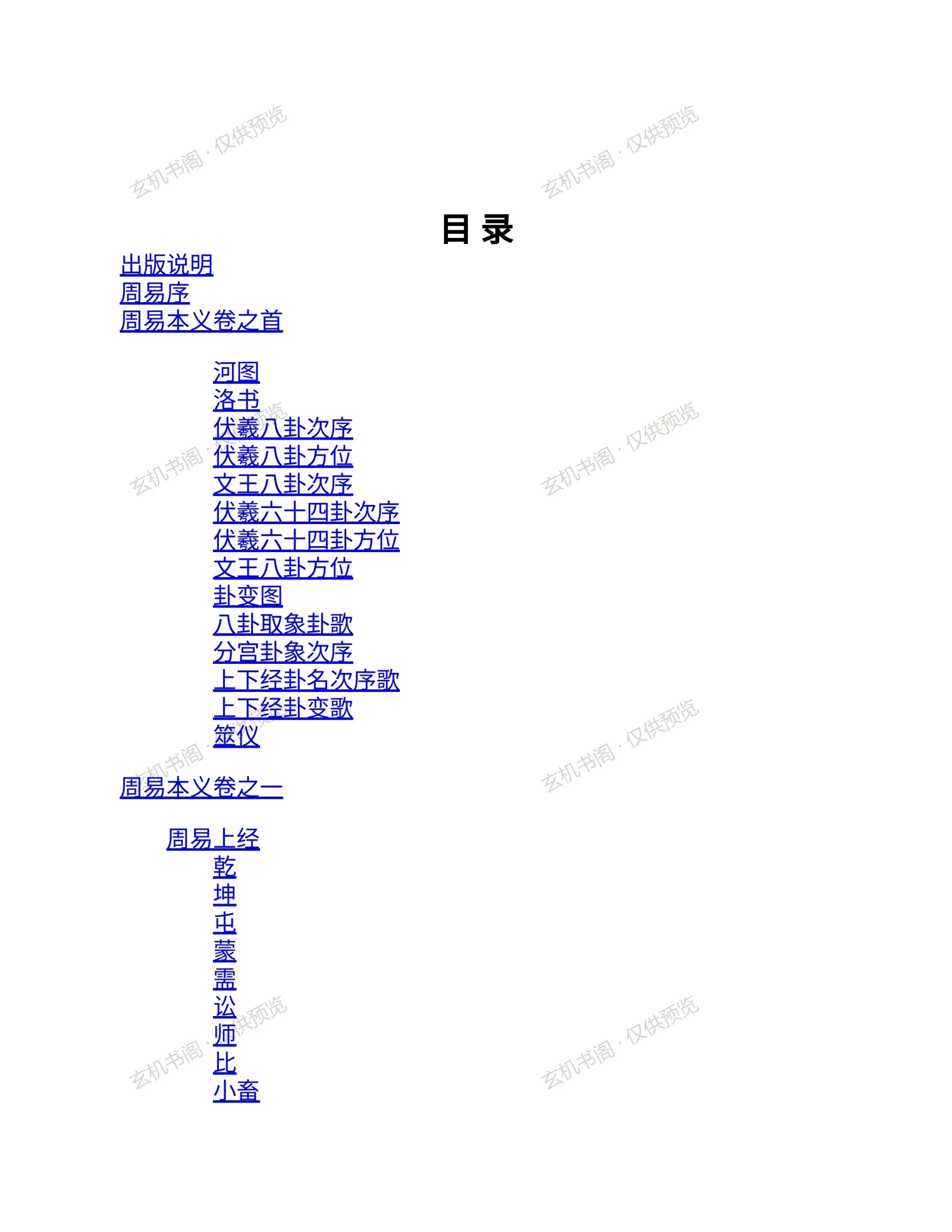
This is a modern edition of Zhu Xi's Zhouyi Benyi (The Original Meaning of the Zhouyi). The cover and copyright page identify the author as Zhu Xi of the Song dynasty and the editor as Ke Yu, published by Central Compilation & Translation Press. The introduction explains that the work, first titled Yi Benyi, took Zhu Xi more than twenty years to complete and once served as a standard text for the civil examinations. Following Lü Zuqian's Old Zhouyi edition, it keeps the classic and the commentaries separate, comprising twelve fascicles. The table of contents shows a publisher's note, a preface to the Zhouyi, and the opening fascicle, which gathers the Hetu, Luoshu, the sequences and directions of Fuxi's and King Wen's eight trigrams, the sequence and directions of Fuxi's sixty-four hexagrams, the hexagram-change diagrams, mnemonic verses on the images and names of the hexagrams, and the divination ritual. The first fascicle covers the upper classic, beginning with Qian and Kun and continuing through Zhun, Meng, Xu, Song, Shi, Bi, and Xiaoxu.
Contents
Publisher's note
Preface to the Zhouyi
Opening fascicle: Hetu, Luoshu, and the sequences of the trigrams
Hexagram-change diagrams and image verses
Mnemonic verses on hexagram names and changes
Divination ritual
Fascicle one: the upper classic, Qian through Xiaoxu
Key Points
Zhu Xi's commentary separates the classic from the commentaries and is a representative work of Song-dynasty Yijing scholarship.
The opening fascicle collects the Hetu, Luoshu, the sequences and directions of the trigrams, and hexagram-change diagrams.
Mnemonic verses on hexagram images, palace sequences, and hexagram names aid memorization.
Fascicle one explains the upper classic starting from Qian and Kun.