Reading guide
Content guideOverview
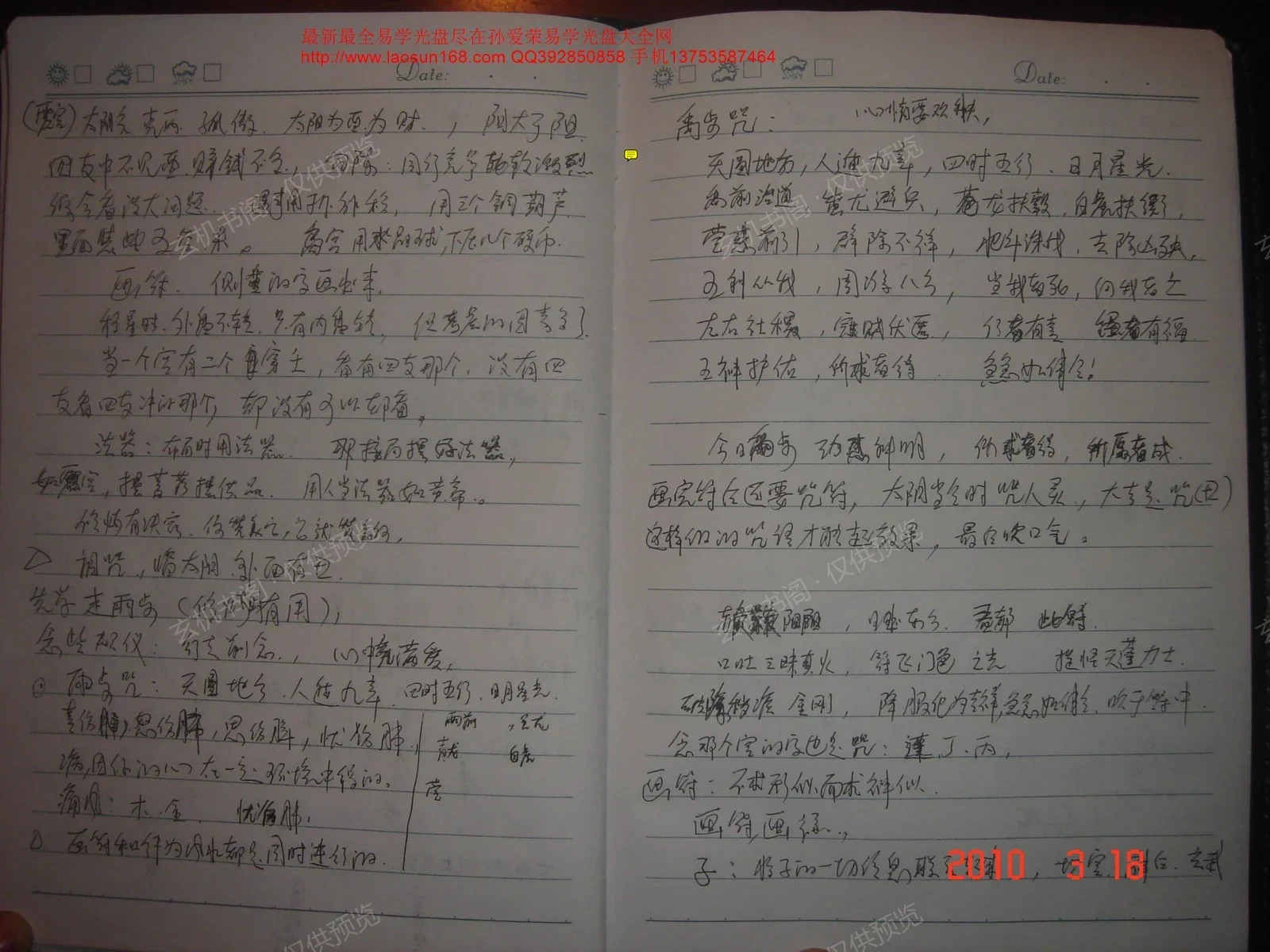
These six double-page scans record lecture notes from Wang Fenglin's ritual Qimen (Qimen Dunjia) class held March 16–18, 2010. The notes focus on the eight gates—Rest, Life, Harm, Delusion, Scenery, Death, Fright, and Open—their palace placements, auspicious or inauspicious readings, and how to identify and remedy 'broken gates' and 'gate oppression.' Examples include Rest Gate falling in the Qian palace with water stems and Life Gate being constrained in the Zhen palace. The notes also map the twelve spirits onto body locations such as the Dazhui, Mingmen, Yuzhen, and Baihui points, and describe talisman drawing, incantations, and offering rituals. The handwriting is dense and heavily abbreviated, making it a working classroom record best suited to readers who already know Qimen fundamentals.
Contents
General principles of ritual Qimen: yin-yang dun and patterns
Eight gates in the palaces: auspiciousness and broken gates
Remedies for gate oppression: useful gods, clashes, combinations, filling
Twelve spirits and their body correspondences
Talisman drawing, incantations, and offering rituals
Key Points
Judging whether a gate is broken is central to choosing the useful god and timing
Broken gates can be remedied by clash, combination, filling, or mediation
The twelve spirits map to body locations for diagnosis and layout
Talismans require head, body, and foot components coordinated with incantations
Ritual Qimen stresses intent, sincerity, and offerings, not technique alone