Reading guide
Content guideOverview
This is an annotated edition of Ba Zhai Ming Jing, part of a series on ancient Chinese geomancy. The content summary presents it as a renowned work devoted to yang dwellings and a cornerstone of the Eight Mansions school, which arose in the Tang and flourished in the Song. The preface outlines four core themes: a person's birth-year destiny, mapped to the eight trigrams and divided into east-four and west-four destinies; the three eras, each of sixty years for a total of 180, used to fix the timing and orientation of a house; the emphasis on doors and stoves, with the door as the household's qi and the stove as its food spirit, to be oriented toward auspicious directions and against inauspicious ones according to the owner's destiny; and the stress on marriage and offspring, with matches judged by compatible birth years. Diagrams such as the chen-south-xu-north dividing chart illustrate the grouping of the twenty-four mountains. The annotated edition preserves the original text while explaining its framework and methods, making it a useful reference for studying the Eight Mansions school.
Contents
Content summary: origins and standing of the Eight Mansions school
Preface: destiny, three eras, doors and stoves, marriage and offspring
Eight birth-year destinies and the east-four/west-four division
Three eras and the spatiotemporal basis for house orientation
Principles for aligning doors, stoves and auspicious directions
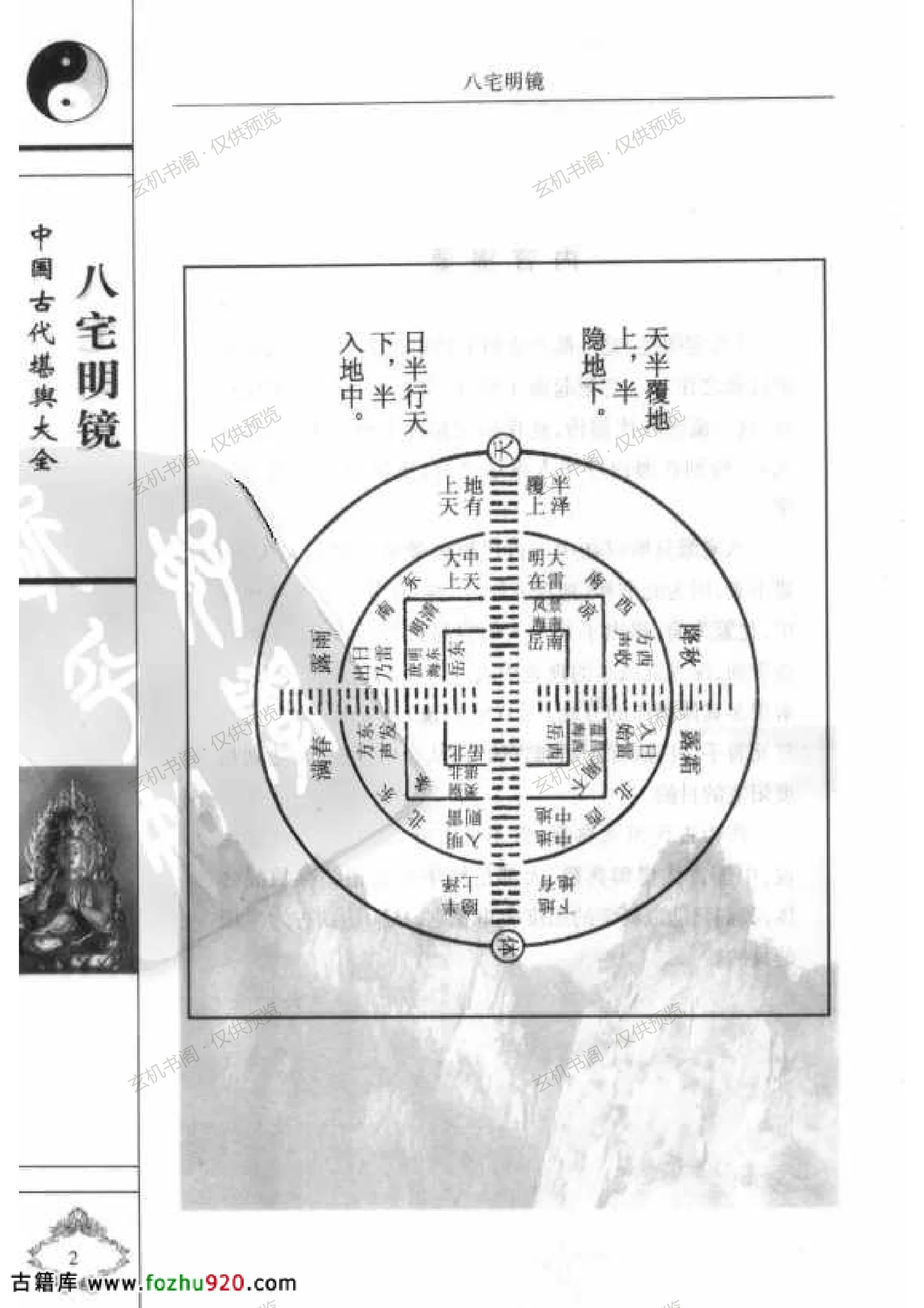
Diagrams such as the chen-south-xu-north dividing chart
Key Points
The Eight Mansions school focuses on yang dwellings, rising in the Tang and flourishing in the Song
Birth-year stems and branches are mapped to the eight trigrams, giving east-four and west-four destinies
Each of the three eras lasts sixty years, 180 in total, as a basis for siting
The door is the qi spirit and the stove the food spirit, oriented toward auspicious and away from inauspicious directions
Marriage and offspring are stressed, with compatibility judged by birth years