Reading guide
Content guideOverview
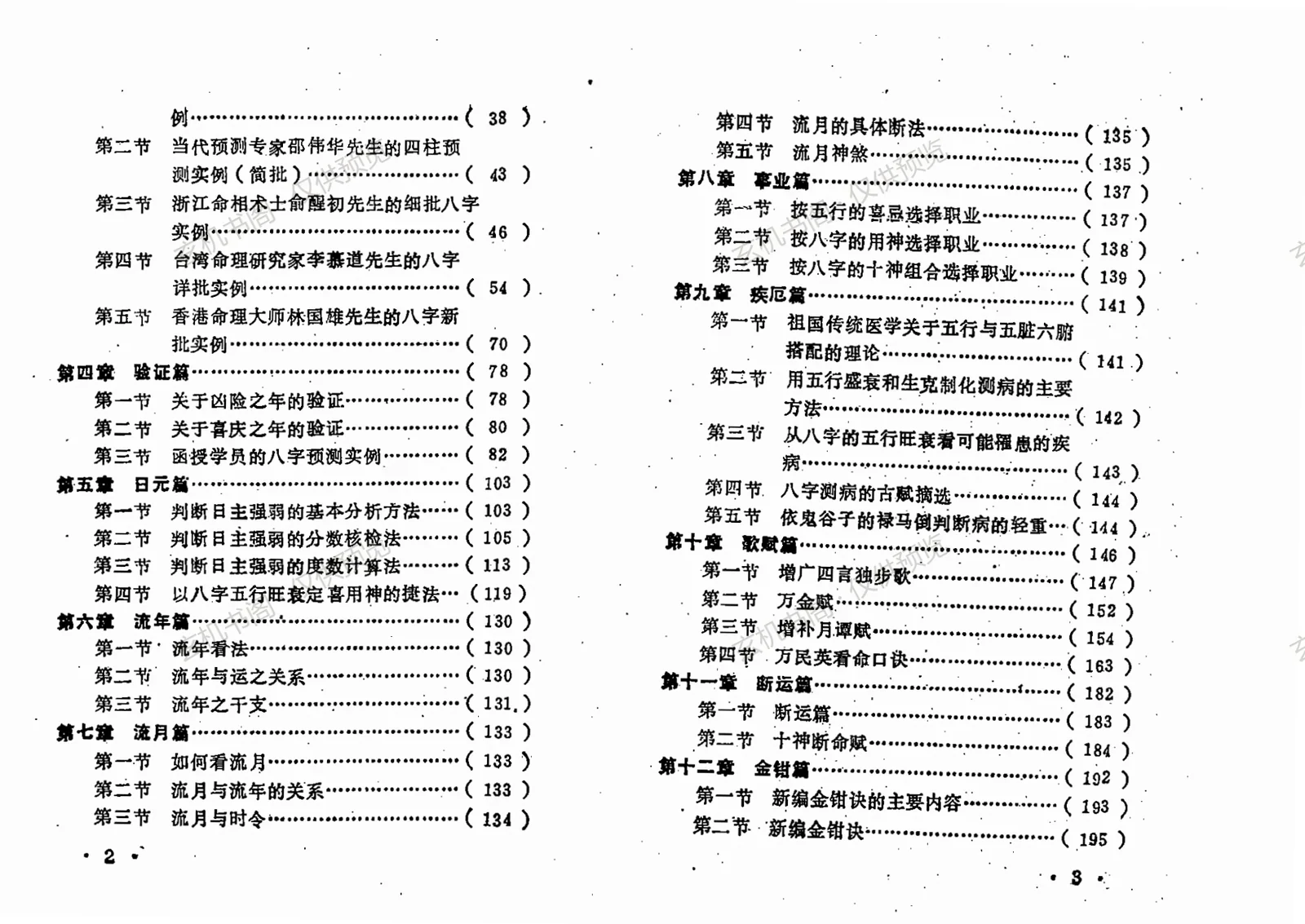
This is Wang Jihou's advanced teaching manual for Four Pillars of Destiny (BaZi), labeled as an advanced class text. The visible table of contents divides the work into twelve chapters. Chapter 1, on destiny adjustment, discusses changing names, regional directions, residential feng shui, interpersonal relations, causality, the power of intention, auspicious objects, mantras and talismans, and biorhythms. Chapter 2 reviews famous Ming and Qing命理 writers such as Wan Minying, Ren Tieqiao, Xu Wuxu, Yuan Shushan, and Wei Qianli through their self-assessments and case notes. Chapter 3 presents chart interpretations by contemporary and Hong Kong/Taiwan命理 practitioners including Hong Pimo, Shao Weihua, Yu Xingchu, Li Mudao, and Lin Guoxiong. Chapter 4 verifies predictions for inauspicious and auspicious years and correspondence-course student cases. Chapter 5 addresses day-master strength, scoring and degree-based calculation, and useful-god selection. Chapters 6 and 7 explain annual and monthly cycle judgment. Chapter 8 matches careers to five-element preferences, useful gods, and ten-god combinations. Chapter 9 links Five Elements to internal organs and illness diagnosis, including ancient methods. Chapter 10 collects mnemonic verses and old formulas; Chapter 11 covers fortune-cycle judgment with ten-god verses; Chapter 12 presents a newly compiled Jin Qian formula. The book is practical and case-oriented, suited to readers with basic BaZi knowledge who want to strengthen chart reading and useful-god skills.
Contents
Destiny adjustment: names, directions, feng shui, intention
Case highlights: Wan Minying, Ren Tieqiao, Xu Wuxu
Practical examples: Hong Pimo, Shao Weihua, port-area masters
Verification: bad years, good years, student cases
Day master: strength analysis and useful-god selection
Annual and monthly cycles: concrete judgment methods
Career, illness, and mnemonic verses
Fortune cycles and the new Jin Qian formula
Key Points
Organized as an advanced class textbook with clear sections.
Nine adjustment methods include naming, direction, feng shui, and talismans.
Quotes many classical and modern chart cases across regions.
Day-master strength includes scoring and degree-based methods.
Career, illness, and annual/monthly cycles use practical old formulas.