Reading guide
Content guideOverview
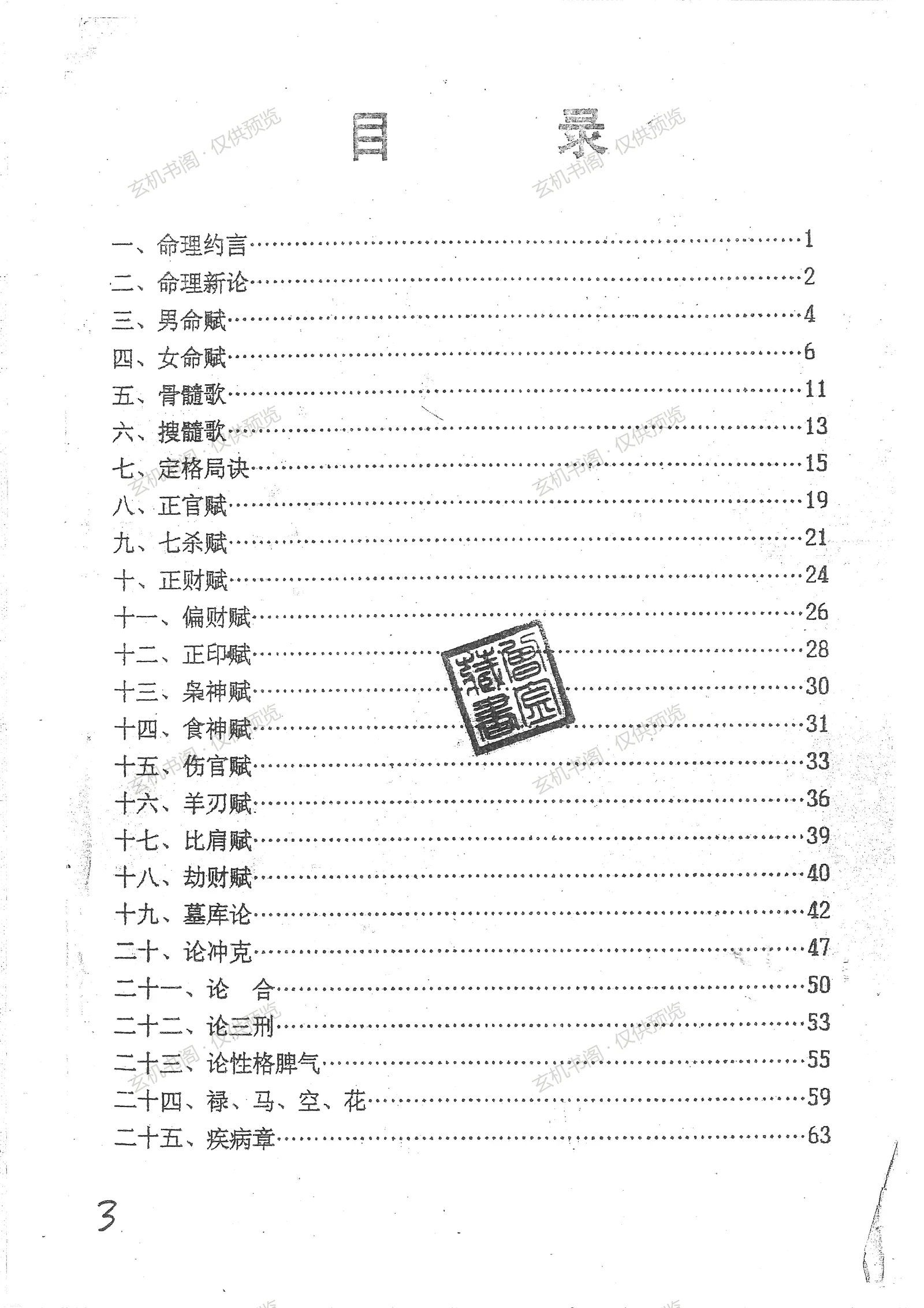
The cover reads Zeng Gong Feng Shui, with the subtitle 'Post-Heaven Three-Element Geography and Day Selection, Peerless Under Heaven, Volume 34', and the central title Mingli Zhengjue (Correct Formulas of Fate Analysis), attributed to Zeng Jinquan and published by the Zeng Gong Feng Shui Culture Research Association. The table of contents lists 25 sections. The first seven cover general principles: brief sayings on fate, new discussions, male and female fate rhapsodies, marrow and marrow-searching songs, and a formula for fixing patterns. These are followed by rhapsodies on each of the ten gods—Direct Officer, Seven Killings, Direct and Indirect Wealth, Direct Seal, Owl God, Food God, Wounding Officer, Yang Blade, Friend and Rob Wealth. The closing sections turn to tomb-storehouses, clashes, combinations, three punishments, temperament, the lu-ma-kong-hua markers, and illness. The opening text argues that reading fate rests on generation, restriction, support and suppression, and urges readers to discard superstition while keeping what is useful. It is a traditional Four Pillars reader laced with oral-formulaic verse and a strong lineage flavor, suited to readers already familiar with the ten gods and patterns.
Contents
Brief sayings and new discussions on fate
Rhapsodies on male and female fate
Marrow songs and marrow-searching songs
Formula for determining patterns
Rhapsodies on the ten gods
Tomb-storehouses, clashes, combinations, three punishments
Temperament and the lu-ma-kong-hua markers
Chapter on illness
Key Points
Generation, restriction, support and suppression are the master method; first assess strength and flow.
Each of the ten gods receives its own rhapsody with character and application notes.
Four parts fate, six parts human effort; environment and circumstance matter.
The final chapters extend into clashes, punishments and illness judgment.
The text carries a lineage flavor tied to Three-Element geography and day selection.