Reading guide
Content guideOverview
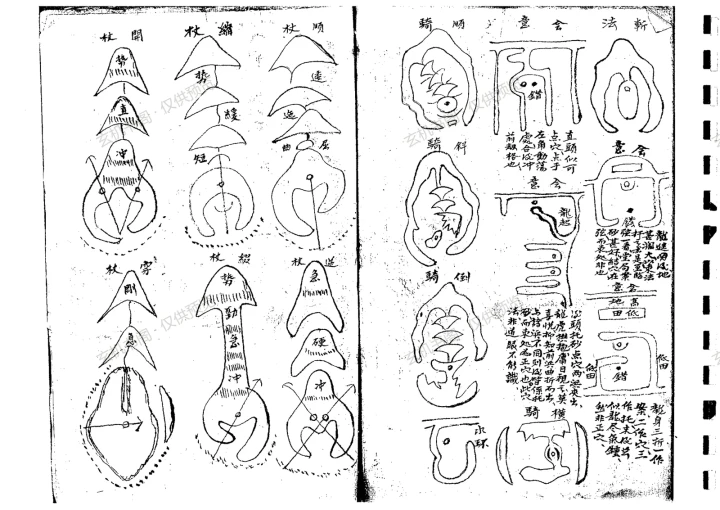
This volume contains books five and six of Zeng Gong's Feng Shui: Relief for the Poor, attributed to Zeng Jinquan and published by the China Heluo Yijing Academy research association. The preface traces the lineage to Zeng Wenchang of Jiangxi and presents the material as secret teaching on Three-Element (Sanhe) feng shui and day selection, aimed at ordinary households. Book five sets out methods for yin and yang dwellings: identifying dragons and spotting the acupoint, classifying the twenty-four mountains into eight great dragon forms, five-element and nine-star dragon forms, and judging whether dragons advance straight or pause when mutually generating. It discusses ponds and pools as star plates on the dragon body, round mounds as seals, spear-like formations as military acupoints, and the placement of bright halls, embracing sand, three terraces, water-mouth star rocks and the gates of heaven and earth, with star names such as Purple Qi, Sun and Julmen invoked to judge rank and wealth. The table of contents for book six lists day-selection sections: Yanqin celestial day lessons, Sun-and-Moon (Wutu Taiyang) celestial day lessons, Three-Element Undefeated day lessons, Heavenly King Star day lessons, immortal-response day lessons, Later Heaven sixty-four hexagram day lessons and lineage-transmitted auspicious lessons. The style is aphoristic and formulaic, best suited to readers already familiar with Sanhe feng shui and traditional day selection.
Contents
Preface: origins of the Zeng family feng shui and day selection
Introduction: ancient strategists and feng shui predictions
Book 5: methods for yin and yang dwellings
Dragon recognition and the eight, five-element and nine-star dragon forms
Dragon-body star plates, seals, bright halls and sand-water
Book 6 contents: Yanqin and Wutu Taiyang day lessons
Three-Element Undefeated, Heavenly King Star and immortal-response lessons
Later Heaven sixty-four hexagram lessons and lineage-transmitted auspicious lessons
Key Points
Presented as the Zeng Wenchang lineage oral tradition, a folk manuscript-style text
Book 5 focuses on dragon-spotting and form-school sand-water patterns for dwellings
Stresses eight great dragon forms, five-element and nine-star dragons and their stopping rules
Book 6 shifts to day selection, including Yanqin, Wutu Taiyang and Three-Element Undefeated methods
Written largely as aphorisms and judgment formulas rather than systematic theory