Reading guide
Content guideOverview
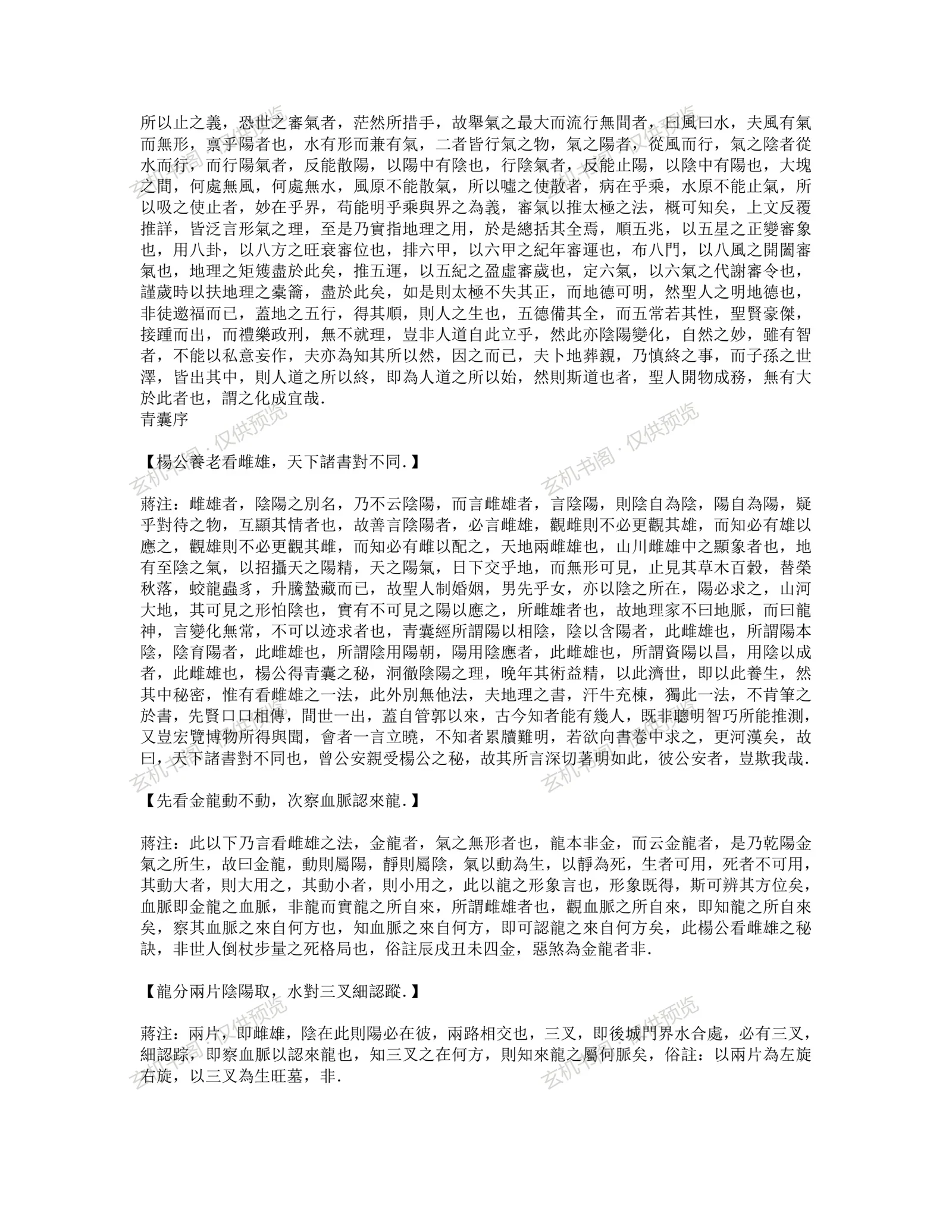
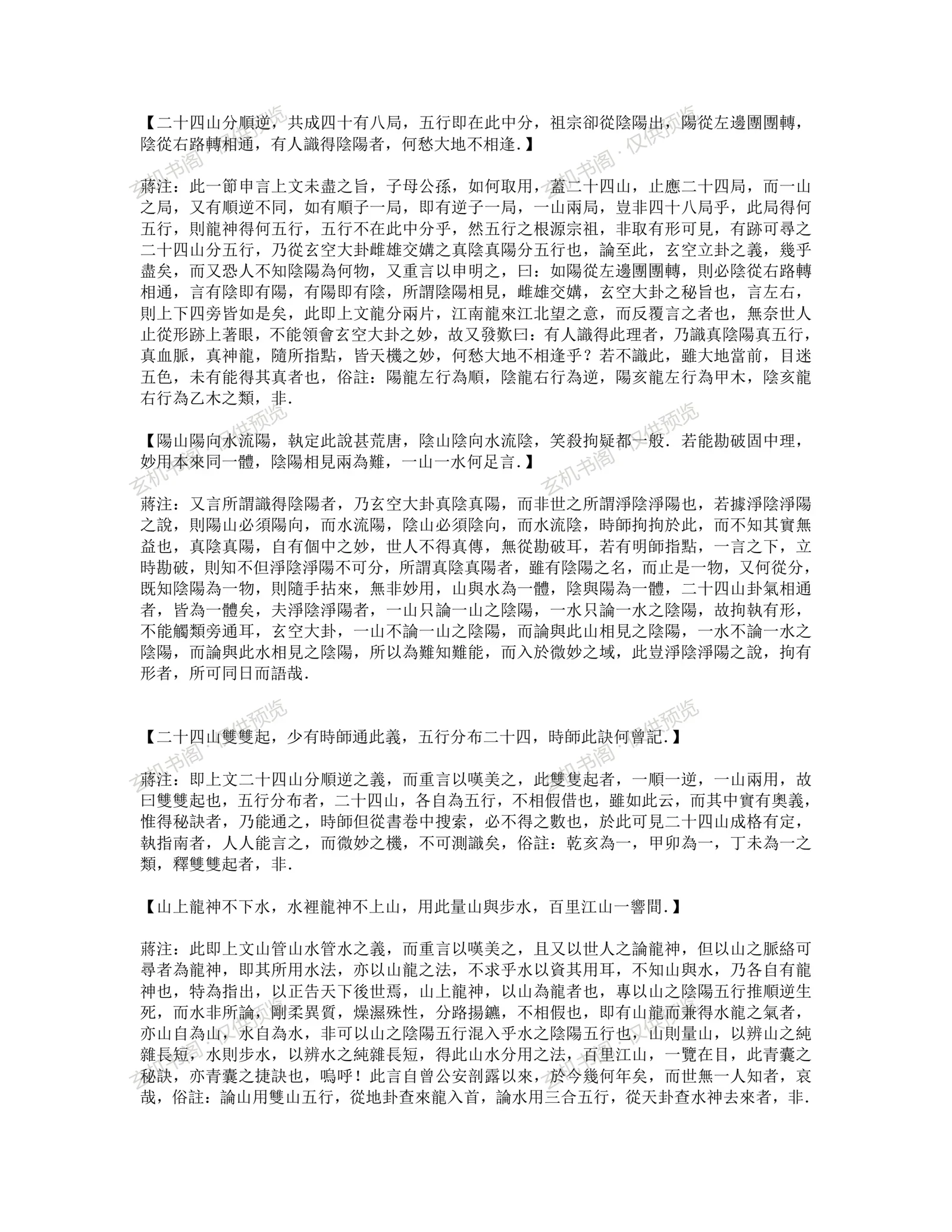
This text presents Jiang Dahong's commentary on the three volumes of the Qingnang Jing as included in Dili Bianzheng. The upper volume opens with the paired principles of Heaven and Earth, odd and even, and uses Hetu-Luoshu numbers and the earlier and later Bagua arrangements to explain the circulation of yin and yang qi, the mutual rootedness of opposites, and the generation of the Five Phases. The middle volume turns to visible forms, linking celestial patterns, mountains and rivers, the twenty-eight lunar mansions, and the seven governors to the principle of 'observing qi through form.' The lower volume grounds the discussion in the Wuji and Taiji, the four orientations and eight directions, inner and outer qi, and the practical rules of riding the wind and gathering water. The Qingnang Xu then introduces the Yang Gong method of 'looking at male and female' as a metaphor for yin and yang, discussing the movement of the golden dragon, incoming dragon vessels, and the two pieces and three forks. It is a core theoretical text of the Xuan Kong school of feng shui.
Contents
Upper volume: Qingnang Jing text and Jiang's commentary on Hetu-Luoshu numerology
Middle volume: celestial patterns, twenty-eight mansions, and observing qi through form
Lower volume: Wuji-Taiji, four orientations, inner and outer qi, riding wind and water
Qingnang Xu: Yang Gong's male-female method and identifying dragon vessels
Formulas on golden dragon movement, two pieces and three forks, and river directions
Twenty-four mountains, forward and reverse arrangements, and forty-eight configurations
Key Points
Explains yin-yang pairing and Five Phase generation through Hetu-Luoshu numbers
Gives equal weight to earlier and later Bagua, stressing mutual rootedness of yin and yang
The middle volume derives feng shui logic from celestial and terrestrial forms
The lower volume turns to practical rules of orientation, inner-outer qi, wind and water
The Qingnang Xu uses male-female language to teach dragon identification