Reading guide
Content guideOverview
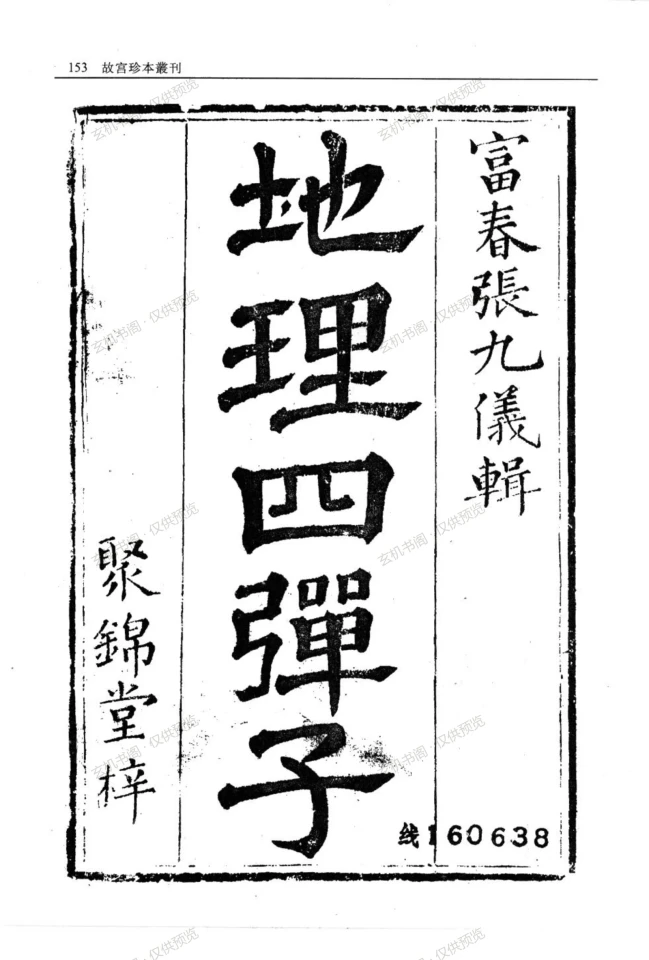
This work by Wang Miaoda (style name Ruoyuan), written in the Republican period, is a commentary on Jiang Dahong's Dili Bianzheng. Three prefaces by Ma Zhanweng, Deng Yufen and the author explain its origins: Wang received the star-and-trigram oral formulas of the Zhao Liancheng lineage of Wuning, and after more than forty years of study sought to clarify the hidden instructions on tonggen, paigua, aixing and tuiyun that Jiang left unexplained. The book follows the five divisions of the original: the Qingnang Jing, Qingnang Xu, Qingnang Aoyu, Tianyu Jing and Dutian Baozhao Jing. Each passage of scripture is followed by a detailed exposition grounded in the Hetu and Luoshu, the former and later heaven trigrams, yin-yang parity and the generating and completing numbers of the five phases. A prefatory section on reading method stresses fixing the sitting mountain, tracing the root, arranging the trigrams and stars, and then applying the cycles, making the volume a key to San Yuan Xuan Kong geomantic theory.
Contents
Prefaces by Ma, Deng and the author on origins and lineage
Reading method and the aim of correcting heterodoxy
Volume 1: commentary on the Qingnang Jing
Volume 2: passage-by-passage commentary on the Qingnang Xu
Volume 3: exposition of the Qingnang Aoyu
Volume 4: star arrangement and cycles in the Tianyu Jing
Volume 5: form and qi in the Dutian Baozhao Jing
Key Points
Follows the five texts of Jiang Dahong's Dili Bianzheng verse by verse
Draws on the Zhao Liancheng lineage and the Hunan school of Liu Zhi'an
Sets out the order of tonggen, paigua, aixing and tuiyun
Grounds argument in Hetu, Luoshu, yin-yang parity and five-phase numbers
Stresses mutual response of qi and the unity of form and qi