Reading guide
Content guideOverview
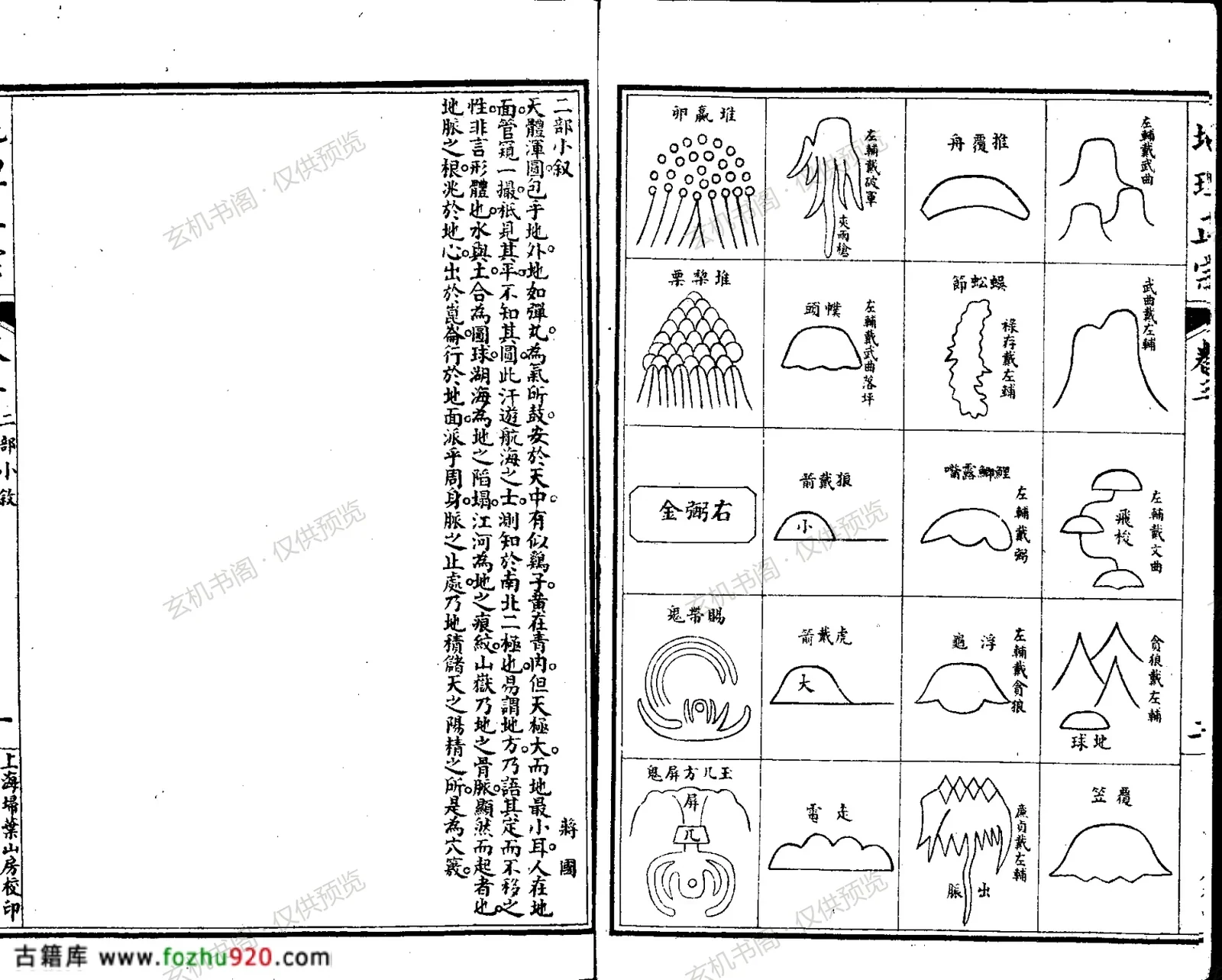
This is the upper part of the third fascicle of Dili Zhengzong, titled Longjing (The Dragon Classic). It belongs to the xingshi (landform) school of fengshui. The first half presents full-page grid diagrams such as the 'Hanlong Nine Stars Chart,' mapping peak forms to the nine stars—Tanlang, Jumen, Wuqu, Lucun, Lianzhen, Po Jun, and others—along with their auspicious and inauspicious variants, plus diagrams of Wenqu water and Fubi earth. Small annotations mark 'true form,' 'transformed form,' 'broken army,' 'bearing wealth,' and 'bearing sha,' making the charts useful for identifying forms at a glance. The second half turns to the Longjing text itself, with sections such as 'General Discourse,' 'Wall Enclosure,' and 'Tanlang Chapter,' discussing how dragon veins issue from ancestral mountains, pass through curtains and narrows, shed and transform, and finally form an穴. The text stresses that the nine stars must be judged together with the whole dragon body, the穴 star, and surrounding sand and water, not by a single peak. Written in classical Chinese with dense terminology, the diagrams and text serve as mutual evidence, making it a reference for studying the Yang Gong landform tradition and nine-star terminology.
Contents
Hanlong Nine Stars Chart: Tanlang, Jumen, Wuqu and other peak forms
True and transformed nine-star forms, Po Jun, bearing wealth and sha
Diagrams of Wenqu water, Fubi earth, and sand-water forms
General Discourse: ancestral mountains, transformation, and穴 formation
Wall Enclosure: Northern Dipper, celestial stars, and enclosure formation
Tanlang Chapter: true forms, variants, and auspicious/inauspicious identification
Jumen Chapter: true forms, combined forms, and穴 star appraisal
Key Points
Grid diagrams visually map nine-star peaks and sand-water forms for easy form identification.
The text stresses that dragon veins must issue from ancestral mountains and undergo curtain-passing, narrow-passing, and transformation before forming an穴.
Nine-star auspiciousness depends on the whole dragon body and穴 star, not on isolated forms.
Recurrent variants such as 'bearing wealth,' 'bearing sha,' and 'broken army' are key to distinguishing true from false.