Reading guide
Content guideOverview
This is the fifth lesson of a feng shui course, centered on using the luopan and measuring orientation. It begins by noting that for yang dwellings one only needs the eight trigrams and twenty-four mountains, not the many rings of the compass, and uses a Mao-mountain west-facing house to explain how sitting and facing directions map onto east and west. It then discusses precision in feng shui: each trigram spans 45 degrees and each mountain 15 degrees, while finer divisions to 3 or 1 degree would require an impractical number of verified cases. The lesson introduces magnetic declination, explaining that the compass points to magnetic north rather than true north, that declination varies by region and changes yearly, and gives Shanghai as an example at about five degrees west. It traces the history of the luopan, noting it appeared only in the Song dynasty, while earlier periods used the earth gnomon and sundial shadow methods, citing the Rites of Zhou and other texts. It warns that steel, concrete and electromagnetic fields in modern buildings distort readings, so one should measure the whole building from an open area downstairs and convert to the apartment's orientation. It closes with the Hetu and Luoshu, identifying the Hetu's four-direction interlace as the basis of form schools and the Luoshu nine palaces as the basis of liqi schools.
Contents
Luopan and twenty-four mountains basics
Reading sitting and facing: the Mao-west example
Precision in feng shui and case verification
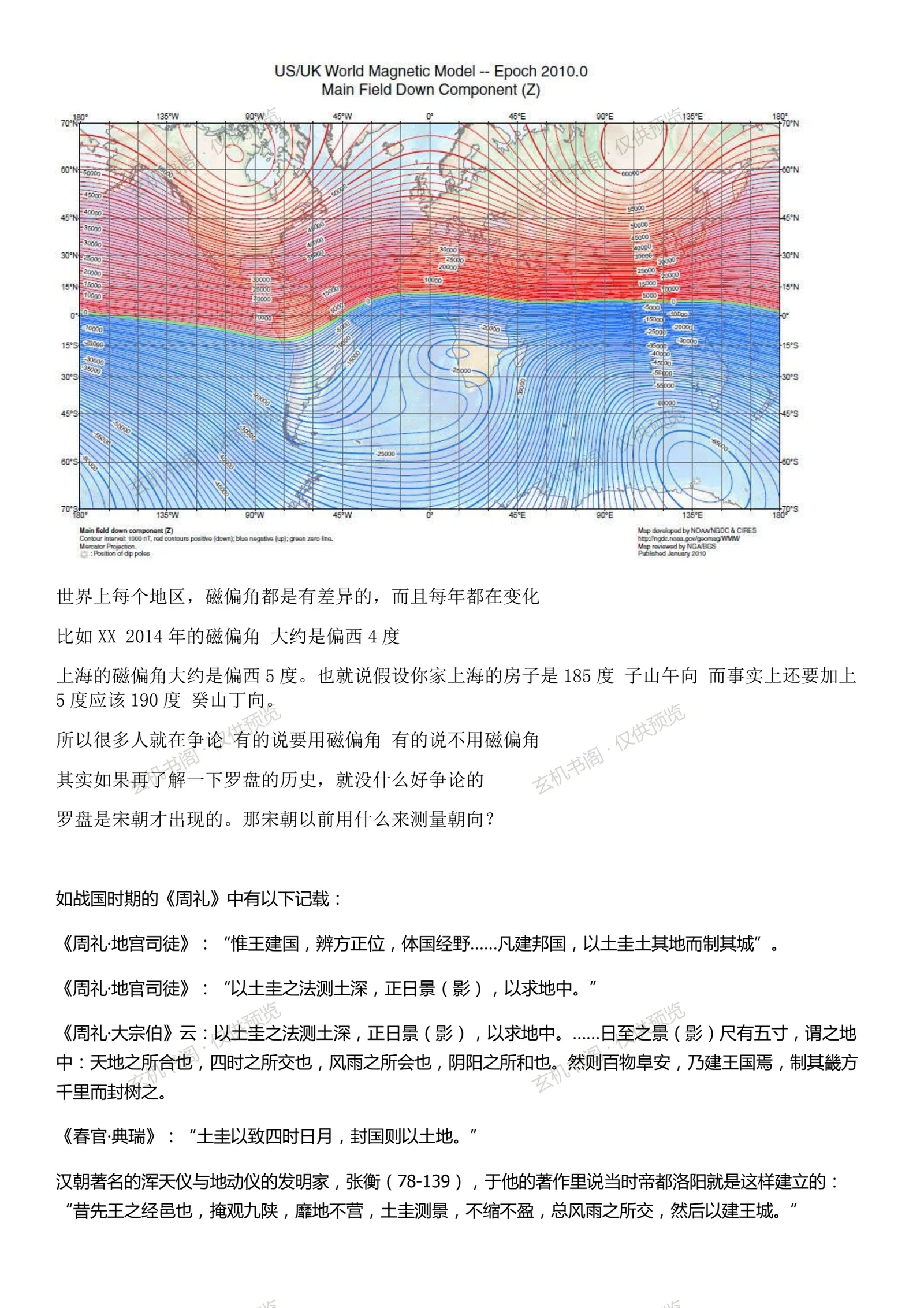
Magnetic declination and true versus magnetic north
Earth gnomon orientation and classical citations
History of the luopan and needle correction
Measuring in modern buildings
Hetu, Luoshu and the form-liqi foundation
Key Points
For yang dwellings, the eight trigrams and twenty-four mountains suffice; the many compass rings need not intimidate.
A Mao-west house sits east and faces west; sitting and facing must be mapped quickly to directions.
Magnetic north differs from true north by declination, which varies by place and over time and must be corrected.
The luopan appeared in the Song dynasty; earlier orientation relied on the earth gnomon and sun shadows.
Modern buildings distort compass readings; measure the whole building from an open area and convert.
The Hetu underlies form schools; the Luoshu nine palaces underlie liqi schools.