Reading guide
Content guideOverview
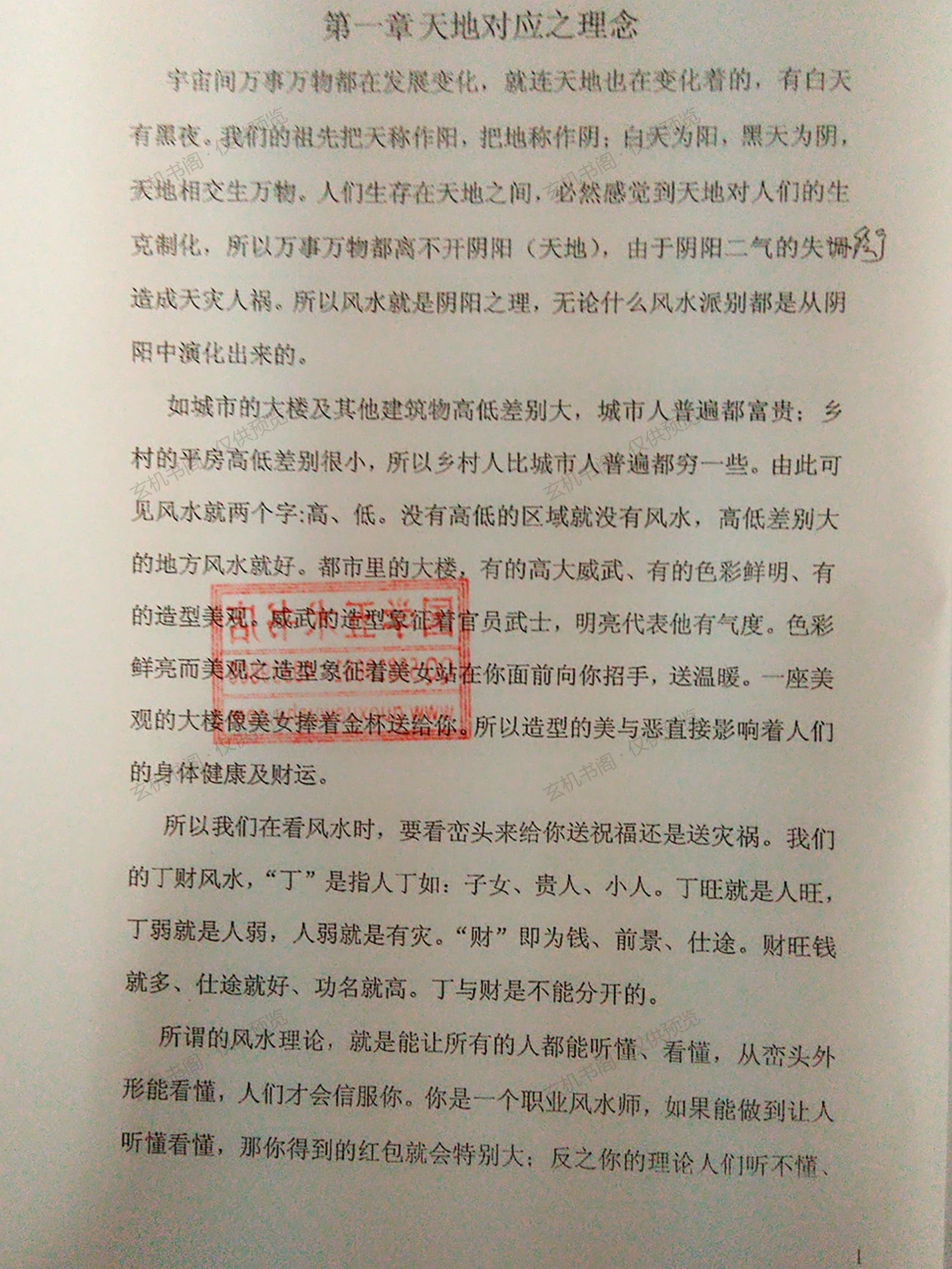
Attributed to Su Zhigang and marked on the cover as internal material not for circulation, this book is a practical guide to form-school (xingluan) feng shui. Its central pair is ding and cai: ding covers people, children, benefactors and petty rivals, while cai covers money, prospects and official career, and the two are treated as inseparable. Chapter one grounds feng shui in the correspondence of heaven and earth, reducing it to yin-yang and high-low contrast, and uses a question-and-answer format to explain science, philosophy, spirit, taiji, yin-yang and the Yijing. Chapters two through six move to practice, discussing theoretical basis, ding-cai dragon-tiger configurations, outer dragon-tiger sand, rear support of dwellings, and the bright hall. Chapter seven turns to interior layouts, and an appendix links the xiantian and houtian taiji diagrams. The style is direct and visual, suited to readers with basic yin-yang and five-element knowledge who want an accessible entry into form-school house assessment.
Contents
Ch.1 The idea of heaven-earth correspondence
Ch.2 Theoretical basis
Ch.3 Analyzing ding-cai dragon-tiger forms
Ch.4 Outer dragon-tiger sand forms
Ch.5 Rear support of a dwelling
Ch.6 Analyzing the bright hall
Ch.7 Interior ding-cai layouts
Appendix: Xiantian and houtian taiji diagrams
Key Points
Treats offspring and wealth as one inseparable pair
Reduces feng shui to yin-yang and high-low contrast
Judges fortune mainly by visible landform: dragon-tiger, rear support, bright hall
Uses Q&A to review taiji, yin-yang and Yijing basics
Stresses that feng shui theory must be understandable to lay clients