Reading guide
Content guideOverview
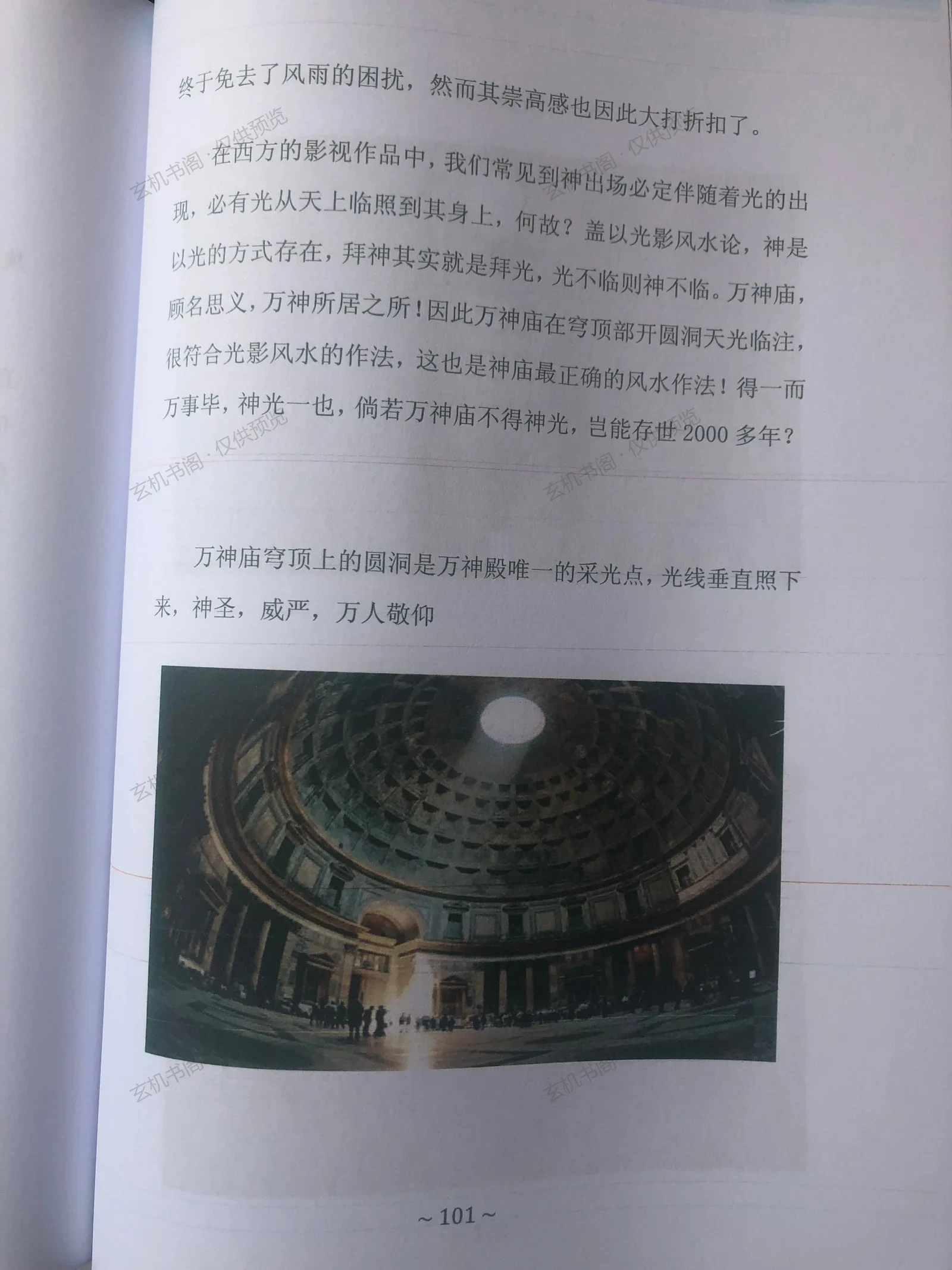
This book examines 'light-and-shadow feng shui' through concrete cases. The visible pages present two core examples: the Roman Pantheon, where a single oculus casts vertical light into the rotunda and is interpreted as a feng shui technique of divine illumination, with careful attention to ventilation and underground drainage; and the Bamei cave in Guangnan, Yunnan, where twin shafts of light meet on a rounded rock form, described as the natural pattern of 'heavenly light descending and earthly virtue bearing.' Combining photographs, architectural details, and traditional terms such as dragon veins and acupoints, the book connects natural light positions and cave openings with qi circulation and sacred spatial design. It is suitable for readers interested in architectural feng shui, light symbolism, and landscape-based geomantic observation.
Contents
Case 15: Light-and-shadow techniques of the Pantheon
Oculus lighting and sacred atmosphere
Photographs of dome light and oculus
Underground drainage and floor outlets
Case 16: Heavenly light descends, earthly virtue bears
Bamei cave's converging-light pattern
Key Points
The Pantheon's oculus is the sole light source, casting vertical light that creates a sacred atmosphere.
The author interprets the Pantheon's oculus as a feng shui practice of divine illumination.
Photographs show dome lighting and floor drainage holes.
At Bamei cave, light shafts from two 'dragon eyes' meet on a rounded rock form.
'Converging light at center' is used to explain the natural pattern of heavenly light and earthly virtue.