Reading guide
Content guideOverview
This is internal teaching material for Jinwen Mingli's advanced online course, marked 'internal material, strictly not for external circulation.' The visible pages belong to a course edition connected with the seventeenth-anniversary online teaching of Jinwen Mingli Chanwei. The first lesson, 'On BaZi, Da Yun, and Annual Cycles,' begins with the Taiji yin-yang diagram to explain balance and conservation of energy, then discusses differences in fortune, wealth, honor, and lifespan. It introduces the idea of three-generation causality to account for unusually skewed destinies and urges reverence and good conduct. Later pages present a BaZi structure diagram, showing the year, month, day, and hour pillars with their heavenly stems and earthly branches, along with the corresponding palace positions for parents, siblings, spouse, and children. It notes that the four pillars contain eight characters, hence the name BaZi, and that destiny studies is also called Four Pillars or BaZi studies. The visible pages are introductory and framework-oriented, suitable for readers with some BaZi background who want to understand Jinwen Mingli's teaching approach. Because only the first six pages are visible, later techniques, cases, and the complete table of contents cannot be verified.
Contents
Lesson 1: On BaZi, Da Yun, and annual cycles
Taiji yin-yang diagram, balance, and conservation of energy
Individual differences in fortune, wealth, honor, and lifespan
Three-generation causality and skewed destinies
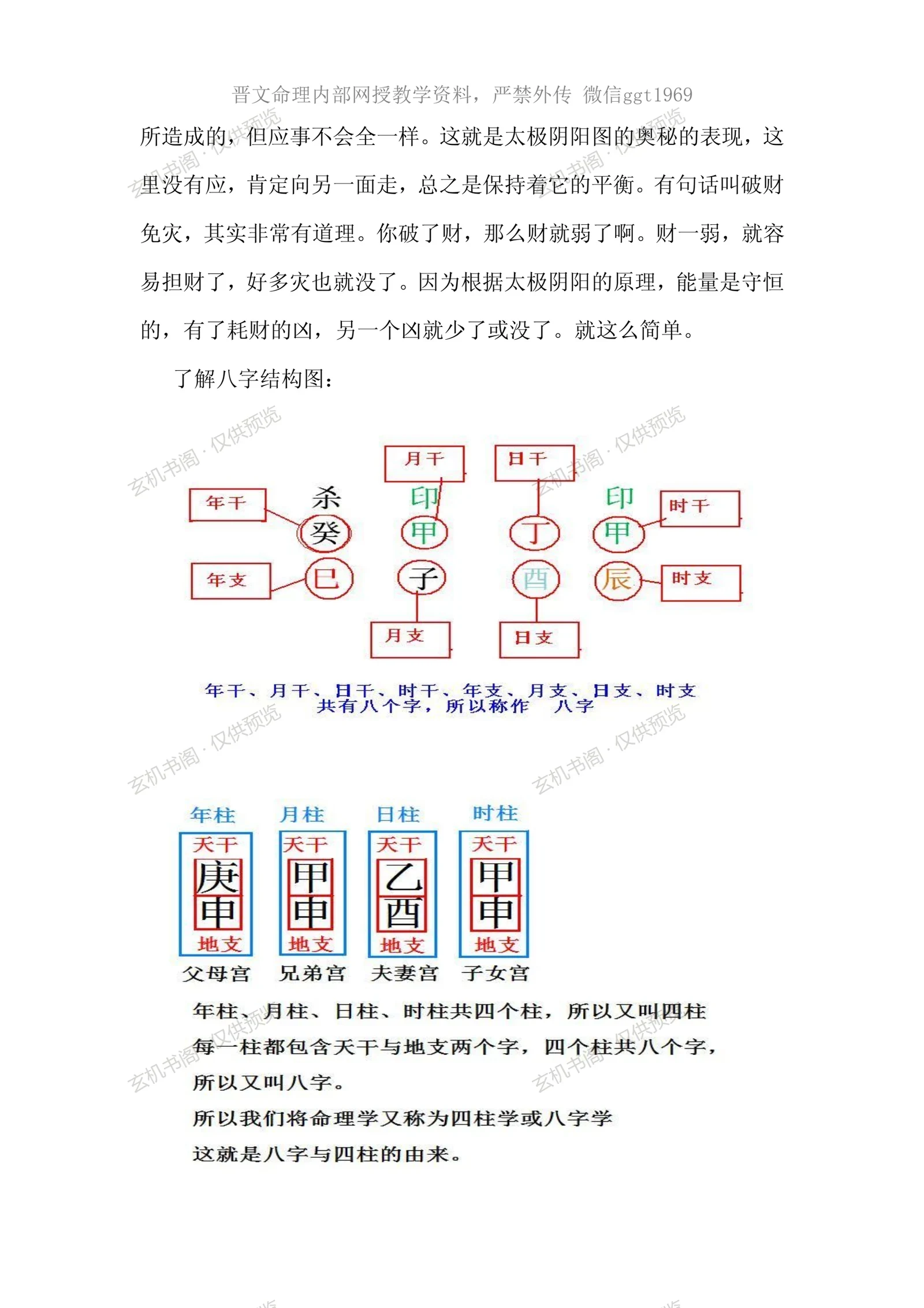
BaZi structure: year, month, day, and hour pillars
Four-pillar palaces: parents, siblings, spouse, children
Key Points
Uses the Taiji yin-yang diagram to explain balance in destiny studies
Stresses that BaZi is a life framework, not every detail
Introduces three-generation causality to explain skewed destinies
Shows the basic structure of Four Pillars and palace positions
Notes that destiny studies is also called Four Pillars or BaZi studies