Reading guide
Content guideOverview
This academic article examines the historical formation of the Chinese dragon-vein theory. It shows that the Ming-Qing Three Great Dry Dragons doctrine, which holds that all mountains stem from Kunlun and branch into three main trunks, served both as a geomantic worldview and as a general framework for understanding macro-geography. The author traces earlier understandings of mountain systems in the Shanhaijing and Yugong, the Hua-Yi divide in the Shiji's Treatise on Astronomy, and the Tang-era Two Bounds theory of Yixing. He then discusses the anthropomorphic geography centered on Kunlun in apocryphal texts and the shift of geomancy from city-site selection to macro-geography, culminating in the hierarchical descriptions of dragon veins in the Hanlongjing and Yilongjing. The article argues that dragon-vein theory is an overlap of real terrain and imagined geography, jointly produced by literati and geomancers amid dynastic politics.
Contents
Introduction: the Three Great Dry Dragons and the problem
Early understandings of macro mountain systems
Yugong, Shanhaijing, and the Hua-Yi divide
Yixing's Two Bounds theory and political geography
Kunlun-centered anthropomorphic geography in apocrypha
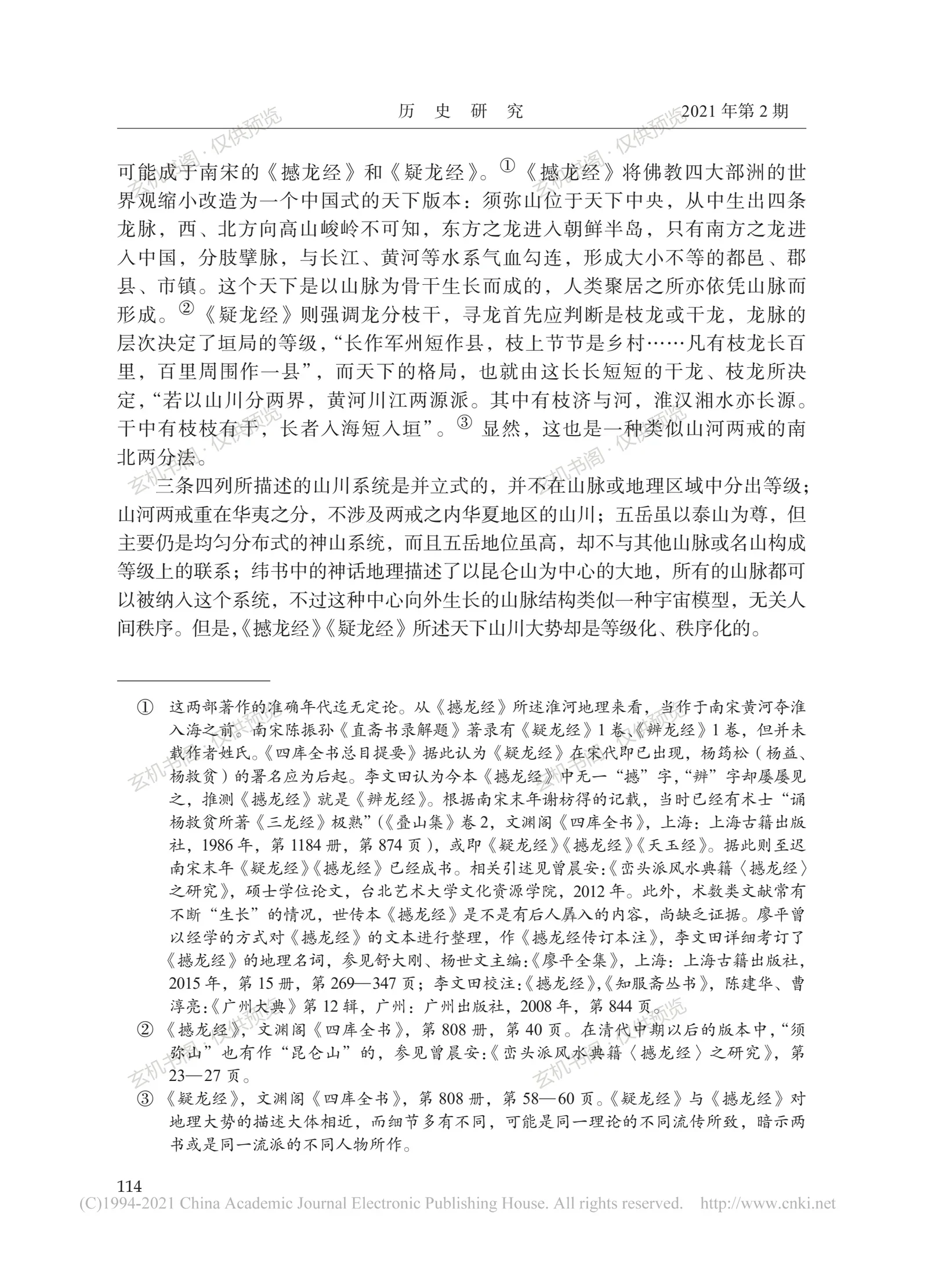
Geomancy's evolution and the Hanlongjing and Yilongjing
Key Points
The Three Great Dry Dragons doctrine has complex, multiple origins beyond Wang Shixing.
The Yugong mountain lists and the Shiji's Hua-Yi divide represent two geographic traditions.
Yixing's Two Bounds theory explains the Hua-Yi order via astral fields.
Apocryphal texts present an anthropomorphic earth centered on Kunlun.
The Hanlongjing and Yilongjing hierarchize and order the realm's mountains.