Reading guide
Content guideOverview
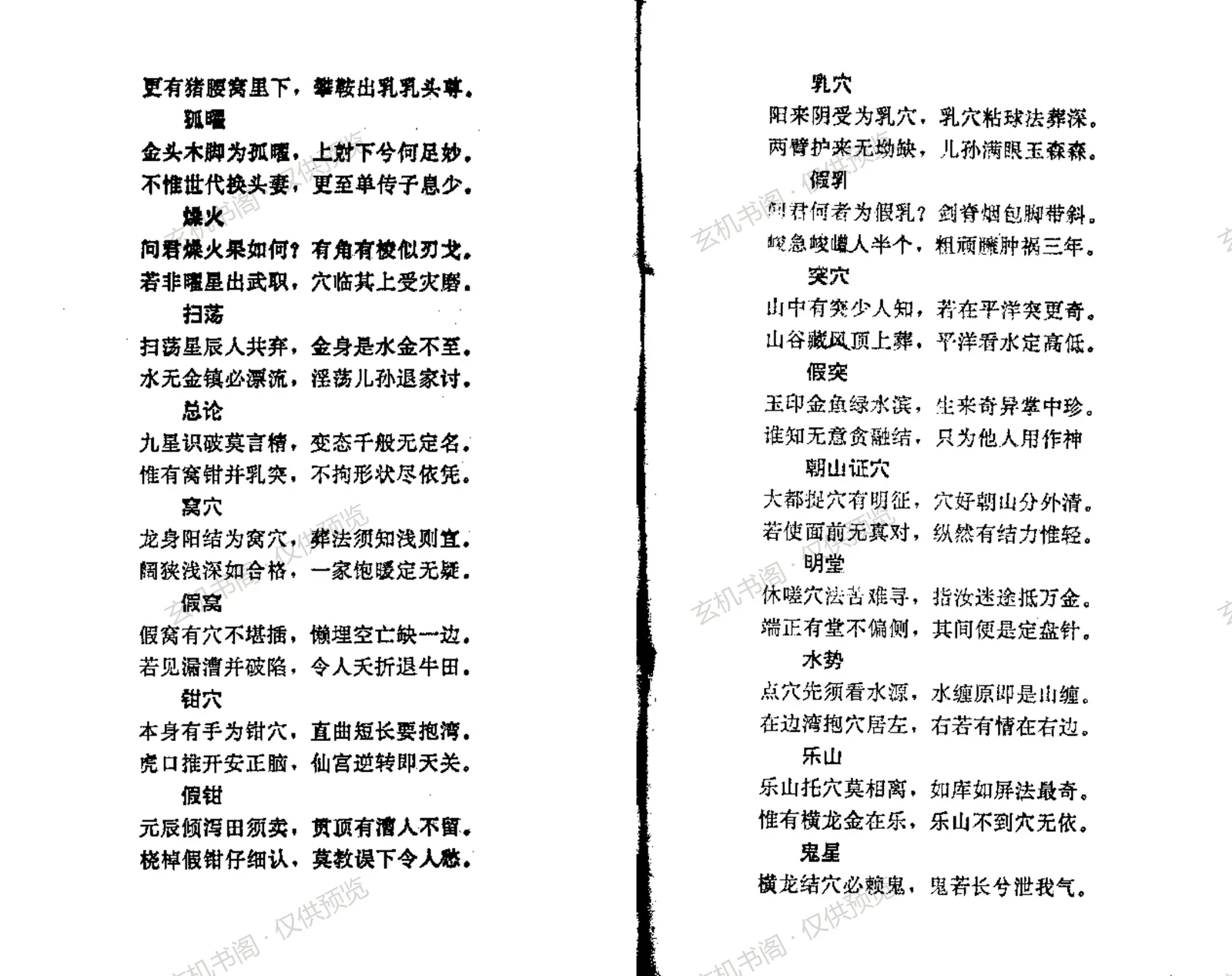
Attributed to Liu Ji, this text presents form-school (luantou) feng shui in seven-character verse. It moves from the grand scale—the Kunlun mountain ancestor, water sources, and the three great dragon ranges (north, central, south)—to detailed criteria for identifying true and false dragons, noble and base landforms, ancestral and parental mountains, and the processes of transformation (剥换) and gorge passage (过峡). It then treats the evaluation of branch feet, escorts, resting points, and host-guest relations among mountains, before turning to穴 methods: the four basic穴 types (窝, 钳, 乳, 突), their true and false forms, and the five planetary shapes (metal, wood, water, fire, earth) with associated variants such as sun, moon, heavenly wealth, solitary eminence, dry fire, and sweeping tides. Supporting features—facing mountains, bright hall, water configuration, music mountain, and ghost star—are also discussed. The rhymed format makes it a useful reference for readers with some grounding in form-school feng shui who want a structured, mnemonic overview of dragon-seeking and穴-spotting.
Contents
Mountain origins, water sources, and the three great dragon ranges
Branches and trunks, true and false dragons, noble and base, ancestral mountains
Transformation, gorge passage, branch feet, escorts, resting points, host-guest
Dragon types: alive, dead, strong, weak, forward, reverse
Five planetary forms, sun and moon, heavenly wealth穴 shapes
Four穴 types and the identification of true versus false穴
Facing mountains, bright hall, water, music mountain, ghost star
Key Points
Written in seven-character verse, making the core ideas easy to memorize.
Opens with Kunlun as ancestral mountain and the three great dragon ranges.
Carefully distinguishes true and false dragons, noble and base forms, and transformation points.
穴 methods cover the four穴 types and five planetary shapes with emphasis on form and qi.
Repeatedly warns against false穴 and deceptive configurations.