Reading guide
Content guideOverview
This short self-study guide by Huo Jun lays out a clear path for readers new to Liuyao divination. The table of contents moves from the foundational material—pre- and post-heaven trigrams, heavenly stems, five phases, the six relations, earthly branches and their generating, overcoming, clashing, combining, punishing and harming relationships—into the Eight Palaces and the sixty-four hexagrams, followed by hands-on hexagram installation. The opening pages use mnemonic verses and trigram drawings to explain how the eight trigrams arose, how yin and yang families are derived, and how the pre-heaven and post-heaven arrangements differ in both sequence and viewpoint. The author stresses memorizing the post-heaven arrangement on the left palm, including its numbers, directions and five-phase attributes, before moving on to more advanced work. The style is plain and practice-oriented, aimed at complete beginners.
Contents
Memorize the pre- and post-heaven trigrams on the palm
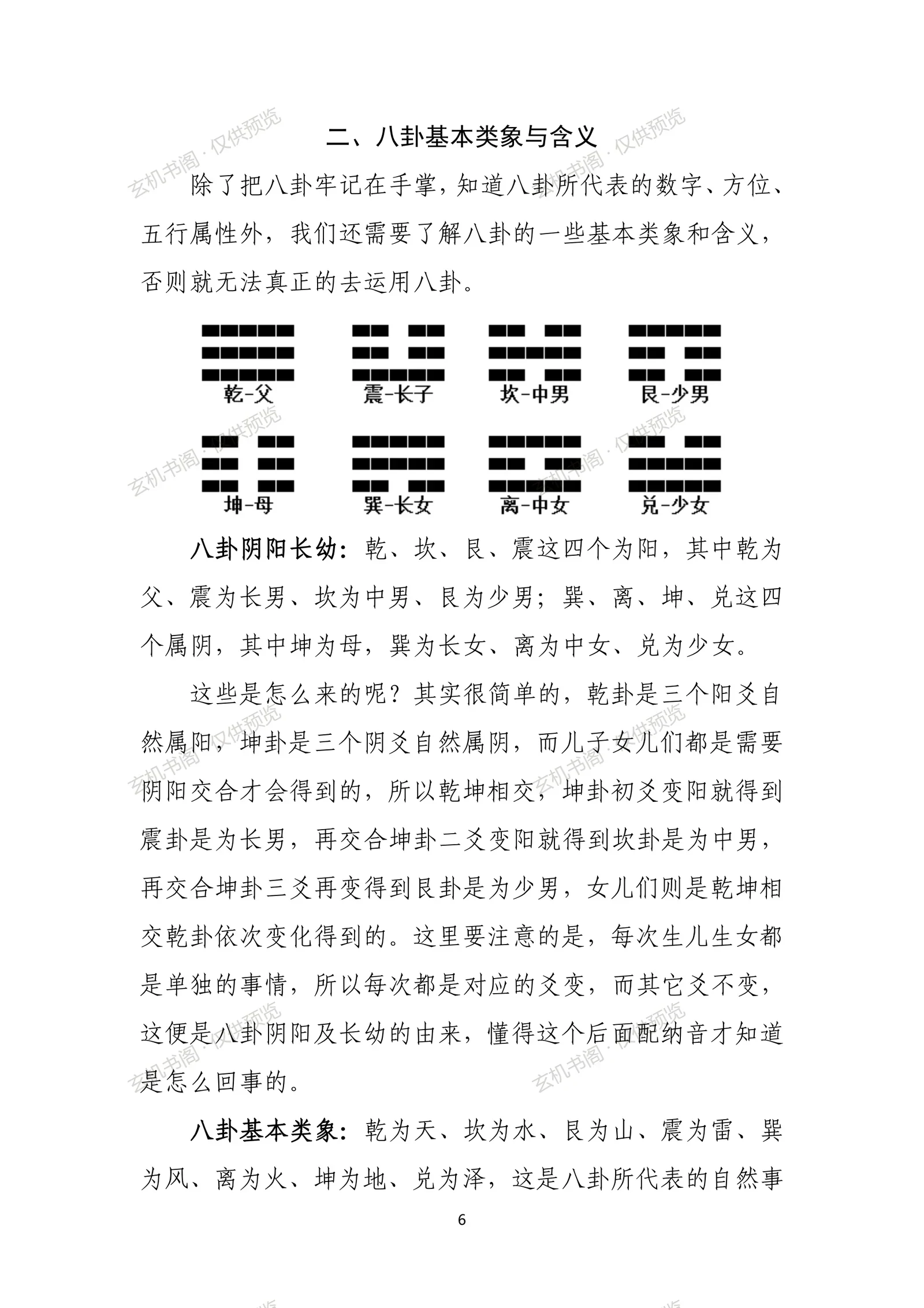
Basic image categories and meanings of the trigrams
Stems, five phases and six relations in Liuyao
Earthly branches and their interactions
Eight Palaces and the sixty-four hexagrams
Installing branches, stems, relations, positions, spirits and stars
Key Points
Mnemonics plus palm diagrams fix the trigram images, numbers, directions and five phases.
Qian, Zhen, Kan and Gen are yang; Kun, Xun, Li and Dui are yin, generating the family roles.
Liuyao judgment mainly uses the post-heaven arrangement.
Hexagram installation proceeds through branches, stems, relations, positions, spirits and stars.
Branch interactions are the groundwork for later judgments.