Reading guide
Content guideOverview
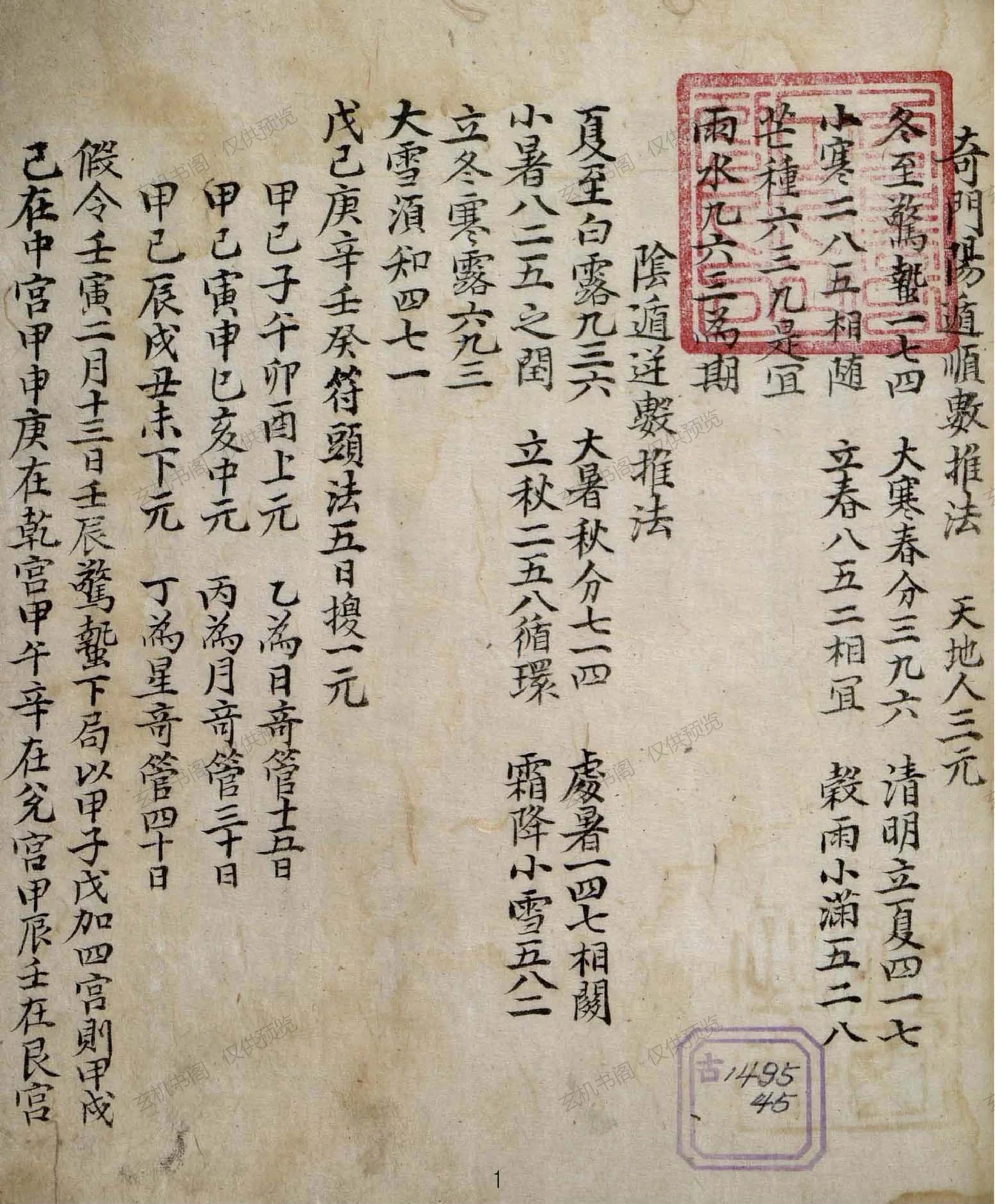
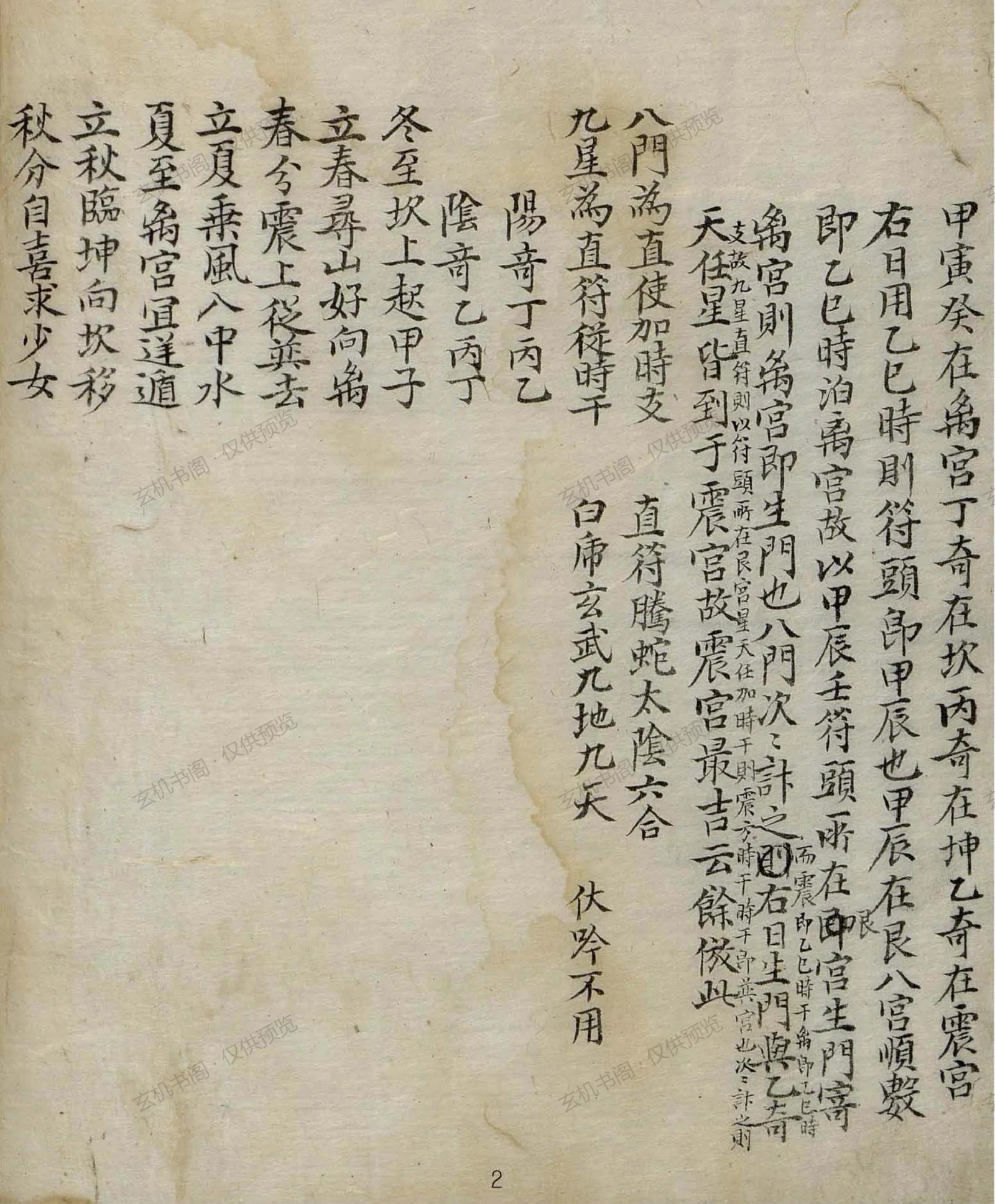
The manuscript titled Qimen Cuoyao (Essential Compendium of Qimen) has no title page or author attribution; its text is brush-written in vertical columns. It opens with a method for counting the Yang Dun forward through the twenty-four solar terms, assigning numerical sets to each term from the winter solstice onward, followed by a parallel Yin Dun backward-counting method keyed to the summer solstice and later terms. A second section explains the five-day prime shift (五日换一元), distributing the stems Jia-Ji, Yi-Geng, Bing-Xin, Ding-Ren and Wu-Gui into upper, middle and lower primes and pairing them with the day, month and hour qi. The latter half pairs the Eight Gates (Rest, Life, Harm, Delusion, Scenery, Death, Fear, Open) and Nine Stars (Peng, Ren, Chong, Fu, Ying, Rui, Zhu, Xin) with the nine palaces, using mnemonic verses such as 'at the winter solstice begin Jiazi at Kan' to show where the ruling stem and gate fall at a given time and how to judge favorable directions. A closing page lists the bare Five Phases generation and conquest cycle. The work is brief and practical, best used alongside standard Qimen mnemonics such as the Yanting Diaosou Ge.
Contents
Yang Dun forward-counting method: solar terms and prime numbers
Yin Dun backward-counting method after the summer solstice
Five-day prime shift and the assignment of符头
Eight Gates as envoy and Nine Stars as ruler, set by hour
Nine-palace placement: winter solstice at Kan, spring begins at Gen
Summary of Five Phases generation and conquest
Key Points
Yang Dun counts forward and Yin Dun backward, both tied to the twenty-four solar terms
The five-day prime shift fixes the符头 for Jia-Ji, Yi-Geng, Bing-Xin and other stem pairs
The Eight Gates serve as envoy and the Nine Stars as ruler, moving with the hour
Directional examples start at Kan for the winter solstice and Gen for the beginning of spring
Ends with a short five-phase generation and conquest mnemonic